

t
az: Ms. Stötzer, in autumn 2026 you will be awarded the Goslar Kaiserring, one of the world’s most important art prizes. How did the news reach you?
Gabriele Stötzer: I was called by Marion Ackermann on behalf of the jury and asked if I would like to accept the prize. I didn’t even know the price. When I read about who had already gotten it – Henry Moore, Joseph Beuys, Rebecca Horn and Miriam Cahn – all people I once raved about and greatly admired, I initially lay in bed like a corpse. I thought the jury mixed me up. But then I said to myself: Gabiyou are now 72 years old, a price like that can come along! I wasn’t allowed to tell anyone, I was able to digest it and now I’m very happy! Everyone I know is happy. Women in particular say: One of us has to make it!
In the interview: Gabriele Stötzer
Gabriele Stötzer, born in Thuringia in 1953, is an artist and writer. In the GDR she was imprisoned for political reasons, ran a private gallery in Erfurt, initiated the Erfurt artist group “ExterraXX” and was co-founder of “Women for Change” in Erfurt in 1989. She was one of the four women who occupied the Stasi district administration in Erfurt in December 1989 to stop the state security from destroying documents. This year she received the Goslar Kaiserring for her pioneering role in the field of artistic and activist work.
taz: You are the first East German artist to receive the prize and also the first to have a solo exhibition at the Gropius Bau in Berlin, which opens in June 2026. In 2013 you received the Federal Cross of Merit for your political and artistic commitment in the GDRthe renowned Pauli Prize in 2024. How do you view this late recognition?
Stötzer: Whether in the GDR or later abroad, I have never done anything other than art. I was undetected and that was completely normal for me. No pig was interested in me. After 1989 I had to make sure I didn’t go under. The first people to really dig me out and look into all my boxes were Franciska Zólyom and Vera Lauf from the Contemporary Art Gallery, where I had a solo exhibition in 2019. This is how the Dresden State Art Collections became aware of me. The then general director Marion Ackermann said: “If Stötzer is to stay, every museum must have something from Stötzer!” That made sense to me. My works of art are my children and they have to go out into the world. Dresden then bought a fashion item from me and two from Verena Kyselka and Monika Andres, who represent the fashion object shows of our Erfurt artist group.
taz: What kind of costumes were those?
Stötzer: An antenna costume and a dress made of newspaper, sewn into transparent foil. We have in the GDR yes, above all, try to read between the lines. We were young women, sewed up our dreams and desires and performed with them. We wanted to feel human existence. But we were always pushed to a human distance. It was a macho society. As a woman you had to assert yourself in order to be noticed. I always went along with everything because I knew: I had to spread my name or I would go under. I was always in solidarity with other artists. Even in the underground in the GDR, I submitted the craziest things to our illegal magazines, which were run by men, some of them IMs and macho men, so that they would get annoyed. Today I think: I’m tough and argumentative!
taz: As a young woman you have In 1976 the petition against the expatriation of Wolf Biermann was signed. The night before you wanted to bring the list to East Berlin, you were arrested. You spent 12 months in the Hoheneck women’s prison. You wrote the book “The Long Arm of the Stasi” about it, which in my opinion should be required reading in German schools.
Stötzer: I see it that way too! It’s currently being reissued.
taz: How do you look at coming to terms with this time today?
Stötzer: Of course there are still blind spots. Everyone has to work on it in their own way. I do what I can. So far I have accepted all requests, films, eyewitness reports, interviews for master’s and doctoral theses. I wrote and talked about it immediately after prison. Many women couldn’t do that. Many of them came to the West from prison and are still silent about it today.
It was a macho society. As a woman you had to assert yourself in order to be noticed.
taz: As a political prisoner, you too would have had the chance to come to the Federal Republic of Germany. You consciously decided to stay in the GDR. Why?
Stötzer: Hoheneck was actually the gateway to the west. That’s where the serious criminals were. The citizens who wanted to leave the GDR were among them. Many were sold to the West for 30,000 to 100,000 West Marks. I didn’t want the assholes getting money for me. I didn’t want to go to the West either. I was born in the GDR and had family and friends. We believed that socialism could be reformed. In prison I knew: That’s not him anymore! I saw how this people was ruled: with hatred, with abuse of power. I saw the torture instruments.
taz: You were only 23 years old at the time, went on hunger strike and were forced to undergo surgery. How do you manage that as a young person?
Stötzer: In a country that was walled in, I found myself behind other walls. I was young enough to find that interesting. I also thought that I would bear some of the German guilt. While in prison, I remembered that I wanted to be an artist as a child. We were 20 women in a cell. I had to solve world problems at night and then we had to work in a three-shift system. The morning shift was the worst. I was sewing tights for “Esda” and almost collapsed. I couldn’t take it anymore. Then I had thoughts of death. In suffering I am One A.
taz: You said that in prison you learned everything about women that your mother didn’t tell you.
Stötzer: I’ve seen tattooed women. I met murderers and lesbians. This was almost normal in prison because many of them went straight from the youth center to prison and had their sexual awakening with other women.
“survive and live”
Ans Swart (Amsterdam) and Gabriele Stötzer (Erfurt)
Association of Berlin Artists 1867
Project room Eisenacher Straße 118
10777 Berlin
5. 3. – 12. 4. 2026
taz: Female figures are still central to your work today.
Stötzer: I always asked myself: What can you do in this world dominated by men? Early on, I created archetypal images of women that women could identify with. I’ve nailed women to the wall by their hair. An image that can emerge anywhere. You can also do this in Spain or in other countries. This is simple and clear. It’s probably great art that I make because I’m so simple and go beyond boundaries.
taz: What are you currently working on?
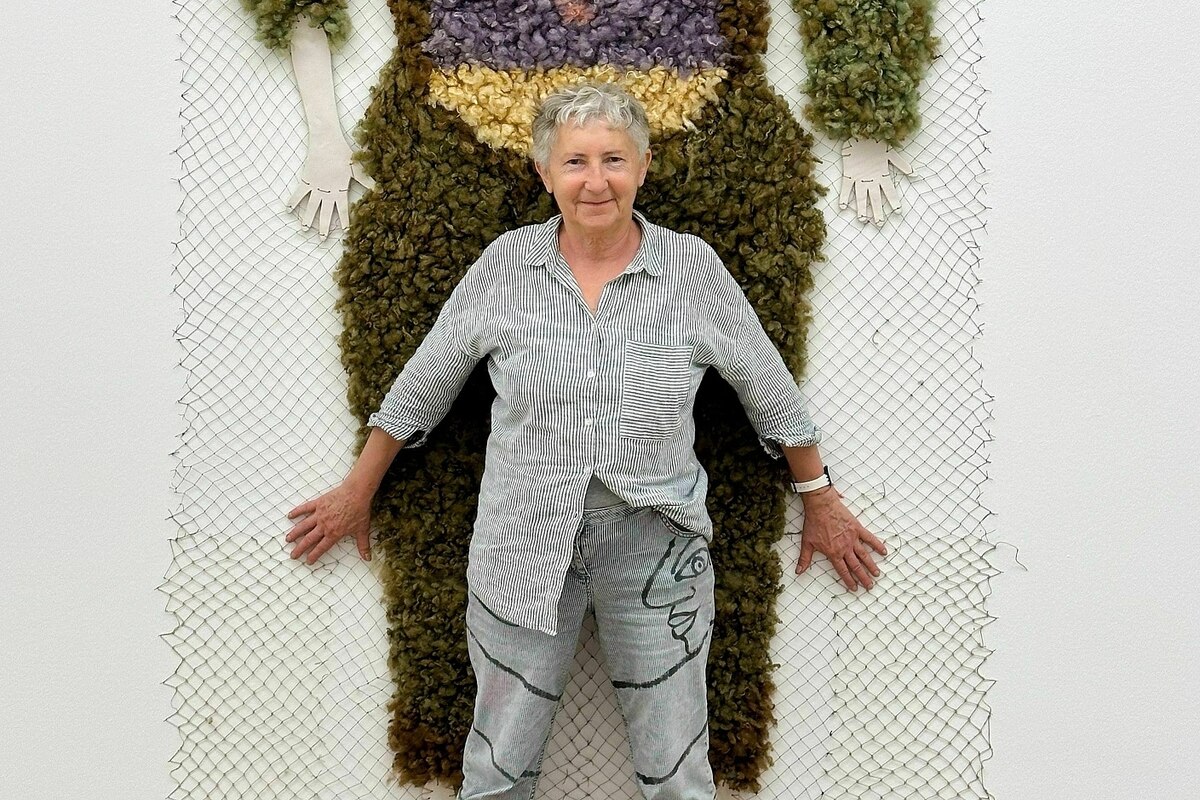
Stötzer: I convey the power of women with monumental images of women. When the war in Ukraine started, I made a big “Women’s Power” figure. When it started in the Middle East, I made a character called “Undine is coming.” This refers to the book by Ingeborg Bachmann, “Undine goes” from 1961, which was also available in the GDR. The original woman leaves the world of warlike men. Now I thought, the female primal power has to come back and learn to look. We must endure the destruction. Just like people have to endure me being in prison and talking about it. For the exhibition in Berlin I made “Undine Comes and Sees”, an infinitely beautiful woman with breasts, hands and feet made of ceramic. The rest is made from wool, which is important to me. A woman who has hairy legs and a hairy face, especially now that women are shaving everything off. This figure is 3.50 meters high. Now I’m making a new one for Goslar. A sphinx. A figure I made out of joy, not out of protest.
taz: Did you ever talk to Wolf Biermann about your imprisonment?
Stötzer: We haven’t talked about my imprisonment, but we know each other. In the fall of 1989, all women’s groups in Erfurt came together to form “Women for Change”. I spoke at a demo and said: If we want to prevent more and more people from leaving, then Biermann has to sing here again, here in Erfurt on the cathedral square. If you want that, shout it loudly! And that’s what people did. I visited Biermann in Hamburg after the fall of the Wall and asked him to come to Erfurt. He was there on January 25, 1990 and also played concerts in Jena and Dresden. He donated part of the entrance fee to us. We were able to do that Kunsthaus Erfurt buy. We had 10,000 marks from Biermann, 10,000 marks from Christa Wolf and 10,000 marks from our own performances. We got a loan and expanded the house. It still exists and is directed by Monique Förster. When I exhibit in Berlin at the Gropius Bau, she will have a parallel exhibition with works from our group “ExterraXX”. And on August 29, 2026, we and the Weimar “Ensemble for Intuitive Music” will do a performance on the roof of the Gropius Bau, because we shot our Super 8 films on the roofs in Erfurt in the 80s.