

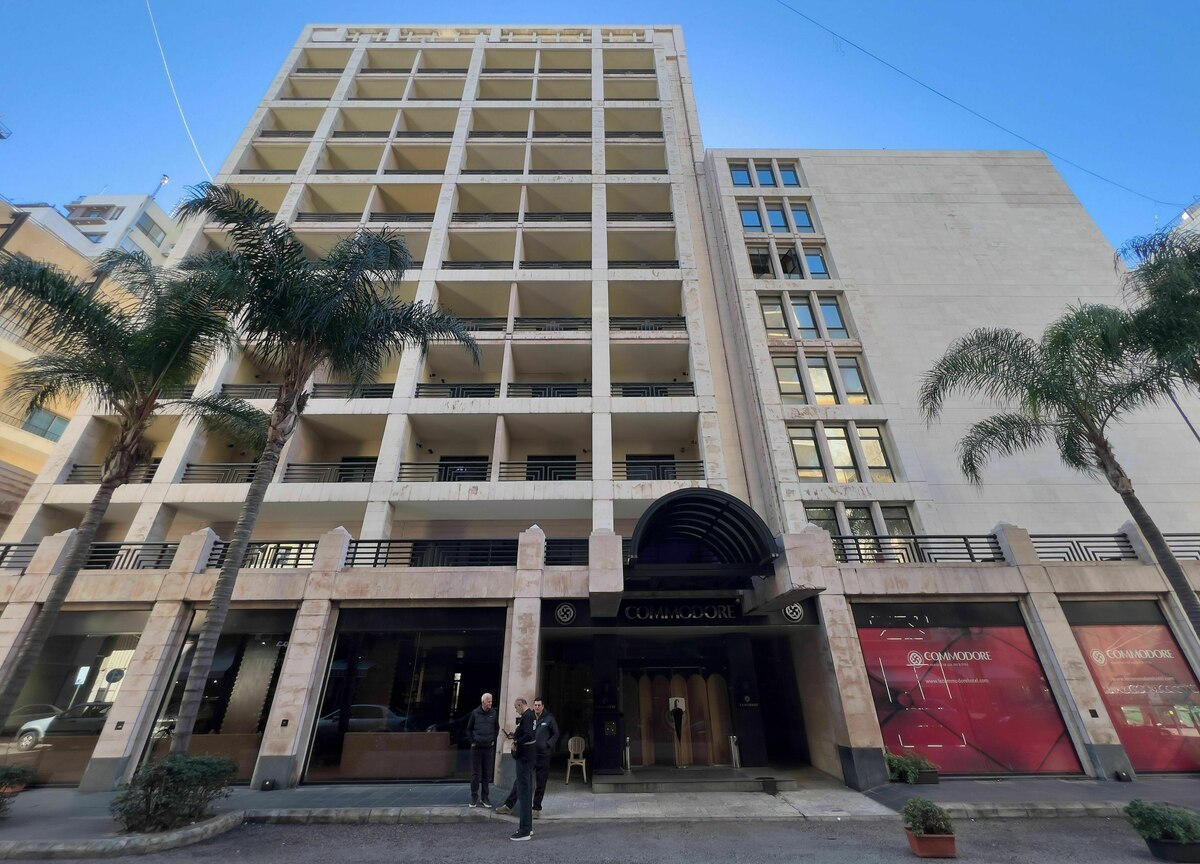
ap | Im crisis-ridden Lebanon A number of hotels have closed in recent years because only a few tourists are coming. But this week it was the turn of a very special establishment – the Commodore Hotel in Beirut’s western district Hammer.
Foreign journalists During the Lebanese civil war, it served as an unofficial newsroom, a safe haven from which they could relay their reports even when communications systems elsewhere were down. Armed guards at the door provided some sense of security as sniper fire and shellfire reduced the city to rubble. The hotel even had its own extremely popular mascot: a cheeky parrot at the bar.
Tensions in the country continue
After a new building, the nine-story Commodore with more than 200 rooms existed for decades after the end of the 15-year civil war in 1990 – until it finally closed on Monday. Hotel operators declined to discuss the reasons for the end.
The situation in Lebanon may have contributed to this. The economy is slowly recovering from a protracted financial crisis that began in 2019. But tensions in the region and the aftermath of the war between Israel and Hezbollah, which ended with a shaky ceasefire in November 2024, continue. Long daily power outages force companies to rely on expensive private generators. Attracting tourists to the country is difficult under these conditions.
A connection to the outside world
Journalists who lived and worked in the Commodore are hit particularly hard by the hotel’s closure. It “was an information center – various guerrilla leaders, diplomats, spies and of course numerous journalists milled about in the bars, cafes and social rooms,” says Tim Llewellyn, a former BBC Middle East correspondent who covered the civil war. “One time even (late Palestinian leader) Yasser Arafat stopped by to have coffee with the hotel manager’s father.”
At the height of the civil war, when telephone connections were broken in many places and much of Beirut was cut off from the outside world, journalists in the Commodore found landlines and telex machines that always worked to send reports to their newspapers and radio stations around the world. Opposite the reception desk in the large hotel lobby were two teleprinters transmitting reports from the AP and Reuters news agencies.
“Like a social club”
“The Commodore had a certain shabby charm. The rooms were basic, the mattresses were lumpy and the food options were not particularly spectacular,” says former Middle East editor Robert H. Reid, who was among the AP journalists who covered the war. And he particularly emphasizes the pleasant atmosphere in the accommodation: “The friendly staff and the camaraderie among the journalist guests made the Commodore seem more like a social club where you could relax after a day in one of the most dangerous cities in the world,” he says.
The parrot at the bar
One of the most famous characters at the Commodore was the parrot Coco, who always sat in a cage near the bar. Guests were often startled when they heard what sounded like the hiss of an approaching grenade – only to realize that it was Coco making the noise.
The AP’s chief Middle East correspondent, Terry Anderson, was a regular at the hotel before he was kidnapped by Shiite extremists in Beirut in 1985. He was released after almost seven years, making him one of the longest held US hostages in history. Videos of Anderson later released by his captors showed him wearing a white T-shirt that read “Hotel Commodore Lebanon.”
After Anderson was taken hostage and other Western journalists were kidnapped, many foreign media representatives left Beirut’s predominantly Muslim west, and the hotel lost its status as a safe haven for foreign journalists.
Lots of memories
Among the many memories associated with the hotel is that it offered financial support to journalists who had run out of money. They were able to borrow something from hotel manager Yussuf Nassal. Their companies then paid him back by transferring money to his bank account in London, says Ahmad Schbaro, who worked at the Commodore until 1988.
Schbaro also thinks back to a terrible day in the late 1970s when the area around the hotel came under heavy fire and two rooms in the Commodore were hit. “The hotel was full and all of us, staff and journalists, spent the night at Le Casbah,” a famous nightclub in the basement of the building.
“A lifeline”
In quieter times, journalists spent the night partying by the pool. “It was a lifeline for the international media in West Beirut, where journalists wrote their reports, ate, drank, slept and hid from airstrikes, shelling and other violence,” said former AP correspondent Scheherezade Faramarzi.
The building, which was built in 1943, remained in operation as a hotel until 1987. It was badly damaged in fighting between Shiite and Druze militias and was later demolished, only to be replaced by a new building that was officially reopened to guests in 1996. But there was no Coco at the bar anymore. The parrot disappeared during the fighting in 1987. According to Schbaro, it is believed that he was taken by one of the militia fighters who stormed the hotel.