

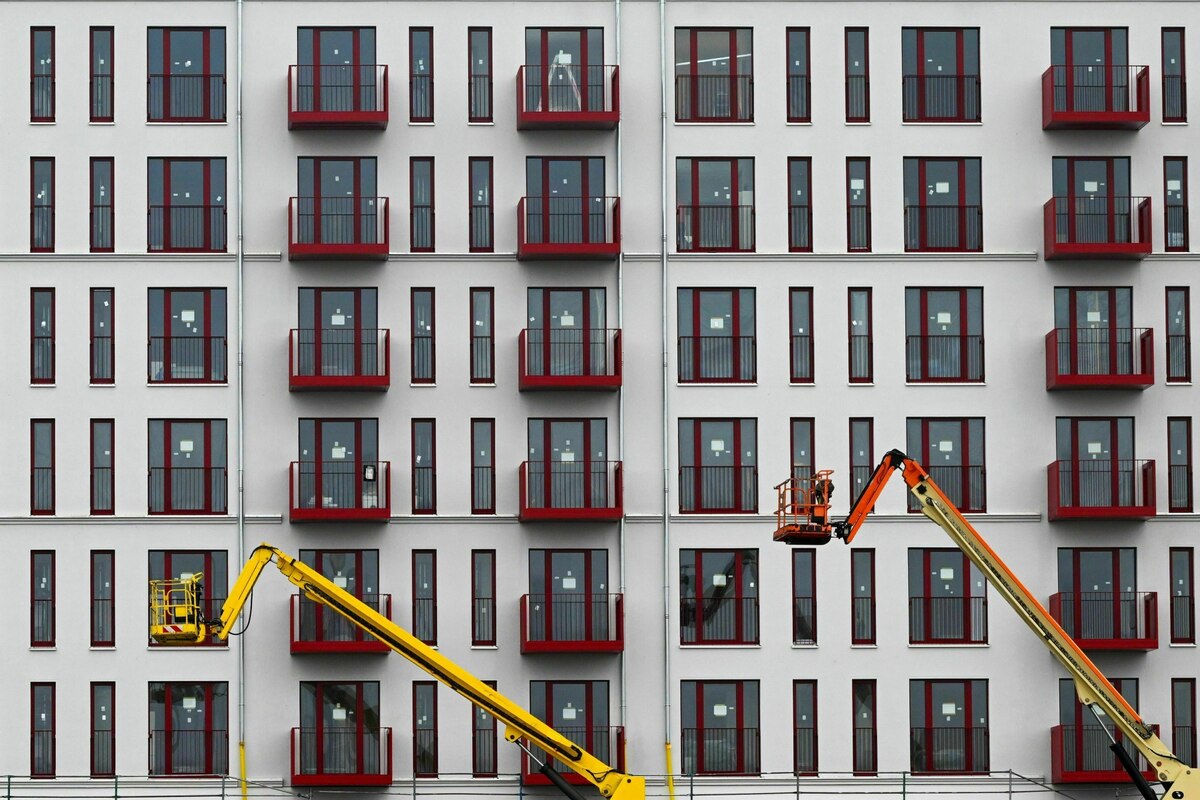
Study director Matthias Günther has to smile briefly when a journalist asks whether he much talked about construction turbo because it could help alleviate the housing shortage. With the Bauturbo, municipalities can, above all, massively accelerate planning processes. Günther, the head of the Pestel Institute, which regularly provides housing market analyses, doesn’t seem entirely convinced.
The construction turbo could perhaps help in the medium and long term, but he doesn’t have such high expectations in the short term. One problem is that densification is not so popular among the population. If a municipality or a mayor does this anyway, they are “putting their re-election at risk.”
Not particularly encouraging in view of what Günther explained shortly before when he presented the Social Housing Monitor 2026 together with the Social Housing Association on Thursday in Berlin. The alliance includes, among other things: the German Tenants’ Associationthe BAU industrial union, Caritas Assistance for the Disabled and actors in the construction industry.
According to the study, the shortage of affordable housing has reached a record high. This means that there is a lack of 1.4 million affordable apartments, especially social housing. “In order to reduce the housing deficit by 2030, a good 400,000 new apartments would have to be built every year,” says Günther.
Although there are also in the country many empty apartments, explained Günther. However, only a fraction of these can be activated. There was a lack of social housing, especially in metropolitan regions, large cities and university cities. Economist Günther assumes that around half of the 23 million renter households would theoretically be entitled to social housing. There are currently only around 1.1 million nationwide. The aim must be to double this number in the future. “Social housing must become a top priority,” demands the alliance.
The study particularly examines the funding policy of social housing. The federal states are responsible for social housing, but the federal government provides funds for it. Whether the states use this to build new social housing, modernize apartments or buy occupancy rights is their decision. The federal government has earmarked 23.5 billion euros in funding from 2025 to 2029.
But the Social Housing Alliance criticizes the fact that the federal government only pays out the money “bit by bit” in several tranches. As a result, the states would have to provide pre-financing – including interest. The alliance is therefore calling on the federal government to change funding practice and switch to “ad hoc funding”.
There is also a need for more transparency at the state level. The federal government has already tripled federal funds from 2020 to 2024 – but this is not reflected in the results. The funding commitments only increased by 32 percent and for new buildings only by 16 percent. Günther criticizes that this discrepancy cannot only be explained by increased building and land prices.
People with disabilities are particularly affected
According to the study, the severity of the housing shortage particularly affects younger people such as trainees and students and older people. They are the “losers on the housing market”. Students have to spend an average of 53 percent of their income on housing and more and more retirees are being forced to move out of the city because they can no longer maintain their apartments with a small pension. This is an “expulsion of older people from the city due to a housing shortage,” criticizes Günther.
People with disabilities even experienced discrimination in the housing market. Special quotas for the allocation of social housing are necessary for this group in particular.