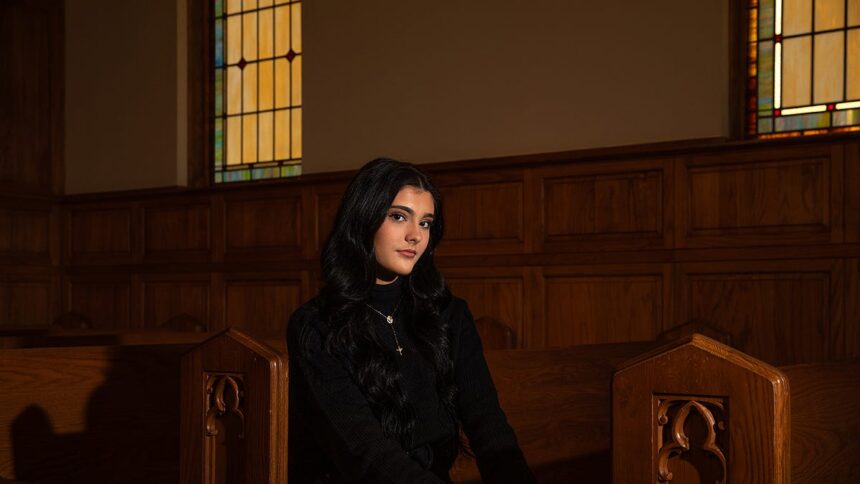
In June 2023, Faith Merrill and her mother drove 11 hours from their home in the Florida Panhandle to Dallas to see social-media influencer Candace Owens speak at the Young Women’s Leadership Summit.
The summit had been organized by Charlie Kirk’s organization, Turning Point USA, and drew about 3,000 attendees. “It’s like your basic Turning Point event, except pink and glittery,” Merrill told me.
She was electrified by Owens, who had built a nationwide audience as a combative, black conservative and then veered into peddling conspiracy theories about Jews controlling Hollywood and the Atlantic slave trade, among other lies. Her audience is now north of six million.
“Watching her on the stage and just being so unapologetic for her takes, I just realized I didn’t have to be this shy, scared girl,” Merrill, 20, said of Owens. Other attendees included television personality Laura Ingraham and college swimmer Riley Gaines, who had become a right-wing media personality by sparring with trans women competing in women’s sports.
Merrill loved Owens’s willingness to offend—to allege the Walt Disney Company employed “child groomers and pedophiles” or to slam George Floyd or to say “Russian lives matter” after Russia invaded Ukraine. (The Russian embassy in Washington reposted that one.) And, over the next few years, she would laugh at (or with) Owens’s more provocative, ahistorical takes—including her Holocaust denial. In 2024, Owens called the accusation that Nazi Josef Mengele had experimented on human beings “bizarre propaganda.” “We all know how Twitter is,” Merrill said. “You’re going to put out the most crazy statement to try to get a reaction. Me, personally, I will always support Candace no matter what she says.”
On the drive back from Dallas in her mom’s Honda SUV, Merrill and her mom listened to Owens’s podcast and the Christian rock station K-LOVE, and Merrill resolved to become an influencer.
By October 2023, she had about 10,000 TikTok followers. “That was my first TikTok account,” Merrill said. “I am currently on my ninth from getting banned all the time”—with an audience of 65,000. She also has 52,000 Instagram followers and nearly 10,000 YouTube subscribers.
In 2024, Merrill started at Troy University, in Alabama, and in the spring of this year, she was baptized in the Catholic Church.
She had attended Protestant churches growing up—her father was an Air Force pilot, and they ping-ponged between Florida and California—but “I never had a deep connection.”
“I remember Candace Owens became Catholic, and I thought, I guess I’ll do my research into that, ” she said. Merrill, like Owens, was part of a trend of “nationalists” embracing a hard-line, hyperpolitical Catholicism. They were fond of posting: CHRIST IS KING.
That was her brand: posting about the glory of God and marriage and railing against hook-up culture. She advertised her newfound faith. “Go to Mass today,” she posted in February. (Merrill has since deleted her X account because, she said, it has become “a cesspool” of “negativity” and “doom.”)
She didn’t really have an agenda. Her agenda, she said, was always shifting.
That was the reason I wanted to talk with her. Two years earlier, in January 2024, as we were inching toward the presidential election, I had spoken to Americans of varying tribe, background, and political orientation about their stories and beliefs, because it seemed like the traditional labels that we attached to ourselves and other people no longer made much sense. We still grouped ourselves in the old groups: liberal, conservative, Democrat, Republican, and so forth. But those words had been mostly sapped of their meanings, or stretched or contorted in such a way that they no longer communicated what we thought they did. I called it “The Great Scramble,” and I argued that we were trapped inside a Tower of Babel, unable to talk to each other in any serious way. Alas, we still are. The forces, the confusions, that led us to this precarious place have only accelerated, become more violent, propelled by assassination attempts, wars, and the rise of the radical fringe. We are blinder than ever. My hope was that, by speaking with Merrill and other voters about the things they were thinking about on the cusp of the 2026 election, by revisiting The Great Scramble, we might unscramble things somewhat.
Read more