

The last few months have produced some of the most scandalous sports headlines ever. That includes a federal investigation that forced Mark Walter to sell the Los Angeles Lakers just two years after he acquired the team, and the NBA banning Steve Ballmer from his own arena for 12 months after finding evidence that he circumvented the salary cap to pay Kawhi Leonard tens of millions in additional compensation. And now we have another that might be even bigger than the rest.
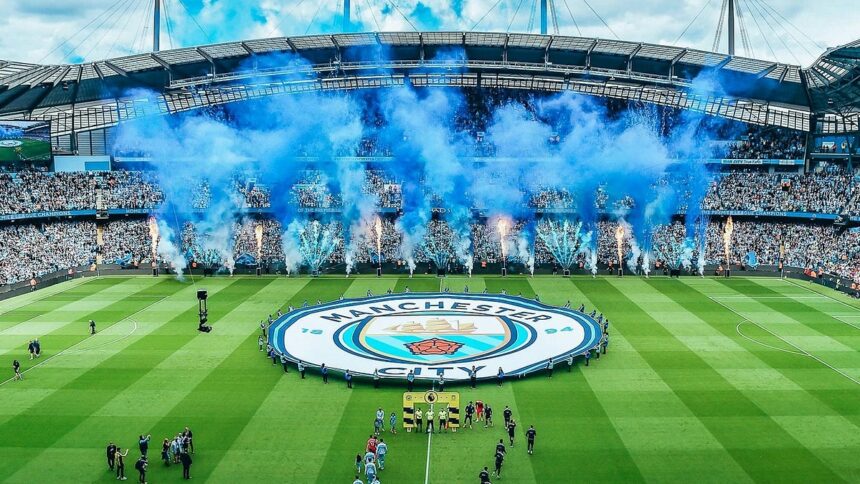
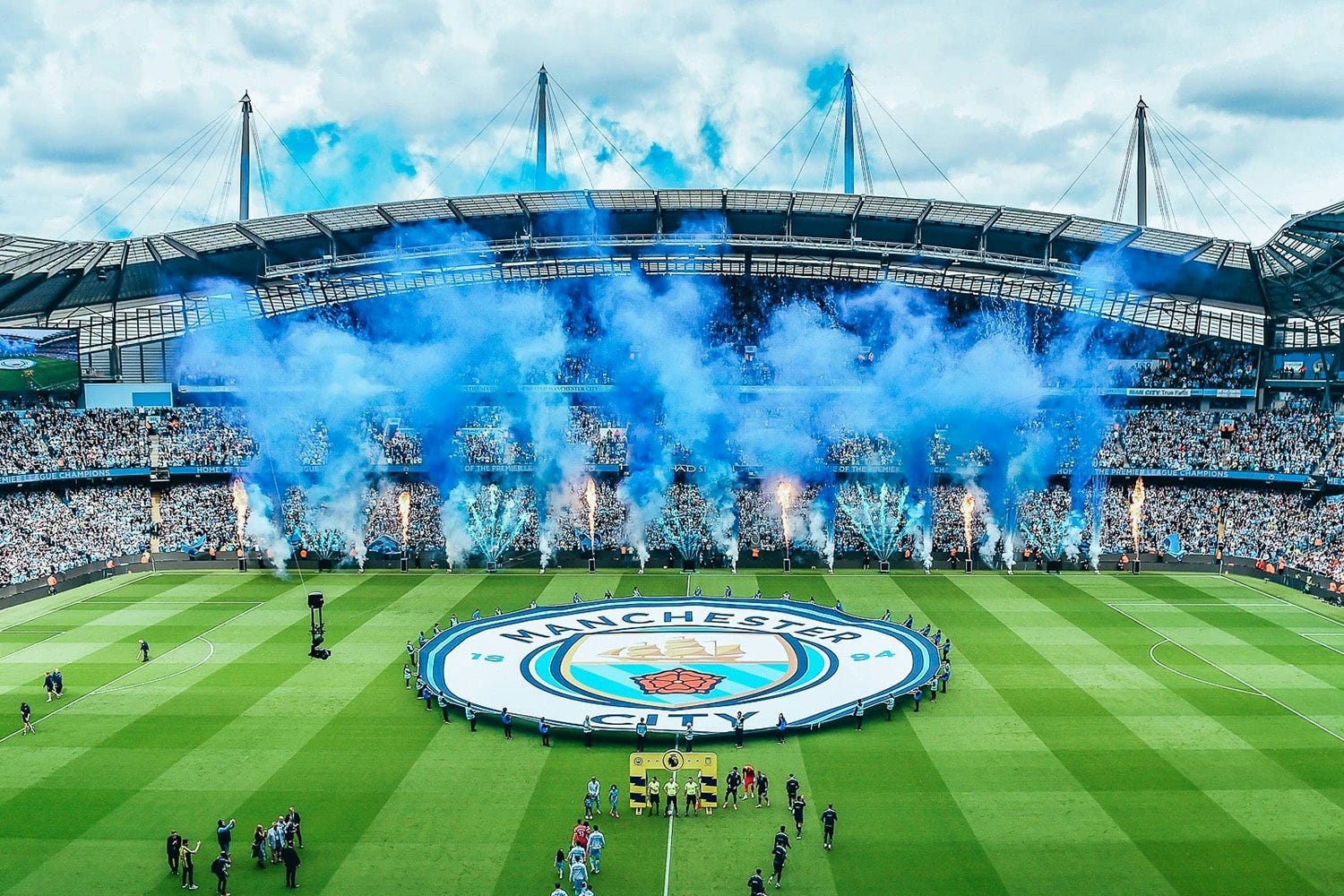
The Premier League announced this week that it has concluded its multi-year investigation into Manchester City. In a 40-page investigative report released on Tuesday, an independent commission found Manchester City guilty of more than 100 charges related to breaches of the Premier League’s financial regulations.
After reviewing everything from the club’s bank records to executive emails, the Premier League determined that 1) Manchester City artificially inflated its annual revenues by arranging “sham” contracts with commercial partners in Abu Dhabi and 2) Manchester City also artificially reduced its expenses by secretly funneling additional money to the club’s players via lucrative deals for their image rights.
Here’s how each scheme worked:
-
Manchester City would sign large sponsorship deals with companies in Abu Dhabi (think: Etihad). The sponsor would pay a portion of the deal (usually around 13%), and then Manchester City’s ownership group would pay the rest. On paper, it looked like the sponsor agreed to pay Manchester City $100 million, but the sponsor would actually pay only about $13 million, with the remaining $87 million coming from Abu Dhabi United Group, the club’s owner. This distinction matters because the financial rules at issue limited how much money clubs could lose. Owner funding could increase the losses a club was permitted to make, but it did not count as revenue. So by disguising owner funding as sponsorship income, Manchester City made its losses look smaller, creating room to spend more on players while appearing to comply with the rules.
-
Manchester City also artificially reduced its expenses by shifting player payments outside of the club. Beyond salary, a player can receive payments for commercial use of his name and likeness (think: advertising). Image rights are a cost to the club, but in 2013, Manchester City transferred those rights to a separate company and then sold that company to an outside party. This sale was beneficial because it gave the club additional income through upfront cash, and it also reduced the club’s expenses (because payments for those image rights no longer came directly from the club). And to make matters worse, the Premier League’s investigation revealed that Manchester City’s ownership group 1) contributed the money to pay for the initial sale and 2) contributed ongoing capital to pay for future image rights. This effectively meant Manchester City could pay a player $10 million per year, but if $5 million was structured as salary and the other $5 million as an image-rights payment, only $5 million in expenses would hit the club’s books.
In total, the Premier League says Manchester City hid nearly $100 million in expenses through its “off-the-books” image rights arrangement, and the club also inflated its commercial revenues by more than $1 billion from 2009 to 2018.
By overstating income and understating expenses, Manchester City made its losses look smaller than they were. This created room for hundreds of millions in additional spending on players while appearing to comply with the financial rules.
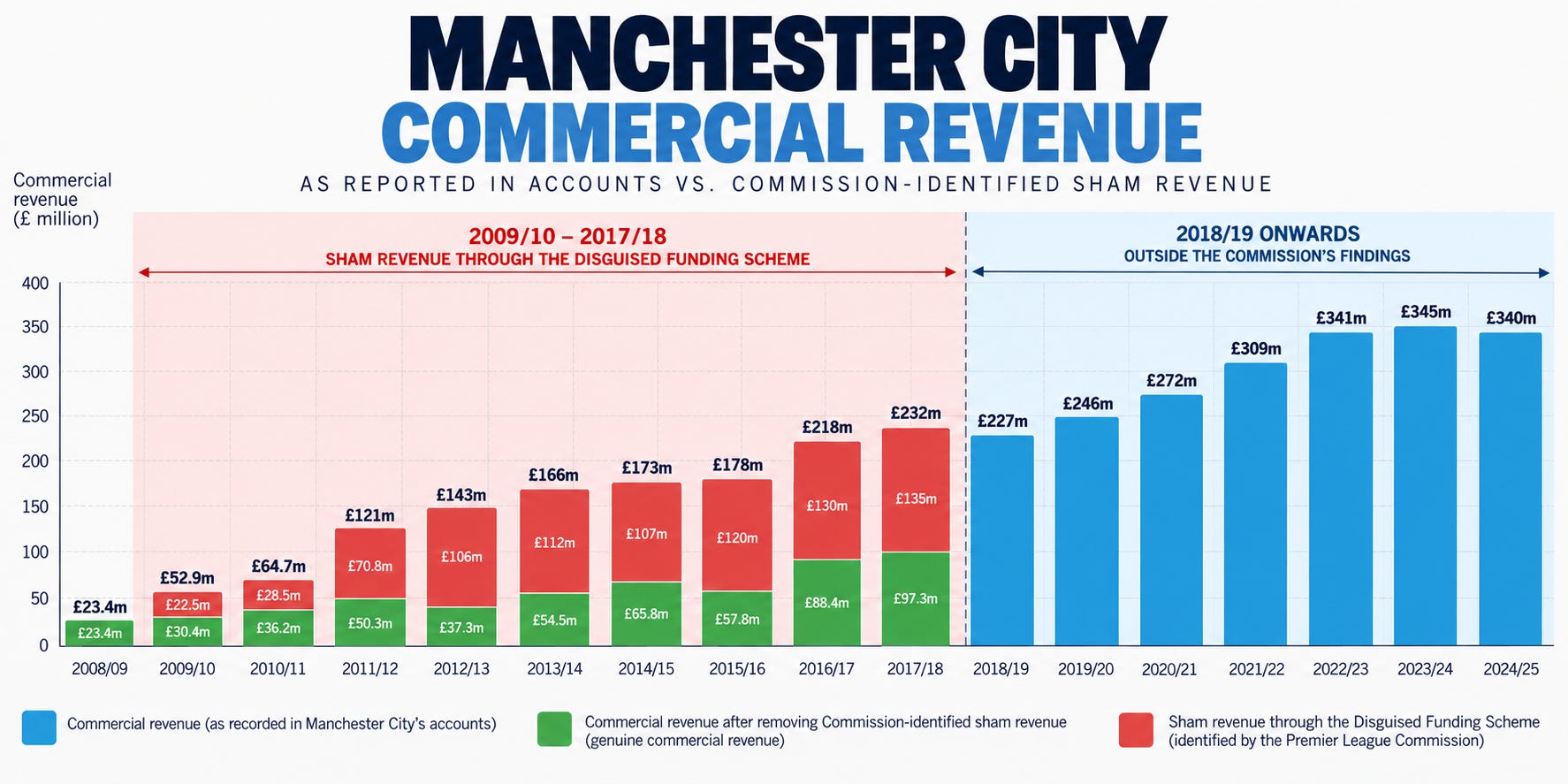
Just look at the chart below. From 2009 to 2018, Manchester City generated $1.26 billion in sponsorship from Abu Dhabi-based entities. However, the investigation found that only $158 million was legitimate, and the remaining $1.1 billion came from the club’s ownership group. The investigation also covered only 2009 to 2018, so while we don’t know how much of the club’s commercial income from 2019 to 2025 was legitimate, it doesn’t take a genius to realize Manchester City’s revenues kept growing, with much of that growth likely coming from its owners.
It’s worth noting that Manchester City denies these allegations and plans to appeal the charges. Manchester City doesn’t necessarily deny that these deals involved questionable financing. Instead, the club claims it has no control over how its sponsors finance commercial deals. In other words, Manchester City is essentially saying that if the market rate for one of its sponsorship deals is $50 million, and the company it executes the deal with can’t afford to pay that much, it’s not illegal for the company to secure government financing to pay for the deal.
Of course, that argument immediately weakens when you remember Abu Dhabi is financing both the club and many of the companies it did deals with. But more importantly, it wasn’t just one or two sponsorship deals. The Premier League says these sham sponsorships started appearing almost immediately after Abu Dhabi acquired Manchester City in 2008. That’s how the club grew its commercial revenue from £23.4 million in 2008/09 to £232.3 million in 2017/18, a 10x increase while all of the other big six clubs (Arsenal, Chelsea, Liverpool, Manchester United, and Tottenham Hotspur) only saw a 2-4x increase in commercial revenue.
This also isn’t the first time Manchester City has been accused of wrongdoing.
In 2015, a Portuguese hacker and whistleblower who went by the pseudonym “John,” later known as Rui Pinto, launched a website called Football Leaks. He says he intended to expose “the hidden side of football,” and that’s exactly what he did. Pinto obtained tens of millions of emails and documents from the sport’s most prominent agencies, executives, clubs, and players. We’re talking about everyone from PSG, Manchester City, Benfica, and FC Porto to Cristiano Ronaldo, Lionel Messi, and Neymar. Pinto then shared his treasure trove of documents with a German newspaper, which reported extensively on the topic.
As a result of Pinto’s whistleblower campaign, multiple footballers were convicted of tax evasion, a rape allegation against Cristiano Ronaldo (and the subsequent investigation by the Las Vegas police department) was uncovered, plans for big clubs to form the European Super League were leaked, and PSG and Manchester City were investigated for breaking UEFA’s financial fair play rules.
UEFA had already reached a settlement with Manchester City in 2014 for violating its financial rules, which included a ~$70 million fine, smaller squad limits, and spending cuts, but UEFA opened another investigation in 2019 after the German newspaper made Pinto’s documents public. That investigation resulted in another ~$32.5 million fine and a two-season ban from European competition. Manchester City eventually appealed that decision, and it was overturned, but that didn’t mean the problem went away. Pinto had to wear a bulletproof vest to court, entered witness protection, and was even attacked in public at one point. The Premier League charged Manchester City in 2023, and an independent commission investigated and delivered its final report this week.
It’s not entirely surprising that Manchester City was found guilty. Sure, maybe the scheme went deeper than people realized, but fans, agents, players, managers, and even other Premier League owners have been talking about Manchester City’s financial improprieties for 15 years. Don’t forget, when Manchester City signed its initial £400m sponsorship deal with Etihad Airways in 2011, Liverpool FC (and Boston Red Sox) owner John Henry tweeted, “How much was the losing bid?” That was John Henry’s way of saying the sponsorship deal wasn’t worth anywhere near what Manchester City was selling it for, and that the club could only sell it for that much because its Abu Dhabi owners controlled both entities.
So what happens next? Well, your guess is as good as mine. Manchester City has already confirmed that it will appeal the guilty verdict. Appeals must be finalized within 12 weeks, and then the panel has another 30 days to deliver its judgment. That means a final decision should be reached by the end of January 2027.
If these charges stick, a huge fine and a points deduction are the most likely outcome. Stripping past titles is less likely because rewriting historical results would create additional disputes, but relegation is still on the table, and that would create a whole host of other problems. Not only would relegation hit revenue hard, but none of Manchester City’s first-team players have relegation release clauses in their contracts. Those clauses are designed to protect the player if their club gets relegated — they allow another club to buy them out at a discount — so some of the world’s best players could be stuck playing for a non-EPL club that is also forced to miss out on Champions League qualification.
If you enjoyed today’s newsletter, share it with a friend.