

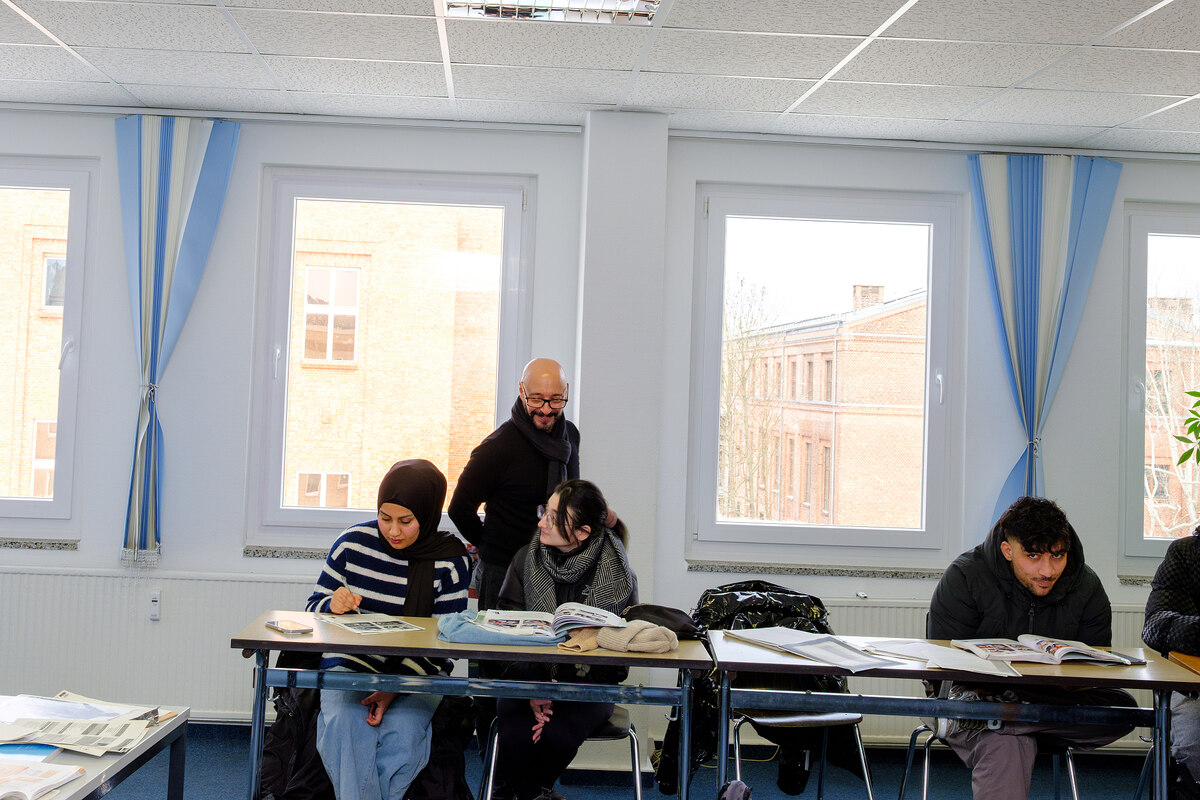
“What do you see?” asks Alessio Trevisani, lovingly addressed as “teacher” by his students, while he hands out a picture. Two people can be seen on it: a young man and a child walking hand in hand. As soon as the question is asked, the students shout sentences into the room: “You look happy!” –“These are father and son!” – “You run barefoot!”
The tables are arranged in a U, with Shaahusain Muzazai sitting on the left side; he is still wearing his winter jacket, like many people in the room. He says that there is a barefoot street in Berlin-Wedding. The teacher looks at him questioningly: “Does everyone walk barefoot there?” – “No,” laughs Shaahusain, “that’s the name of the street.”
Despite the slippery sidewalks and sub-zero temperatures, 12 of 13 registered participants came to Berlin-Rummelsburg on this January morning for the final German course A2.1 of the “Escape to the Front” project. Among them are people from Afghanistan, Iraq, Georgia, Turkey, Cambodia, Benin and other countries. They are between 16 and 22 years old.

18-year-old Shaahusain from Afghanistan has been in Berlin for almost three years. First he was in a welcome class at a school in Berlin-Lichtenberg. “I didn’t feel so comfortable, I wasn’t happy there,” he says. Also because there were too many people in one class for him.
Learn in small groups
He has been with “Flight Forward” for almost a year. Here he can learn German in a smaller group and at a slower pace. “All the people are very friendly, I’m really happy here,” says Shaahusain.

“We fulfill an important bridging function,” says Martina Gartner, head of the project
Photo:
Maria Sturm
The Integration project “Flight Forward” from the Stiftung Sozialpädagogisches Institut Berlin (SPI) is one of the few extracurricular places in Berlin where young refugees aged 16 to 25 can learn German every day. The courses are aimed primarily at those who cannot make the transition from the welcome class to a regular class, or who are too old for compulsory schooling and youth welfare. They often have a low educational background and have only been in school for a few years.
Literacy courses, math courses and social-educational support are also part of the project. Close communication with the responsible social workers and institutions plays a major role. The regular school system often lacks the capacity for this. Almost 200 people are currently using the offers. Martina Gartner, the project manager of “Escape to the Front” for five years, says: “We fulfill an important bridging function.”
A bridging function for almost 40 years
This bridging function has been having an impact on young refugees for almost 40 years. But now the future of the project founded in 1987 is not looking good. At the end of November 2025, the news came that the Senate Department for Education, Youth and Family wanted to stop funding completely.
The project expanded significantly two years ago. The number of staff and participants has almost doubled. “The worst thing we feared was that we would lose jobs and downsize again,” says the project manager.

Shaahusain Muzazai comes from Afghanistan. He wants to become a nurse one day. Or painter
Photo:
Maria Sturm
Gartner says every carrier is worried that there will be cuts at the end of the year, but since they hadn’t heard anything negative until the end of November, the sudden news of the shutdown was a “big shock.”
It is clear that the current semester can still be completed. What will happen at the beginning of February is still unclear at the moment. “We are totally in limbo,” says project manager Gartner.
Conclusive statements on financing are not possible
When taz asked the Senate Department for Education, Youth and Social Affairs, it confirmed: “A conclusive statement on the financing of the ‘Escape Forward’ project is not possible at this point in time.” The process is in coordination with the Senate Department for Labor, Social Affairs, Equality, Integration, Diversity and Anti-Discrimination (SenASGIVA) and they will wait for the outstanding decisions there. However, when asked by SenASGIVA, they informed taz that funding for the project was not provided for in the current double budget.

Across Berlin, similar projects are being affected by cuts or even an end to funding. What is repeatedly complained about by the sponsors and project participants during the budget negotiations: the communication chaos and the associated uncertainty. Major savings were also initially planned in many areas for the record budget for 2026/27, which was approved at the end of December.
But shortly before the double budget was passed, there was a surprise: many of the announced cuts were not made. Even if this is good news for many projects, the previous announcement of cuts has long since left its mark on the individual structures.
This is also the case with the “Flight Forward” project. Three fee-based teachers have already told Martina Gartner that they are quitting due to the uncertain future. If the project were to continue to be financed, Gartner would first have to advertise new positions. That would mean that the start of the next semester would be delayed. This interruption should not last too long, otherwise the freelance workers who remain will leave the project. Because “no teaching can threaten their existence,” says Gartner.
Gaps that are too large, whether due to a delayed start to the semester or a complete end to the project, are also highly problematic for the participants. Because they need psychological stability, everyday structure and also the continuation of youth welfare services linked to the courses.
Around 30 percent of the young refugees in “Escape to the Front” are in youth welfare services, so they have an environment that can support them. Martina Gartner and her employees are already starting to communicate with carers so that they can look for alternatives at an early stage. “It becomes more difficult for those who are not looked after,” says Gartner.
These are, for example, people who live in communal or homeless accommodation. Educational opportunities for these young people are very limited in Berlin. “I am not confident that we can offer everyone an alternative offer,” says Gartner. For people from this group who are in the literacy course or Those who need close social-educational support will find it particularly difficult. “There is no offer like ‘Flight Forward’ for them in Berlin again,” says the project manager.
What Martina Gartner is calling for is a different financing structure. “There’s a project that people have apparently been convinced the city needs for 40 years, so why does it have to be annual funding, why can’t you plan for the longer term?” After all, the need did not suddenly disappear.
If the project as an educational bridge is dismantled or canceled “then not only do the people taking part lose future prospects, but there are also high financial and social costs,” says Martina Gartner.
Shaahusain is one of the lucky ones who can still build future prospects with the help of the project. He would like to first pass the B1 exam and then do an apprenticeship. What profession is still unclear, perhaps a nurse or a painter. If he could and the project was continued, he would like to do another A2 course with “Escape to the Front,” he says. “I want to stay here.”