
What was once supposed to be a committee tasked with rebuilding the Gaza Strip could grow into an alternative for the United Nations. The so-called Board of Peace is to be expanded and also deal with the resolution of conflicts elsewhere.
This is what it says in a leaked draft of its charter Medium Times of Israel published. In the preamble there is a direct criticism of the United Nations and previous approaches in international diplomacy: “Long-lasting peace requires pragmatic judgment, sensible solutions and the courage (…) to break away from approaches and institutions that have all too often failed.”
The Board of Peace is, according to the draft, “an international organization committed to promoting stability, restoring reliable and lawful governance and securing lasting peace in areas affected by or threatened by conflict.”
The draft also contains the fee that states should pay to obtain a permanent seat on the Board of Peace: one billion US dollars, payable in “cash”. Anyone who doesn’t pay can sit on the Board of Peace for a three-year term.
The Board of Peace dates back to the administration of US President Donald Trump. He is expected to elaborate on his ambitions for the Board of Peace at the World Economic Forum in Davos on Wednesday.
What is known about the board so far
Various elements operate under the Board of Peace. The European Council on Foreign Relations breaks down the structure like this: There is the chairman – Trump – and his advisors, the board itself and an executive board with eight seats. There is also a Gaza Executive Board with eleven seats and the National Committee for the Administration of Gaza with fifteen seats.
Trump has so far invited around 60 heads of state and government to join the Board of Peace. The following are known: Albania, Argentina, Australia, Austria, Bahrain, Belarus, Brazil, Canada, China, Cyprus, Egypt, Finland, France, Germany, Greece, Hungary, India, Indonesia, Ireland, Israel, Italy, Japan, Jordan, Kazakhstan, Morocco, Netherlands, New Zealand, Norway, Oman, Pakistan, Paraguay, Poland, Portugal, Qatar, Romania, RussiaSaudi Arabia, Singapore, Slovenia, South Korea, Spain, Sweden, Switzerland, Thailand, Turkey, Ukraine, the United Arab Emirates, Great Britain, Uzbekistan and Vietnam.
Hungary, Kazakhstan, Argentina, Morocco, the United Arab Emirates, Israel and Belarus have accepted the invitation.
French Prime Minister Emmanuel Macron declined to participate – to Trump’s displeasure. Paris explained: The powers of the chairman – Trump – were very broad. He can even block decisions made by a majority of members with his veto. “This is very, very far from the United Nations Charter,” French Foreign Minister Jean-Noël Barrot said on Monday. Trump reacted promptly by promising possible punitive tariffs of 200 percent on French wine and champagne.
Trump’s concentration of power is one of the main criticisms of the Board of Peace concept. And that it calls into question the role of the United Nations.
Who sits on the Executive Board
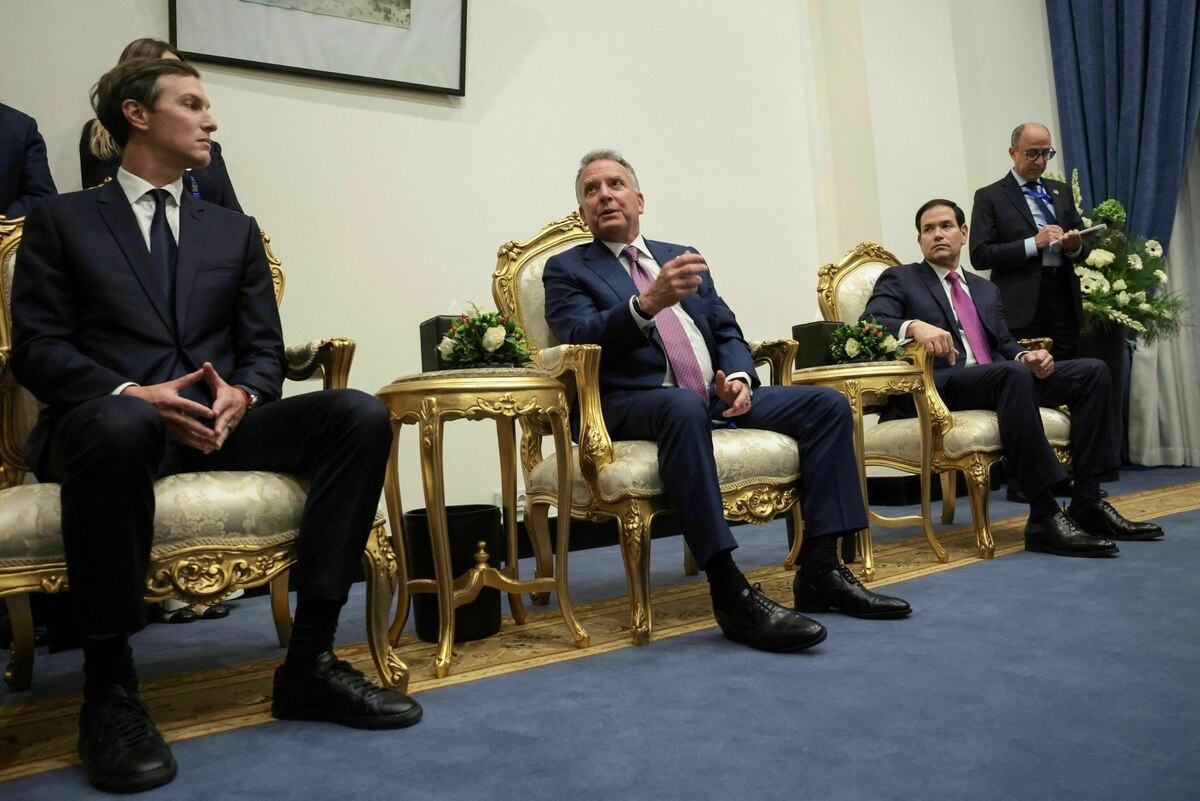
The composition of the Executive Board also indicates a concentration of power among Trump and his confidants and allies. Sitting there: US Secretary of State Marco Rubio, special envoy Steve Witkoff, Trump’s son-in-law Jared Kushner, and former British Prime Minister Tony Blair. The four’s closeness to the Trump administration is documented.
There are also: Ajay Banga, chairman of the World Bank and former head of the payment service provider MasterCard; entrepreneur and Republican Party supporter Marc Rowan; Deputy National Security Advisor Robert Gabriel; and United Nations Special Coordinator for the Middle East Peace Process Nickolay Mladenov.
Das Gaza Executive Board
Some of the same people sit on the Executive Board and the Gaza Executive Board – such as Rubio, Kushner, Blair, Rowan and Mladenov. There are also six other people, some of whom come from the region: Hakan Fidan, Foreign Minister of Türkiye; Qatari diplomat and negotiator Ali Al-Thawadi; Egyptian intelligence chief Hassan Rashad; the Emirati Minister for International Cooperation Reem Al-Hashimy – incidentally one of only two women – and the Israeli entrepreneur Yakir Gabay and the diplomat Sigrid Kaag.
The National Committee for the Administration of Gaza
While there are no Palestinians on the Gaza Executive Board, at least the administration committee is headed by Ali Shaath. The politician, originally from the Gaza Strip, chairs the fifteen-member committee. It includes technocrats close to Fatah and Hamas. The appointment of the committee was also approved by Israel. The fifteen members are each assigned to an area: such as health, finance or telecommunications.