

A ceasefire between Israel and Hamas will officially come into force in October 2025. A few weeks later I traveled to Tel Aviv with a fellowship from the Minerva Foundation to research artistic strategies of remembrance.
Creative forms of remembrance are omnipresent in Israel. Monuments and memorials commemorate the Zionist struggle against the British mandate and Arab revolts, Jewish resistance in the Holocaust and the first Arab-Israeli war in 1948, also known as the Israeli War of Independence. Memorial stones and plaques commemorate attack victims and fallen soldiers from all generations.
Dealing with recurring conflicts, loss and grief are the building blocks of this country, as is the hope for security and an end to violence.
After my arrival, I view Micha Ullman’s “Letters of Light”. The circular monument was created for the National Library in Jerusalem and consists of 22 Hebrew letters carved from limestone from the Ramon Crater. In a deeper shaft, the sunlight creates a play of shadows from the Hebrew Aleph, the Arabic Alif and the Latin A.
Beginnings and creation
The work was installed in October 2023 as a continuation of Ullman’s memorial to the book burning at Berlin’s Bebelplatz, which commemorates the attempt to destroy the Hebrew language. The Jerusalem installation is intended to symbolize beginnings and creation. It was only inaugurated months later because of the Hamas massacres on October 7th.
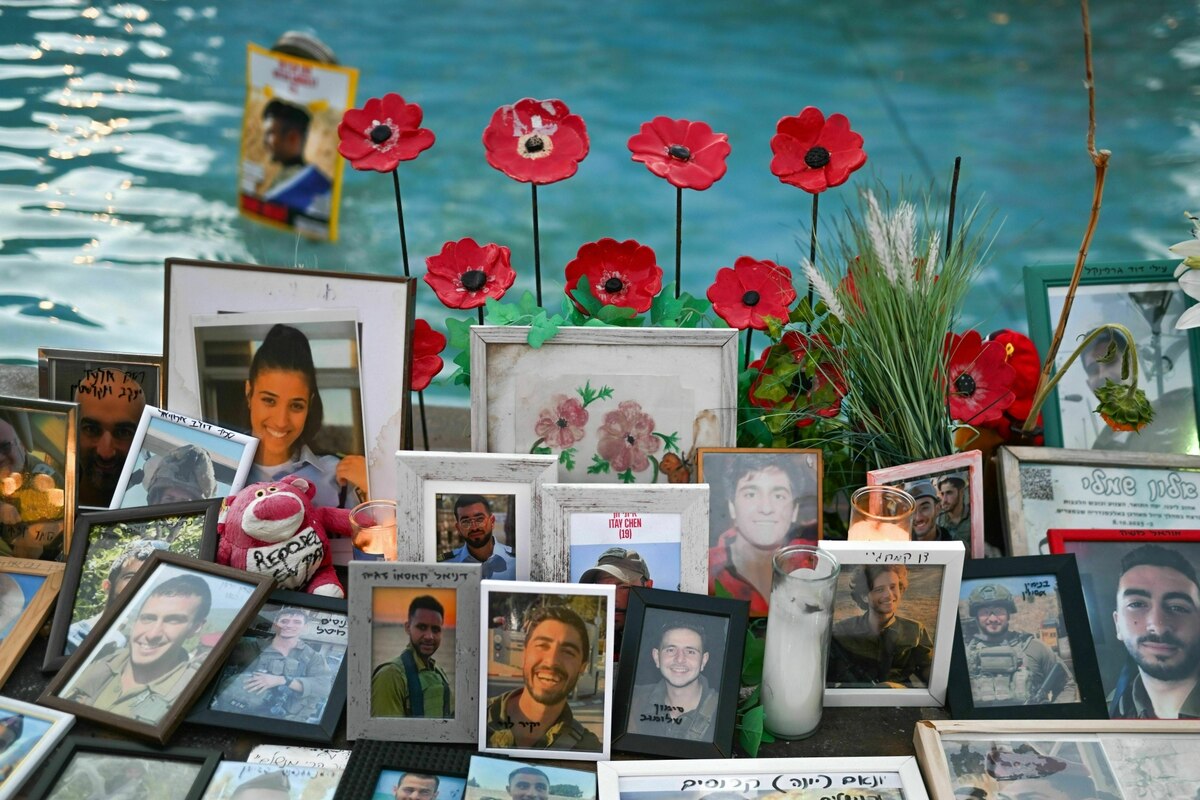
I explore Tel Aviv on foot. I often see young people in uniform and with firearms, and everywhere I see pictures of the dead on October 7th. “Bring them home” on house walls or bridge pillars still reminds us of the fate of the hostages. Bus stops and train stations are covered with stickers for the missing and dead. Since October 7, 2023, death, grief and loss, heroization and militarization have shaped the cityscape.
Many public places here, more than in the more religious Jerusalem, have been transformed into vernacular places of remembrance. On Dizengoffplatz, surrounded by bars and restaurants, there is a fountain sculpture by Yaacov Agam, on which portraits of hostages, those killed and the fallen are superimposed. People lay flowers and light candles.
After Yitzhak Rabin was murdered in 1995, the square, then called Kings of Israel, became a temporary memorial site. Open spaces were littered with political statements and personal reflections. 30 years later there is hardly anything left, the city had most of it removed. Graffiti has spread in Israel since then, according to the Ha’aretz-Journalist Naama Riba, has established itself as a common form of protest. How long will the current memorial sites exist? Many of the stickers, posters and lettering fade and peel off, but new ones are constantly being added.
On the way to Habimaplatz
Dizengoffstrasse leads to Habimaplatz. A few years ago it was redesigned according to plans by Dani Karavan, one of the few Israeli artists known in Germany alongside Ullman. In Berlin he designed the memorial for the Sinti and Roma murdered under National Socialism.
Diagonally opposite the National Theater, which was once designed by the same architect as the Berliner Volksbühne, Oskar Kaufmann, the inscription “Bring them home” shone on the roof of the Charles Bronfman Auditorium for two years. “Welcome back home” has been written there since October.
This is the meeting point for the weekly rallies that began as nationwide protests against judicial reform and then called for an end to the war. Hundreds of thousands of participants marched across nearby Kaplanstrasse. Since the ceasefire, they have been calling for an independent government investigation on October 7th.
A commission is to investigate errors and omissions by Prime Minister Benjamin Netanyahu’s government, which failed to prevent the Hamas massacres. Many protesters show photos of killed children from Gaza, and pictures of the hostages hang in trees.
On Hostage Square
A few streets away is Hostage Square. The square in front of the Tel Aviv Museum of Art hosted the hostage forum mass rallies, which recently ended after the return of almost all of the abductees. When I visited, the walk-in reconstruction of a Hamas tunnel was still standing. Many of the hostages were held captive in such underground passages and murdered.
Grief and destruction are also present in the museum. Until November, works by the Romanian-born painter Reuven Rubin, who is largely unknown in Germany, were guests. In 1912 he studied at Jerusalem’s Bezal’el Academy and settled in Palestine in 1923.
The paintings are usually shown in his former home in the city’s historic core, where most of the buildings were built in the International Style during the Mandate period. Damaged in June Iranian missiles the museum and surrounding houses are sometimes difficult.
This will probably not be shown in Germany due to the increasing boycott of Israeli artists
Aktuell ist die Videoinstallation „Observation/The Field Observers of the Gaza Sector“ by Talya Lavie. It brings together ten reports from young women who did their military service in IDF observation posts between 2016 and 2024. The traditionally female ones audit monitor the border area between Gaza and Israel.
Museum border experience
Months before the attack, they reported unusual activity in the border area, such as increased Hamas simulations of attacks or hostage-taking. High-ranking officers and intelligence officials did not take the observations seriously.
The work underlines the calls for a commission of inquiry. In the dark exhibition room, visitors burst into tears. Instead of the usual museum distance, this reflects the emotional borderline experience of the present.
The video installation “By the Rivers” by Ariel Hacohen is based on the choir of Hebrew slaves, also known as the prisoners’ choir, from Verdi’s opera “Nabucco”. This tells the biblical story of the destruction of the First Temple and the expulsion of the Israelites into exile.
The Hebrew and Arabic translations hang at the exhibition entrance. The projection presents a choir of sickly duplicates of the artist in a theatrical setting. A cycle of sunrise and sunset plays with associations with the morning of the Hamas attack and the course of destruction, the burned-down kibbutzim and the bombed-out Gaza Strip, the longed-for homecoming of the hostages and the right of return – to continuous expulsion, loss and mourning.
Eretz Israel Museum in the north
I take the bus to the Eretz Israel Museum in the north of the city. The exhibition “Wuthering Heights” by Yoav Weinfeld initially impresses with its materiality. The artist painted and engraved bright images on aluminum plates. This is reminiscent of early photographic methods in which images were fixed onto metal plates.
The recurring motif of a child shows the artist’s two-year-old nephew. Almog’s mother was murdered on October 7th and his father, the artist’s brother-in-law, was kidnapped to the Gaza Strip. He lived with Weinfeld and his partner for two years.
In Israel, temporal stratifications are impressively present in public space. But the current omnipresence of grief, war, suffering, loss and destruction is overwhelming. At the same time, I see more outstanding art than I have for a long time, which points to the tradition of a processing practice developed over decades.
And the Germans?
It is shown in established exhibition halls in Germany the increased boycott of Israeli artists probably not shown. A differentiated examination of the huge turning point that October 7th means for Israeli society and artistic ways of dealing with it seem less and less possible.
At the end of December it is announced that the Romanian-born sculptor Belu-Simion Fainaru will represent Israel at the upcoming Venice Biennale.
Destroyed in June an Iranian missile his apartment and studio in Haifa. The Berlin Galeria Plan B previously represented him in Germany. Since his participation in the Biennale was announced, Fainaru’s name has disappeared from their website.