

It is rather empty in the auditorium of the Hamburg regional court, although the trial was moved there specifically because room 288 offers a lot of space and additional security checks. But the public and the press are more interested in the latest twists in the Block kidnapping case than in the question of whether burning a Koran disturbs public peace.
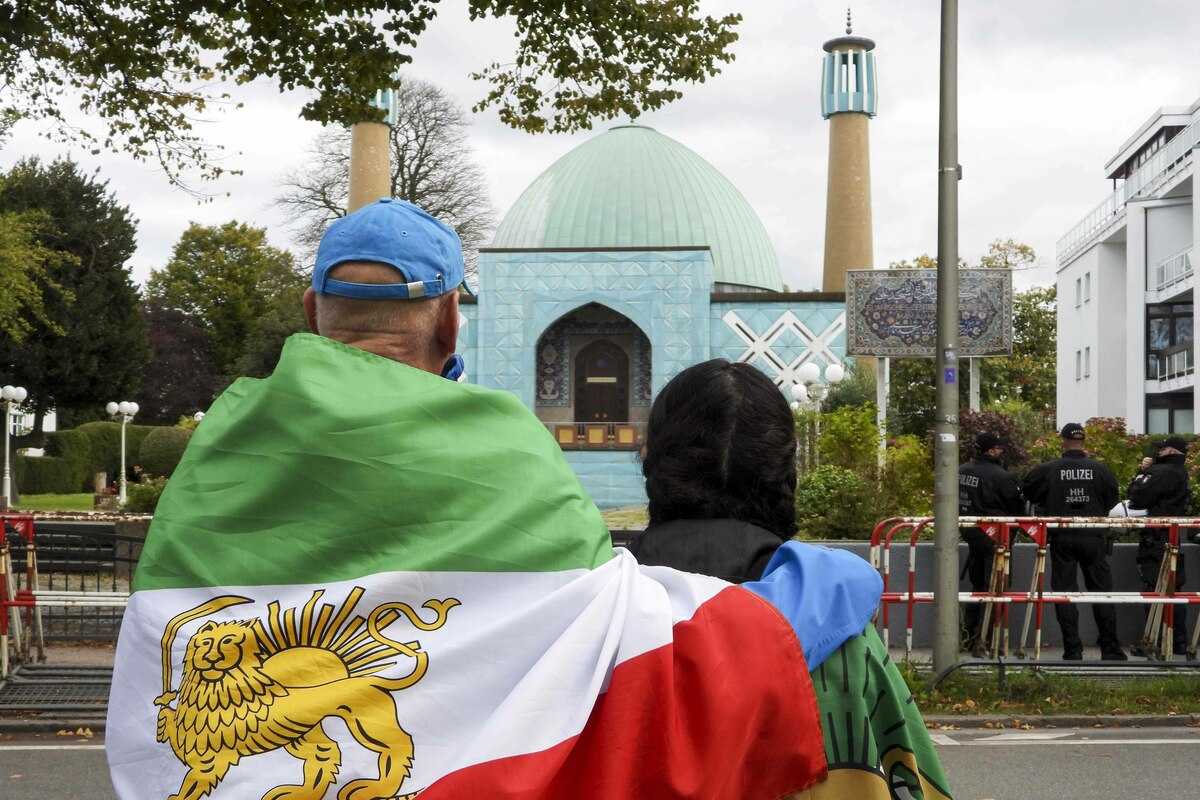
According to the indictment, the Hamburg public prosecutor’s office accuses Jasmin M. and Reza K. of “insulting religious beliefs” because they took part in a demonstration in front of the Blue Mosque are said to have torn pages from a Koran and then burned them. But they refuse to pay a fine because of it.
If the lawyers had their way, there would be no trial today. Reza K.’s lawyer makes a long statement and makes three motions. In it he complains that the investigations against M. and K. were only started after the Iranian Consulate General had called for “serious, immediate and legal action against the perpetrators”.
The lawyer for the Hamburg Shura, the council of the city’s Islamic communities, had demanded something similar and recalled the mood after the publication of the Mohammed cartoons in Denmark. In contrast, the police report immediately after the demonstration in front of the Blue Mosque noted that there had been no special incidents.
When is public peace disturbed?
Then, legally speaking, it becomes even more fundamental: M. and K. are due to the Section 166 of the Criminal Code accused: this criminalizes insulting religious denominations or faith communities if it is done in a way that is “likely to disturb public peace”.
The lawyer for Reza K., a slim, gray-haired man in a blue and white shirt, criticizes the wording of this as far too vague to justify an infringement on freedom of expression. He demands that the constitutionality of Section 166 be examined first – which would postpone the proceedings against his client into the very distant future.
Unfortunately, hardly any of it can be understood in the audience. If you interpret their facial expressions and short interjections correctly, a few sympathizers of the defendants have gathered there, but also a law student who has come especially from the Ruhr area because he is doing his doctorate on Paragraph 166.
Later, during a break in the hallway, he will say that he is Muslim and that in some cases he finds it difficult to keep his feelings out of legal considerations. And that he thinks it’s good that the chairman always brings the proceedings down to the factual level; after all, it’s about how people live together in German democracy and not about Iran.
Jasmin M., an exiled Iranian with long dark hair, a tight outfit and carefully made up, denies that she knew that the book that three men tore apart in front of her was a Koran. It was an Arabic-language book, the interpreter translated, and M. was busy with her speech anyway. She read the report of a young Kurdish woman who was raped by IS men, who also killed her father and brother.
Not all Muslims are terrorists, but all terrorists are Muslims
Jasmin M., defendant
The court shows a video of M. giving her speech, her voice is loud and passionate and that is what she is in court. “For us, the Koran means the code of law based on which our sisters and brothers are executed,” she says. “I am an ex-Muslim. I did not tear up the Koran, but I confirm this action 100 percent. Would you accept this book?” she asks the judge.
“I’m not here to answer questions,” he replies. Instead, he wants to know why M. didn’t choose another means of protest, one that was presumably based on less would have encountered religious sensitivity. “Religious feelings are not protected by Section 166,” replies her lawyer.
The blue mosque had long been controversial on August 6, 2022, when M. organized one of many protest demonstrations there. The Office for the Protection of the Constitution called the mosque a propaganda tool for the Iranian regime. Many called for it to be closed – but it was only two years later that the Federal Ministry of the Interior banned the association.
Jasmin repeatedly emphasizes that that was exactly what she was interested in: the closure of the Blue Mosque, the fight against a politically exploited Islam and not about Islam itself. Otherwise she would have protested in front of all the mosques in the city. “Not all Muslims are terrorists,” she shouts. And then: “But all terrorists are Muslims.”
Conciliatory gesture on the sidelines
The judge tries to find out more practical things from the video. What did the men who tore up the Koran shout? “Damn the Koran,” translates the interpreter. The lawyers will basically. “Protest has to hurt,” says M.’s lawyer. “Of course it was a provocation – like the flags of the Iranian monarchy. In Iran that leads to execution. But why did it It took ten years for the mosque to close?“.
The judge says he is the wrong address for this question too. Instead, he asks the public prosecutor and the lawyers to speak without an audience. After that, everything happens very quickly: the procedure is stopped upon payment of a fine of 300 euros. Is that a success? It means: no conviction, says M.’s lawyer afterwards in front of the entrance to the court. And: The defendants only have to pay a quarter of the original penalty order.
A farewell beforehand in the court hallway was at least as interesting: the law student and a supporter of the demonstration shook hands goodbye. Definitely a contribution to public peace.