

E One of my favorite programs is the “ZwischenTONe”, on Sunday lunchtime on Deutschlandfunk. An hour and a half of quiet conversation, and the guest brought the music. You can tidy up or clean the kitchen. Radio like before. Last Sunday Lukas Beckmann was a guest, One of the founders of the Green Party at the end of the 1970sand now 75 years old. Things got off to an exciting start when he made a benevolent but fundamental assessment of his party: there was no longer any impetus coming from it. Perhaps that is no longer expected of her, the interviewer, Marietta Schwarz, said, quoting Winfried Kretschmann: “The voters want growth.”
What a template. But Beckmann followed a curve: He didn’t want to question that at all, but growth was “an open question”, especially with regard to social issues, also because social issues such as pensions, health and education were directly related to the question of growth. After six minutes of the broadcast, the big question was: Are ecology, climate protection and growth compatible? Or also: How could we organize social security without growth?
I stopped cleaning the kitchen and turned up the volume on the receiver. Then Beckmann spoke a sentence that could have come from the oracle: “If you turn a big wheel, the small wheels also turn, but turning a small wheel and keeping the big one moving at the same time takes a lot of energy.” So that we often “process what is current, but leave out what is real”.

What does he mean by the real?
The real thing? What does he mean? Climate change, the income and wealth gap, AI, poverty in the South, the devastation of the world through the growth of things or the driver of all this, capitalism? And what would the “processing” look like? The abolition of capitalism? The democratic post-growth society? Even socialism? I was excited.
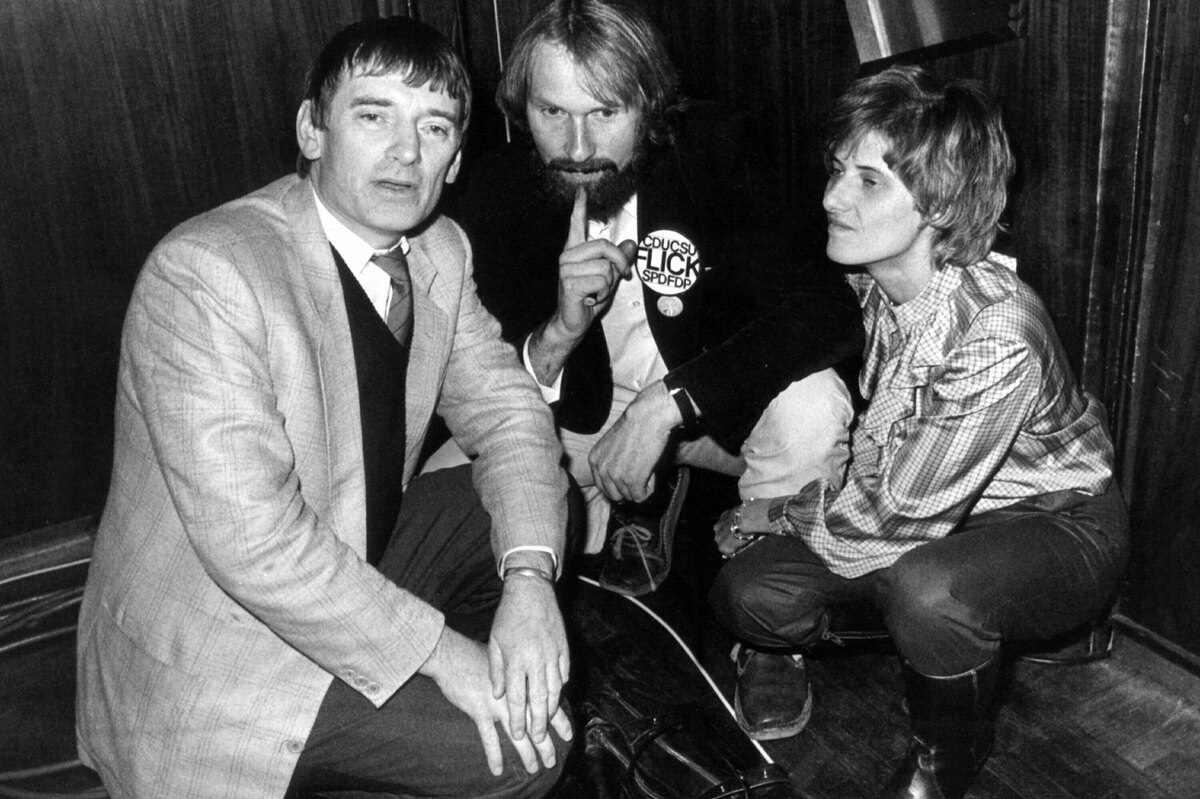
But then there was no demand, but music: “It’s been a damn long time since I took almost everything seriously, a damn long time since I believed in something…” The BAP song from the early eighties was followed by a slightly wistful conversation about the great founding period, when artists like Joan Baez, Lindenberg, Gianna Nanini sang for the Greens, Otto Schily played the piano, Petra Kelly recited poems and Beuys was also there. When the Greens were a cultural movement.
Much of the enthusiasm for 68 came from artists and scientists
Between the music from the eighties: bravely presented resignation in brief snippets. On the rent issue, for example: “No party is prepared to to talk about ownership of land. It would be an issue for the Greens, but they don’t have the confidence to talk about the important questions.” This doesn’t just apply to the Greens. In parliamentary representative democracies, the middle parties would not be able to find appropriate solutions. So they are dependent on impulses from society, which they wischlaglochederum do not demand because, see above: the voters want growth.
It was similar Niklas Luhmann already written in the mid-nineties. Under the title “Did we really vote – or did the people roll the dice?”, he imagined a contemporary “party for industry and work, which (…) would only be conceivable as a ‘grand coalition'” and anticipated great difficulties “of a political opposition to such a regime. There are enough worries, for example those that are expressed in the new social movements, worries about the consequences of technology or ecological problems or worries that have to do with migration problems, with increasing willingness to use violence (…).” Which is why Luhmann feared a blocked democracy.
What’s interesting about Beckmann’s mix of sadness and democratic humility: The Left didn’t appear. Not the party and not the adjective. As if there was only a vacuum to the left of the oversized center. We are currently experiencing the unexpected comeback of a socialist party, the doubling of its members in twelve months, with an old recipe: going door to door, a little help with the housing benefit calculator. So everything all over again, like before 1890, like in the 1950s, until the SPD abolished the cashier and replaced it with the debit authority.
Courage to think strategically
Despite the sudden rise, this left hopefully has time to think strategically. A new left would have to be more than a completely revamped social democracy. 60,000 new members, mostly young, widespread frustration even in the academic middle classes and sympathy among “creatives” give hope for cultural renewal. Lukas Beckmann, most of the veterans of 68 ff. did not come from the proletariat, but from the middle class, and a large part of the enthusiasm came from the participation of artists and scientists. This drove the SPD’s electorate to the left, founded paperback series, educational experiments, and university seminars.
After all, socialism is more than redistribution to prevent riots. Not just a rational organization that could ensure the survival of humanity. It is the legacy of Christian revolutionaries, bourgeois enlightenment and bloody battles. “We reclaim the content of history,” wrote Friedrich Engels in 1844, and that meant: the efforts of all the generations before us, the enlighteners, the poets, the workers and the mothers, should not have been in vain.
Folk singer Woody Guthrie later said something more briefly: This land was made for you and me. It would be nice if such cultural assets could inspire the left-wing fight for low rents. Some veterans could certainly help out with quotes.