

The initial reactions on social media sounded like disaster reports: “I was devastated”; “… completely destroyed me.” There were stories of viewers remaining paralyzed in their seats and crying to themselves even after the credits rolled; others reportedly had to hold each other’s hands.
But it was “just a movie” – in the specific case, Chloé Zhao’s “Hamnet,” which premiered at the Telluride and Toronto fall film festivals. Nothing against the enduring relevance of Shakespearebut performances of his pieces rarely evoke such deep emotional resonances these days.
Chloé Zhao begins her film with a written note: In 16th century England, the names Hamnet and Hamlet were actually interchangeable. This casual observation is the start of a thought experiment: Why did William Shakespeare, whose only son Hamnet died in 1596 at the age of eleven, give the title “Hamlet” to the drama he wrote around three years later? No artist or author would randomly name a piece after their own deceased son. “It had to mean something,” is how it puts it Maggie O’Farrell, the author of Zhao’s filmin an interview with the New York Times.
“Hamnet”. Director: Chloé Zhao. With Jessie Buckley, Paul Mescal and others United Kingdom/USA 2025, 126 min.
Two sides of one coin
O’Farrell’s “Hamnet”, published in 2020, is not an autobiographical Shakespeare novel that relies on new historical research, but rather a speculation about the long trail of grief for a child and how it is reflected in a work. At the same time, the names Hamnet/Hamlet are not used interchangeably, but as two sides of the same coin.
If the play “Hamlet” is the side of Shakespeare that we all know, “Hamnet” tells about the other side, the underside, if you will, where we know little to nothing, about Shakespeare’s private life, his marriage, his children and, above all, about his wife Anne Hathaway, who is sometimes referred to as Agnes. Because Anne and Agnes were still interchangeable at the time.
People in landscapes
This Agnes, played by Jessie Buckley, is at the center of “Hamnet”. Chloé Zhao places her in landscapes with her own sensitivity for people – see the unvarnished Frances McDormand in the wintry desert of “Nomadland” – as a young woman with a connection to nature. With a falcon in her arms, she roams the forest as if it were her very own garden. Zhao and her cameraman Łukasz Żal film it as if it had the dimensions of a jungle, with a luminous ceiling, a shimmering, damp underground and a multi-voiced, unique background noise. Agnes seems familiar with all the branches and niches in which a useful herb might be hidden.
On one of her journeys she meets young William (Paul Mescal), who is not yet a writer, but has to support his bitter, indebted glovemaker father by teaching the neighbors’ sons Latin. Their first meeting is a real “meet-cute” with a friendly back and forth of witty remarks. Afterwards there is a hidden smile on the lips as they part, which shows the joy of the future.
Doubts and resistance are overcome, the young couple love each other, Agnes becomes pregnant, they get married, even if Shakespeare’s parents look disgruntled. The first child is a daughter, Susanna. Agnes has a prophetic dream in which two children will one day stand at her grave. But then in her next pregnancy she gives birth to twins, Hamnet and Judith. The tragedy is announced. Which of the three will not survive?
William, who is not very prone to superstition, eventually leaves the countryside and goes to London. But the film remains entirely with Agnes, who asked him to do it in order to promote his writing. How William finds his voice and comes to the theater is hardly mentioned and is only reflected in a few quotes, for example when the three children reenact the opening scene from “Macbeth” with the three witches: “When will we three meet again / In the lightning and thunder, or in the rain?”
Surprisingly, Zhao hardly avoids the clichés that present themselves: Agnes actually has something of the contradictions of a “suburban housewife” who simultaneously enjoys and criticizes her husband’s absence, not because she misses her husband so much, but because he is so missed as a father to the children.
We would like to show you external content here. You decide whether you also want to see this element:

The heartbroken twin brother
And then the plague comes, first Judith falls ill, for whom the worst is feared. Twin brother Hamnet is heartbroken and goes to bed with her – and essentially dies in her place. The tragic climax is the moment when William comes home late and is first relieved to see his little daughter in good health, before he has to understand what has happened to Hamnet. It happens like in modern relationship dramas: grief puts an enormous strain on the marital relationship.
O’Farrell cites one of the motives for her book as the intention to save Anne Hathaway from the insinuations of all the Shakespeare scholars who over the past 400 years had developed their own favorite speculation without much factual basis: namely, that William hated his wife Anne.
Paul Mescal as Shakespeare must necessarily pale in comparison to Jesse Buckley’s force of nature
In Zhao’s film, this becomes a classic emancipation topos: Agnes doesn’t become anything like that Glenn Close in „The Wife“ of 2017 is revealed as the true author of the great man’s lines, but the weight of the film highlights her as the driving force with her untamed, emotional power. Her influence was important so that the son from a strict home could find the courage to break out of conventions and create according to his own rules.
Captivating representation
Jesse Buckley ist great in this role. You can acknowledge that even if you don’t particularly like the film as such. Her slightly slanted smile, her throaty pronunciation, the way she can make her chin tremble and captivate the viewer with the depiction of seemingly bottomless pain is unique. (She is certain of the Oscar). Paul Mescal as Shakespeare must necessarily pale in the face of such a force of nature.
Nevertheless, it is his authorship, kept in the background, that ultimately provides the answer to the question of what it means that Shakespeare named his “Hamlet” after his deceased son. Anyone expecting an intellectual formulation will be disappointed: Zhao’s film delivers a purely emotional interpretation, but with a force that causes the reactions described at the beginning.
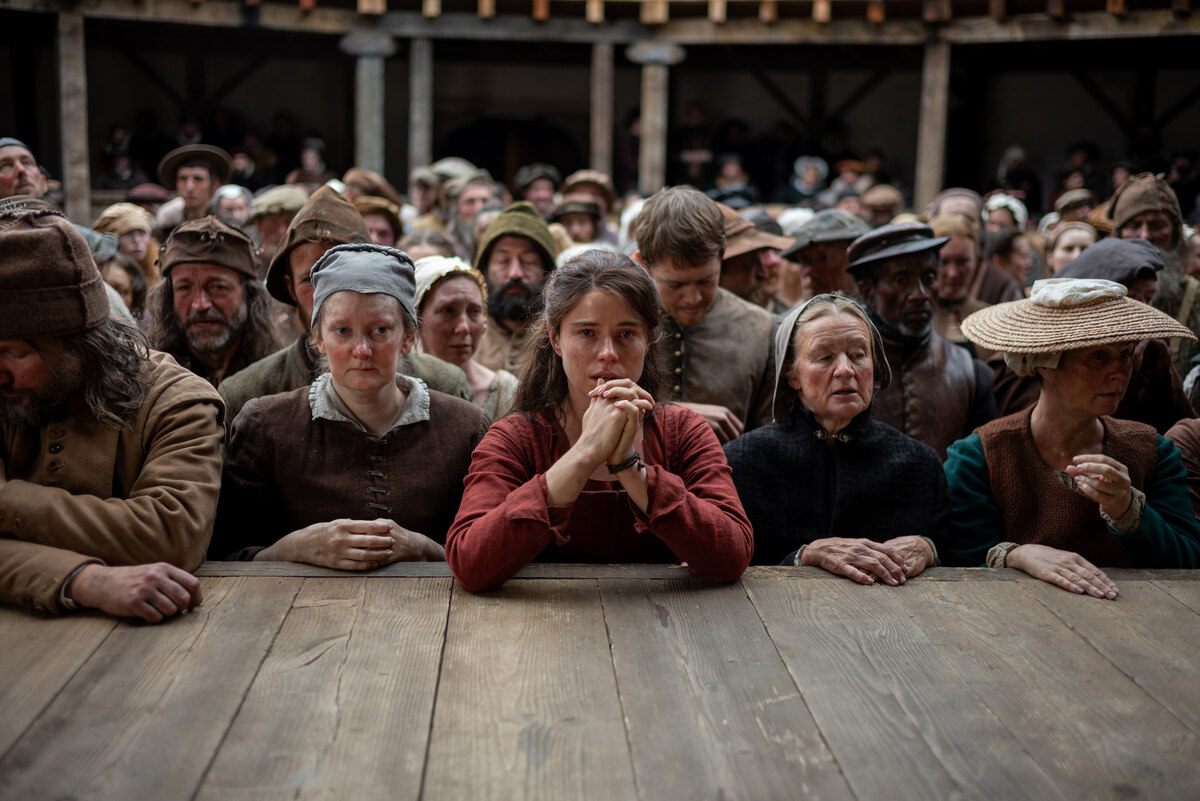
Agnes ends up in London for the premiere. At the Globe Theater she stands in the front row and is initially outraged that her son’s name is spoken on stage. It seems as if she has no idea what a play is or how it works, but she allows herself to be carried away, amazed, with her eyes and ears open. And then, at the end, she reaches out her hand as if to touch the work of art her husband created, and the other spectators do the same with her. It becomes such a powerful moment that you see it as a great metaphor for what art is and how it moves us, even beyond what we understand.