

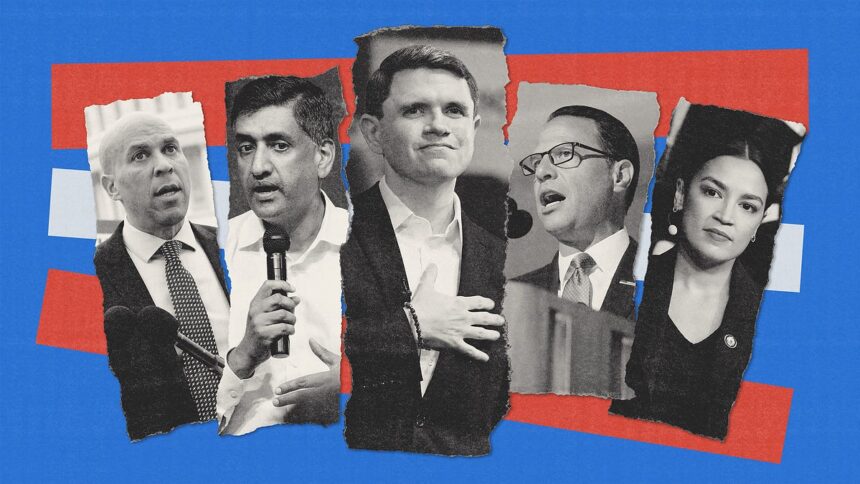
Republicans face a post-Trump crossroads. Democrats are poised for civil war between the socialist left and the moderates, with both claiming the midterm triumph as their own. Few times in American history has the gap between visions of our political future seemed so vast. Are we headed for democratic socialism in the White House, a refashioned MAGA, or something entirely different?
Who better to make sense of it than Matt Taibbi? Matt has been covering presidential elections for more than two decades, and he has done so with radical honesty and verve. He’s someone who thinks for himself—belonging to neither the blue or the red team—and whose perceptive eye has, time and again, spotted where our politics is heading ahead of the pack. We’ve long admired Matt, who worked with The Free Press on the Twitter Files in 2022. That’s why we’re thrilled that Matt is joining these pages as The Free Press’s reporter-at-large for this presidential cycle, delivering regular dispatches from the campaign trail as the country decides on its next chapter.
For his inaugural piece, he reports on the “Elvis” candidate wooing moderate Democrats in 2028, asks why everyone in the party seems so glum, and is booted from a Democratic Socialists of America (DSA) meeting in Boston. —Oliver Wiseman

At the “What’s Next?” organizing conference in Denver last Thursday, the unofficial launch of the 2028 presidential campaign cycle opened with a kick to the groin.
“Get this,” said strategist Stephanie Valencia. “Close to half of eligible Latino voters today, something like 16 million people, were not even old enough to vote when Barack Obama was first elected. Hope and Change does not mean anything to them. They were busy getting potty-trained and doing their homework.”
A nervous laugh shot through the crowd. You could read it on a hundred faces: “Jesus, are we that old?”
They used to call this time the “invisible primary.” In the months between midterms and the first presidential stump speeches in January in half-empty diners in Iowa and New Hampshire (it’ll be South Carolina and Nevada now), party leaders huddled to line up money and endorsements behind a creature vanished from American politics: the “presumptive favorite.” That process took place away from the press in mostly closed conferences—the proverbial smoke-filled room, whose loss has at times been lamented in the Trump age by pundits like Andrew Sullivan—and was nearly 100 percent predictive. The “invisible primary” winner almost always became the nominee.
Now, everything is up in the air, total chaos. In both parties, we have fewer of Don Rumsfeld’s “known knowns” than at any time since 1968. The myriad possibilities of democracy no longer being locked away would have been a definite thrill once, but after the last 10 years, the benefits of seeing behind the curtain are murkier. The Great Oz might be drooling and insane. I went to look anyway.
Read more