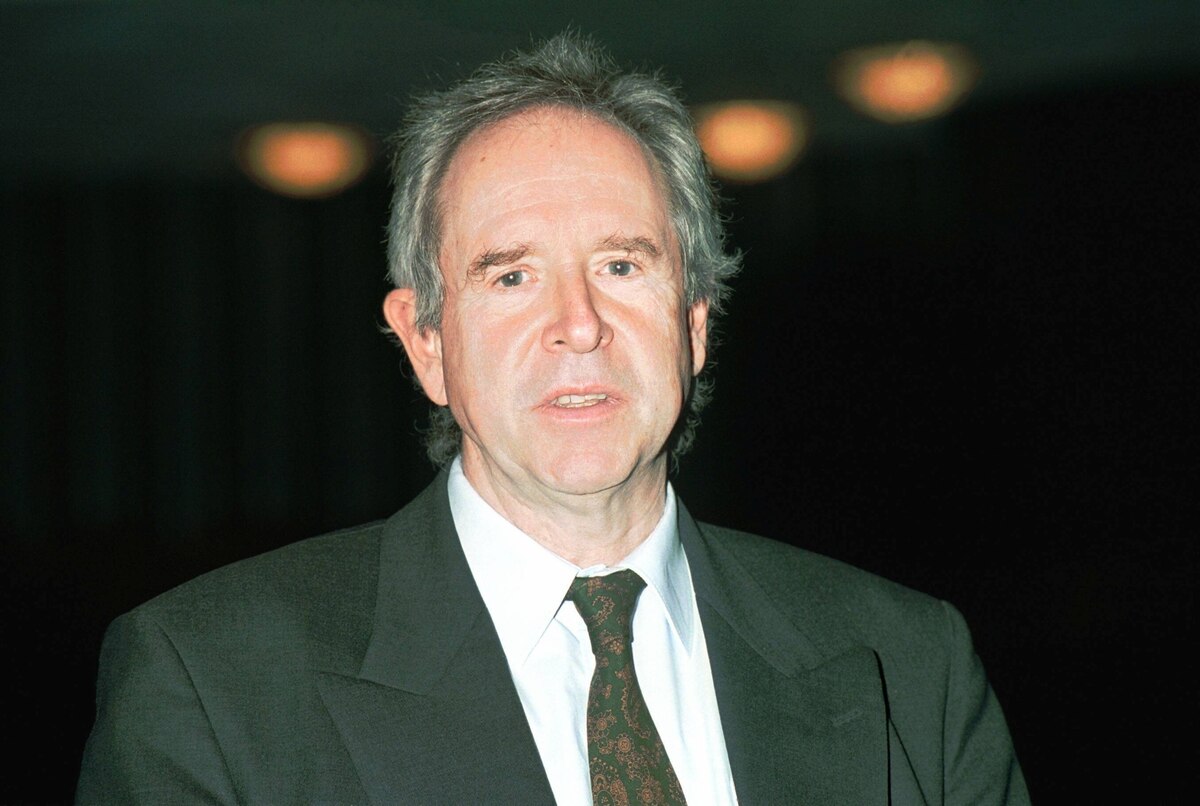
Under the heading “Colleagues, Friends, Companions” on Ulrich Eckhardt’s website there is a long text about a visit to the painter Harald Metzkes in 1988 in his studio near Kollwitzplatz. It is a loving and emphatic portrait of the painter, his humor, his modesty, his approachability. And it is a testament to how much Ulrich Eckhardt enjoyed getting involved with artists, how interested he was in the GDR and how much he enjoyed writing. As if he didn’t have his hands full as director of the Berlin Festival.
At the Presentation of the program for the Theatertreffen 2026 Matthias Pees, now director of the Berlin Festival, took the opportunity to remember Ulrich Eckhardt, who died on December 30, 2025 at the age of 91. Pees told how Eckhardt wanted to ensure that productions from the GDR could also come to the Theatertreffen. He finally managed it with a trick of persuasion: the festival of German-speaking theater is international, after all, productions from Switzerland and Austria are also invited. That worked.
I met Ulrich Eckhardt around 1990, when I started working as an art journalist “Convergences”, a ten-part exhibition series part, for which an artist from the GDR worked together with an artist from West Berlin. The exchange in the period of upheaval after reunification was a self-help project between the artists, intensive and not without conflict in the debate, but with many approaches to everyday life and the conditions of production of art on the other side.
The Berlin Festival supported the exhibition cycle, which took place in its gallery rooms in the Bikinihaus. This was conveyed by the photographer Elke Nord, Ulrich Eckhardt’s neighbor in Dahlem, who had already worked with him on the publication “The Moses Mendelssohn Path. Berlin journey through time or hiking trails into a sunken city”.
The initially repressed and often forgotten Jewish history in Berlin was one of the topics that Ulrich Eckhardt repeatedly pursued as an author, editor and director. “In the twelve years from 1933 to 1945, Berlin’s life law, which had grown over centuries and was based on tolerance of those who thought differently and the assimilation of foreign influences, was erased. The city of the Enlightenment lost its soul, its identity – not through natural events or foreign rule, but through a self-inflicted catastrophe, the deepest fall in its 750-year history,” he wrote about the program “Music from Exile” in 1987. That today is the topography of terror He was also committed to documenting the crimes of the National Socialists at one of their crime scenes.
International art for Berlin
The Berlin Festival took place in the walled city of West Berlin, which Eckhardt had headed since 1973responsible for bringing international art to the western part, forging connections, for culturally overcoming boundaries created by the island’s location, and for producing global glamour. The first “Horizons – Festival of World Cultures” took place in June 1979. It brought art, theater, dance, music and film from African countries to the congress hall and thus laid the foundation for the work in the today’s House of World Cultures. Large cultural-historical exhibitions focused on Latin America, the Orient or Beijing.
The director was supported by an educational political furor and the trust that culture has a task “in times of regression, atavism and an increase in violence”. When “liberality, religious freedom, enlightenment, humanism, emancipation, tolerance, democratic participation” threaten to fail,” he wrote in 2018 for the book “Looking Beyond Walls,” we can learn from the arts “politeness, empathy, the ability to differentiate, shade, relativize, gain distance from oneself, reflect on the self, the self and the world, not to judge oneself alone, to recognize values and to gain an attitude from them (…).”
On January 30, 2026, a funeral service will take place for Ulrich Eckhardt in the St. Annen Church in Berlin-Dahlem.