

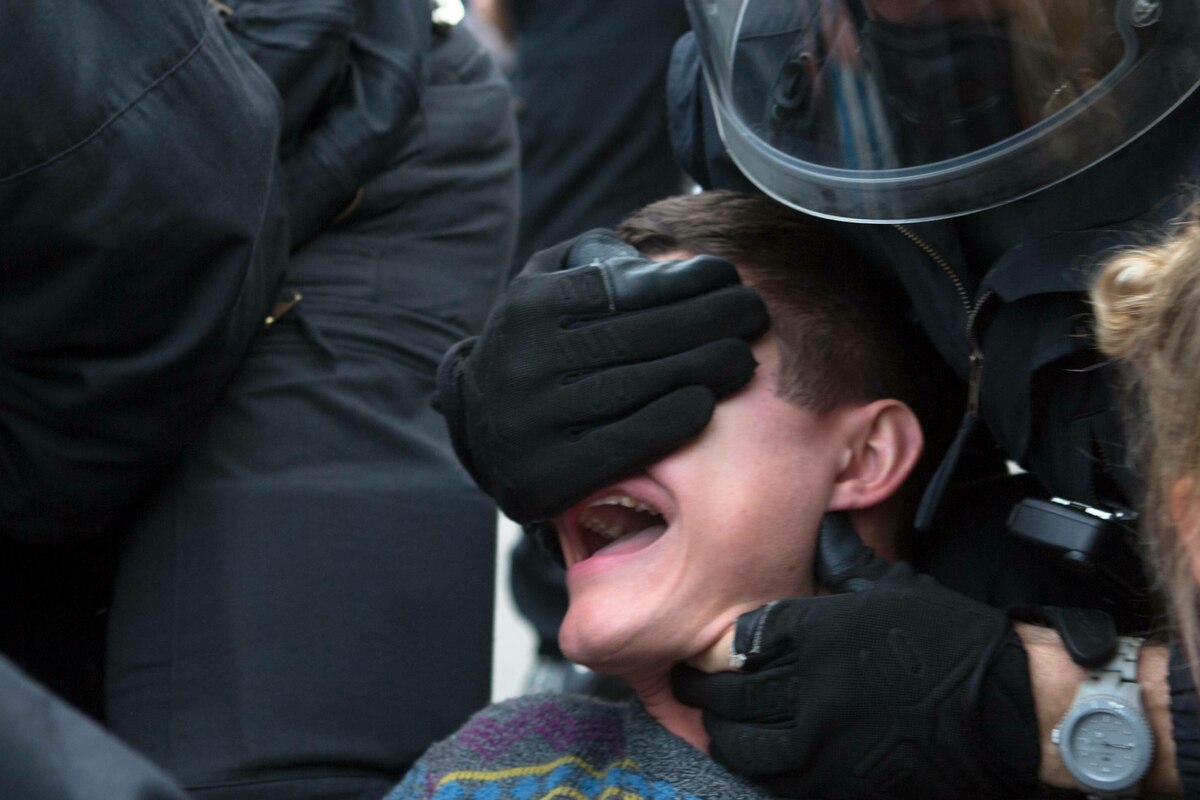
A climate activist from the group Extinction Rebellion, who was subjected to pain-grip attacks by the police during a sit-in, won justice before the Hamburg administrative court on Thursday. Because the verdict is still pending, it is unclear whether the activist won in this instance for substantive or formal reasons.
His lawyer Christopher Brandt had attacked, on the one hand, whether the pain grips themselves were illegal – and, on the other hand, whether the police had formally handled them correctly: So had the police officers announced to the activist that they would hurt him if necessary?
The incident in question happened several years ago. The proceedings were delayed because of the corona pandemic, said presiding judge Michael Bertram apologetically. In September 2019, organized by Extinction Rebellion, around 150 people gathered on Willy-Brandt-Straße and simply stood there during a green phase. Around 40 people sat down and refused to open the main road even after a request from the police.
As can be seen on a video, the plaintiff had his hands crossed under his drawn knees. So he could have been carried away without any problem, says the activist – unlike if he had completely relaxed and made himself heavy. “The carrying away was an offer to the police,” he told the taz afterwards, an offer to peacefully dissolve the blockade. The activists had already announced in advance that they would not defend themselves.
Techniques of coercion
Nevertheless, the police did not carry the activist away. Instead, they tried to get him to stand up using various techniques: back hold, hand flexion lever, finger lever and pressure with the knuckles on the upper arm muscle, from which the activist suffered bruises. The court now had to clarify whether this approach was proportionate.
The presiding judge said that it depends on the special circumstances of the case and also on what lies behind the “diffuse collective term pain grip”. Pain caused by a countermovement of the victim? The court finds this unproblematic. Does the grip reflexively force a certain movement? Or does pain bend the will? The latter probably weighs the heaviest.
The police claimed that the plaintiff had resisted the use of the pain grips, although it remained unclear what they meant by “defend themselves”. The action, which was initially suspected of coercion, endangered public safety because drivers broke out of the traffic jam that was forming and turned across the oncoming lane that remained free.
During the carrying away, both the police officers and the person being carried away could have been injured, for example by stumbling. In another case there was one Policewoman so injured that she is unable to work had to be written.
The judge pointed out whether carrying away was an option also depends on how dynamic the situation is. How big is the blockage? Does the police have enough and sufficiently strong personnel available? In this case there were plenty of officers on site.
Society does not act.
Christopher Brandt, plaintiff’s attorney
A possible basic attitude among the police officers could also have played a role. When an activist asked an officer why the police were acting so brutally, he replied: “Since Brokdorf, the Hamburg police have not carried anyone away.” However, one of the activists actually forced it to be carried away.
However, the question of how all this should be assessed would be superfluous if the court had come to the conclusion in its not yet available reasons for the judgment that the police officers had already acted incorrectly on a formal level. Was it enough for the officers to announce that they would now “use direct force in the form of simple physical force” or should they have been more specific? The point of the threat is that those affected have the chance to react.
Painful grips have a deterrent effect
In his plea, lawyer Brandt talked about the background to the blockade. Anyone who sits down on the street to point out the impending climate catastrophe is not doing so for fun. “Society does not act“, said Brand. In order to draw attention to this problem, one must “create a noticeable disruption to business as usual.”
Furthermore, it is absurd to use direct coercion against an assembly that… appealed to the Federal Constitutional Court could. This obligated the state to protect the climate in the interests of future generations.
From the plaintiff’s point of view, pain attacks against peaceful climate activists have a deterrent effect: “People are shown what happens when you protest.”