In a legal threat issued to Drop Site News last week, attorneys representing former Rep. Mike Rogers and Kristi Rogers took issue with our recent reporting that Aegis, a security firm whose American subsidiary was run by Kristi Rogers, was the recipient of major U.S. contracts—in particular, a $1.017 billion contract to protect the Embassy in Kabul, Afghanistan—including while Rogers was chair of the House Permanent Select Committee on Intelligence.
Rogers is the Republican candidate for Senate in Michigan. Drop Site reported that Aegis had done work in Libya and was pursuing further contracts at the same time that Rogers was overseeing an investigation into the 2012 attack on a U.S. compound that killed four Americans, including Ambassador Chris Stevens.
The attorneys argued it was defamatory to report:
That Aegis, under Mrs. Rogers’s leadership, performed U.S. government work in Libya and was connected to the September 2012 attack on the U.S. compound in Benghazi. The Article’s section on Libya states that “[t]he pursuit of further contracts took Aegis to Libya,” describes Aegis’s presence in Tripoli, and then immediately recounts the tragic Benghazi terrorist attack, followed by a section titled “After Benghazi” that discusses Mrs. Rogers and her company. The clear implication is that Aegis, and Mrs. Rogers, held a U.S. government contract in Libya and bore some responsibility for the events in Benghazi. That is false. Neither Mrs. Rogers, Aegis LLC, nor any Aegis entity has ever entered into a contract with any department of the U.S. government to perform work in Libya, and none was involved in the Benghazi attack. [Bold in the original.]
In fact, Drop Site’s article does not assert, either directly or by implication, that Aegis performed “U.S. government work in Libya” under Kristi Rogers’s leadership, or that it “was connected to the September 2012 attack on the U.S. compound in Benghazi.” Rather, Drop Site reported the company was operating in Libya, a fact about which the public record is clear, and that it had assessed Benghazi in the summer before the attack on the U.S. compound. Aegis Advisory Services, an intelligence arm of Aegis, had boots on the ground in Libya.
The key reason to include Aegis’s Libya work in the article was to show that Aegis was doing work in an area where Rogers was investigating, yet Aegis was never called in for questioning. The source of funding for Aegis’s work in Libya, for the purposes of the article, is entirely irrelevant.
Kristi Rogers and her firm’s employees were covered by a “no interaction” policy with the committee her husband chaired at the time, according to a HPSCI spokesperson at the time. The same lawyerly prose was repeated in the legal threat to Drop Site News, which noted that the Rogers’ had a “strictly observed and enforced” policy of “no interaction with Mrs. Rogers on any matter relating to the official business of the House” and “no interaction between the Committee and any representative of Aegis.”
In the end, there was a firewall for the entire committee and employees of Aegis (as opposed to, for example, Rogers recusing himself) and nobody from Aegis Advisory testified, despite the intelligence firm having on-the-ground intelligence in Libya prior to the attack on the Benghazi outpost. Conservatives looking for a more far-reaching investigation criticized the decision to wall off Aegis from the investigation at the time. See, for instance, Micha Morrison’s “Unraveling Benghazi: Is Mike Rogers the Problem?” in Judicial Watch, republished by the Daily Caller.
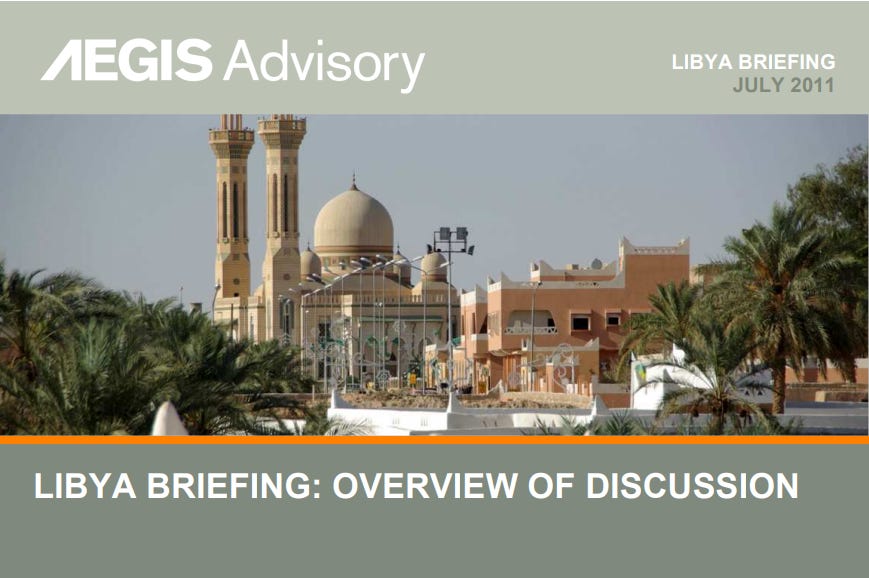
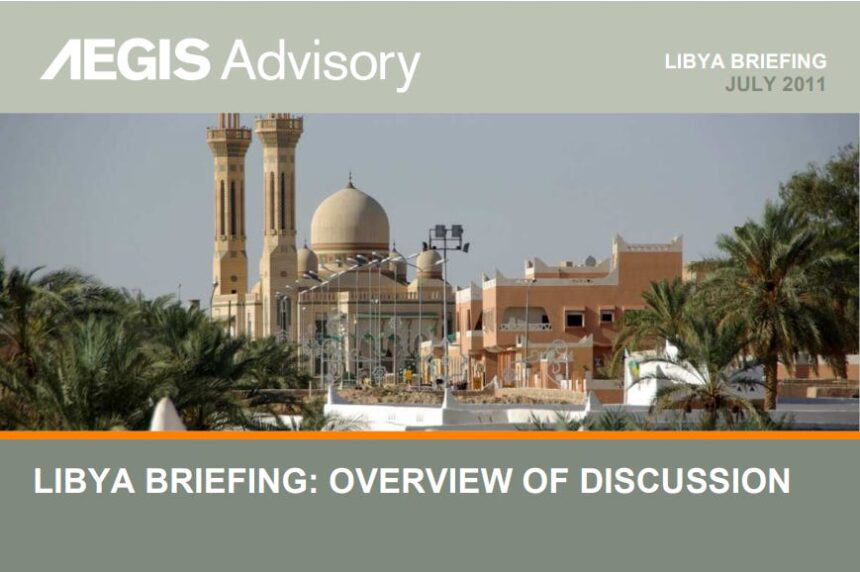
Aegis in Libya
In July 2011, Aegis produced a briefing on Libya that was circulated by Stratfor, an elite private intelligence firm based in Austin, Texas. Stratfor’s work, as Morrison noted in Judicial Watch at the time, is used by corporate, military, and government clients, including the U.S. Defense Intelligence Agency, but also the Departments of Defense and Homeland Security.
The Aegis Advisory Libya briefing from July 2011, along with Stratfor’s email communications, was published by Wikileaks. The Aegis report was sent to Stratfor’s so-called “Alpha List,” an elite circle of intelligence professionals.
Under a heading titled, “Libya: Preparing for Life After Qaddafi,” the report by Aegis Advisory begins: “Richard Ayton, director at Aegis Advisory, travelled to Benghazi in April and May 2011 to examine the situation in the rebel-held east of Libya at first hand. Here is his assessment of the strengths and weaknesses of the National Transitional Council, the role of the revolutionary militias, the international presence in the region and the prospects for a post-Qaddafi government.”
In response to a request for comment about why Aegis’s intelligence briefing was not included, despite the fact that it circulated via Stratfor to the highest levels of the intelligence community, Abby Rosner, a spokesperson for the Mike Rogers campaign, said:
Under Mike Rogers’ leadership, the House Intelligence Committee interviewed every single member of the intelligence community who was in the fight in Benghazi. Because it is not within its jurisdiction, the Committee did not interview Department of State or Department of Defense personnel. As our counsel mentioned in their October 15, 2026 letter demanding retraction of the false and defamatory statements made in your October 13, 2026 article, “Neither Mrs. Rogers, Aegis LLC, nor any Aegis entity has ever entered into a contract with any department of the U.S. government to perform work in Libya, and none was involved in the Benghazi attack.”
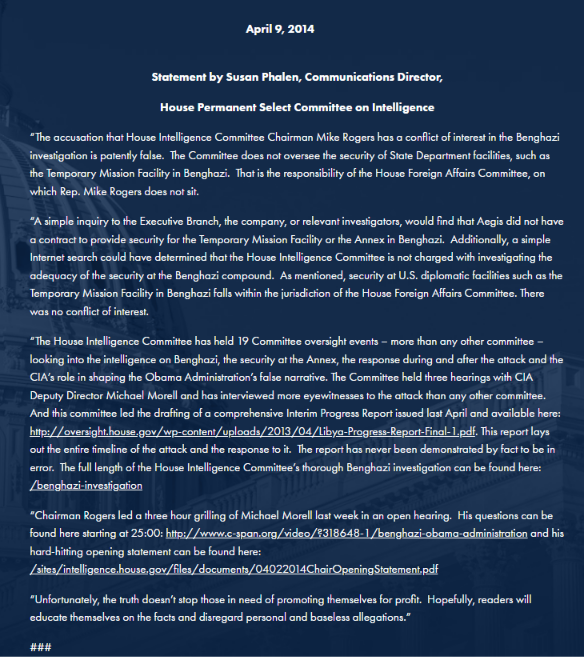
This statement from Rogers’ campaign to Drop Site is in line with comments by HPSCI in 2014. Committee spokesperson Susan Phalen specifically denied that Rogers a conflict of interest in the Benghazi investigation, claiming that HPSCI did not oversee State Department embassy security.
Yet whether in its jurisdiction or not, the final Rogers report quite explicitly targeted the State Department, criticizing then-Secretary of State Hillary Clinton for lapses that led to the deaths:
“Finding #3: State Department security personnel, resources, and equipment were unable to counter the terrorist threat that day, and they required CIA assistance. Although HPSCI generally does not review State Department security capabilities, and this review did not set out to review those capabilities, evidence the Committee received related to the level of the State Department’s security capabilities in Benghazi. CIA security personnel testified that State Department DS agents repeatedly stated they felt ill-equipped and ill-trained to contend with the threat environment in Benghazi. According to eyewitnesses testifying before HPSCI, the DS agents knew well before the attacks that they could not defend the TMF against an armed assault. The DS agents also told CIA about their requests for additional resources.”
Chairman Rogers also mentioned the inadequacy of the ragtag local militias subcontracted by the State Department to defend the compound, including the February 17th Brigade. Aegis, in its 2011 Libya briefing, addressed the February 17th Brigade and its role in the Libyan uprising. “The State Department had contracted with the February 17th Brigade and the Blue Mountain Group to provide local security for the [compound],” the report states. “All available information indicates that the February 17th Brigade guards were inside the walls of the compound and did not detect or report information about the attackers before the attackers breached the gate.”
Why did the February 17th Brigade not detect or report such information? What else was known about them? Had the committee wanted to learn more about the February 17th Brigade in Benghazi, one avenue would have been to call Aegis officials.
Enmity against Gaddafi was unifying the opposition, Aegis reported, but that would fray once he was gone. “At present the February 17th militias are united by a common cause: the removal of Qaddafi and the unification of the country,” Aegis assessed. “However, once Qaddafi has gone—and the rebels have spilt too much blood to countenance a deal that would involve his maintaining any political role—this unity will be threatened.”
The committee did not call Richard Ayton, who was on the ground in Libya pre-attack; Sarah Keeling, Managing Director of Aegis Advisory Services; or Pandora Crawly, Business Development Manager for Aegis Advisory, whose contacts were listed on the Libya Briefing; nor were any employees of Aegis called in for Mike Rogers’s investigation.
Nancy Skinner is a longtime radio and television commentator and was previously a Democratic candidate for office. She has made small campaign contributions to Abdul El-Sayed’s Senate campaign. She has made three contributions totaling $34.