

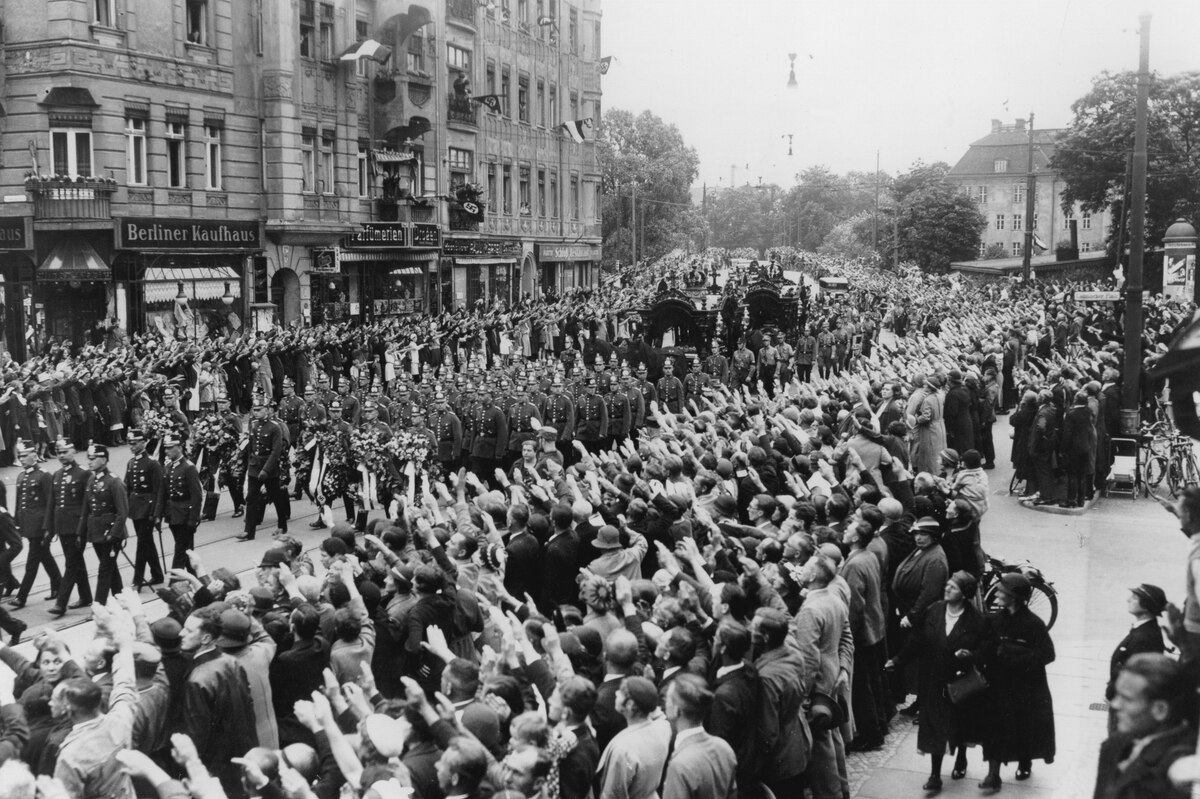
The anxiety turns into shock when we suddenly find ourselves standing in front of this black and white photo: a funeral procession, with men in uniforms at the front. The group says that it has “a lot to do with what you see on the news every evening” – the speaker means reports about the decline of democracy in the USA, with the deadly ICE actionswith a president who covers everything. However, you can see something different in the photo at the “Köpenick Blood Week” memorial and remembrance site: the burial of three SA men in 1933.
In the picture, Joseph Goebbels strides forward, dapper, with that landowner manner that claims power without having to explain it. Thousands of Köpenickers stand on the sidewalks. The arms are raised, the Hitler salute forms a wall of approval. Nobody has their hands in their pockets, nobody turns away. Civil courage can’t even begin to be seen in this photo – it simply doesn’t appear.
The visit of the memorial and remembrance site “Köpenick Blood Week” in the former district court prison in what is now Puchanstraße, on the occasion of the international commemoration of the victims of the Holocaust, turned out to be a tough ride for the around 20 participants – you can see it on their faces. Because the emphatic leadership of museum educator Matthias Wiedebusch consistently places individual fates in the historical process of the National Socialist conquest of power. It shows how violence did not break out suddenly, but was organized, legitimized and carried out publicly.
It happened in full view of the public, as if they were testing how far they could go
The “Köpenick Blood Week” represents one of the early and particularly open violent excesses of the National Socialists after they came to power in 1933. At the end of June of that year, Köpenick was transformed into “a laboratory of terror,” says Wiedebusch. And the Nazis themselves were amazed at how little resistance there was from the population. The SA and SS abducted, tortured and murdered political opponents and Jews – in the middle of the neighborhood, often in front of the public. As if they wanted to test how far they could go.
Resistance as a pretext
In the prayer room, the former prison chapelWiedebusch vividly describes how the Köpenick Blood Week got rolling. On the evening of June 21, 1933, three SA men stormed the Schmaus family home for the second time. They wanted to arrest the social democrat Johann Schmaus and his sons Anton and Hans.
Anton stood in the men’s way. In self-defense, he shot at the intruders: he fatally shot two SA men, and a third was injured in the exchange of fire, presumably by his own men. Anton Schmaus voluntarily turned himself in to the police. He was taken to the police headquarters on Alexanderplatz. There he was shot in the back. Seriously injured, he was taken to hospital, where he died after further abuse in January 1934.
Anton Schmaus is also one of the most famous victims of the Köpenick Blood Week because his resistance served as a pretext for the Nazis to unleash terror. They exploited the act for propaganda purposes – this is also inscribed in the black and white photo mentioned at the beginning. To this day, the Köpenick Blood Week represents the particularly brutal phase of the National Socialist conquest of power in which the SA and SS deliberately and publicly resorted to intimidation, torture and murder. It was an early moment in which the Nazis used intimidation and murder not secretly but demonstratively – and in which civil society failed completely.
Hundreds were mistreated
In the end, the Nazis had killed at least 23 people, hanging their bodies in public forests in broad daylight, putting them in sacks and dumping them in the Dahme. Hundreds had mistreated them: dragged off the tram on the way home, chased through streets, beaten in bars from which the screams could be heard outside.
This horror was made possible by the state of emergency following the fire in the Reichstag at the end of February 1933. With the corresponding regulation, the Nazi regime suspended central fundamental rights: personal freedom, the inviolability of the home, freedom of expression and assembly, and the protection of property. This was immediately followed by a wave of arrests, abuses and murders, which could now be passed off as state action.
They deliberately and publicly resorted to intimidation, torture and even murder
So soon after the so-called seizure of power, the violence served a double purpose: it spread fear and terror – and it forced people to take a position. Anyone who wanted to belong to the “national community” had to show themselves: on the street, at the window, on the sidewalk. And those who had previously located themselves outside the command centers of society and the state could feel encouraged to participate at the lowest level of political rule – and to exercise violence.
Wiedebusch, who has been offering guided tours here for years, responds attentively and, despite his routine, with noticeable vigor to visitors’ questions and comments about the photo. He reports that interest in the memorial has been growing significantly for months. At the same time, the conversations were changing, he says: People were increasingly talking about their fears in person. In one Present, in exclusion gets louder again and Violent fantasies are once again publicly articulateda visit to this place hurts twice as much.