
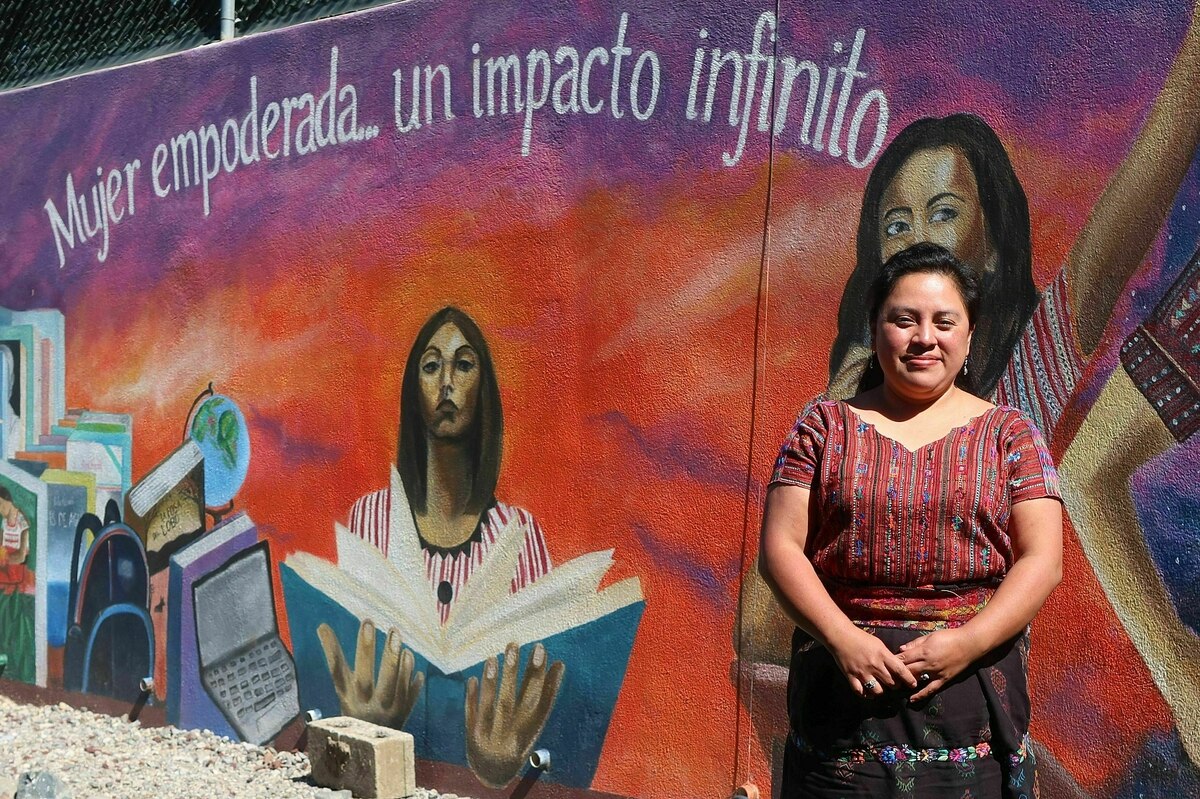
The colorful mural with the slogan “Strong roots, capable woman” is emblazoned on a wall made of natural stone just a few meters in front of the school office. A staircase leads to the three-story school complex of the Maia Impact School, where Vilma Saloj is waiting in the auditorium. The medium-sized woman in indigenous costume is the long-time director of the only secondary school for indigenous girls in Central America and is proud of what she has achieved so far.
“We started in 2007. In 2016 we took the opportunity to build our school opposite a renowned private university in the middle of Sololá, instead of in one of the rural communities where our students come from,” she explains. Being visible – that is important for the optimistic educator from the Guatemalan region of Sololá. The lively provincial town with around 20,000 inhabitants lies above the famous Lake Atitlán and has an indigenous character. Three Mayan ethnic groups, Kaqchikel, Quiché and Tzutuhil, shape the image of the city in their traditional costumes. Vilma Saloj knows how important education is in order to escape from social exclusion. Not from books, but from real life.
Saloj is a Kaqchikel in her mid-thirties. She grew up in one of the villages surrounding Sololá. There are 83 places in the catchment area of the Maia School, 43 of which currently have 375 students who are supposed to do their Abitur in the spacious and well-equipped school. “We deliberately focused on indigenous students because they are discriminated against in four ways: they mostly come from small villages without municipal infrastructure, are poor, female and indigenous,” says Saloj.
She was lucky because, unlike many of her neighbors, her parents decided to allow their six children to attend secondary school – including the girls. “I graduated from high school together with my older sister – the first in my family. My mother only completed two school classes, my grandmother not one,” explains Saloj, wrinkling his nose in disapproval.
Low literacy especially among Maya
This is typical in indigenous households Guatemalaswhich, depending on the source, make up 44 to 54 percent of the approximately 18 million Guatemalans. 48 percent of the 4 million indigenous women in the largest Central American country can neither read nor write. A central reason why Saloj is committed to better education in the Sololá region and all of Guatemala: “Look around our parliament: 160 representatives, and only one is indigenous. It can’t stay like this,” she says, expressing something that was taboo in Guatemala for decades. The right to vote, yes – political participation only existed in minimal doses. Hardly noticeable.

That should change, and the Maia Impact School should serve as a springboard. The declared goal of the Mayan women, who initiated the education project 18 years ago, which was financed primarily thanks to US donations, was to enroll indigenous girls in secondary schools. “We started in 2007 by financing the bus trips to schools, materials, satchels and the like in the form of a scholarship, while at the same time looking after the families. Encouraging them to support their daughters,” remembers Celestine Poz Bocel. She sat down with Saloj on the terrace on the first floor of the school building. Adjacent to these are several classrooms where further training for the teaching staff is currently taking place – the majority of the students are on their end-of-year holidays, which begin in November.
Poz Bocel was one of the first students to graduate from high school here thanks to a mentor and a scholarship. A few months later she began working as a mentor for the school herself; about a year earlier, Saloj had also started working as a mentor. Both were able to convince parents that they could go to school longer than the usual six primary school years and to provide them with targeted support.
“It starts with intra-family communication, more with each other, more mutual help and more trust in their own daughters,” say the two Kaqchikel. Both of them have now studied, graduated in education and are continually refining the structures of their school – the motto is to get better. That’s why the pure scholarship model ended in 2016 after around ten years. “The decision to build and equip our own school according to our specific needs was a direct hit,” they both agree.
“Strengthened woman – infinite impact”
The major project in the upper part of the provincial capital Sololá was financed by an American who wishes to remain anonymous. A stroke of luck for the team around the two determined women, who are committed to training the indigenous offspring of tomorrow. To do this, they have developed a model with internal and external support in which not only the mentors play a central role, but also the educators. They place particular emphasis on math, English, Spanish, but also natural sciences, art and sports.
You can get an idea of this when walking through the clearly structured building. The chemistry and physics rooms are located at the back of the ground floor, behind which is the sports field, where there is an inspiring mural. “Empowered woman – infinite impact” is written on the wall between indigenous women who look through telescopes, wear stethoscopes around their necks or simply stick their noses in books.
19-year-old María Elena Coj Chipin is typical of the Maia Impact School. She came from the village to the then brand-new Maia Impact School in 2018 as a shy 12-year-old and has now grown into a young woman who knows what she wants and can do. Since April last year, after two trial internships, she has been working at a micro-credit provider that grants loans to indigenous women based on social criteria.
At the same time, Coj Chipin is studying management and administration at the Universidad del Valle, the private university opposite the Maia school building. “I dream of being able to manage a social organization someday,” she says, then laughs and points to the Maia logo on the mural at the end of the sports field. “Here I not only learned to value myself, but also my fellow human beings,” says the young woman with long jet-black hair, who, like almost everyone else here, wears indigenous costume.
This is also normal outside of school, even among men, and has something to do with the functioning indigenous structures in the Sololá region. Indigenous authorities there enjoy great respect. This is also the central reason why Vilma Saloj never tires of seeking contact with authorities, both women and men, and explaining what happens behind the doors of the school, which is unique in Guatemala.
The completion rate speaks for itself
“Education is our springboard into the universities, into the institutions – a tool to demand more participation,” says Saloj, who once wanted to study medicine in Cuba, but is now fighting for the right to education here – for the indigenous girls, but also for the entire indigenous population.
This works, as the statistics prepared by the two educators show. 46 percent of the approximately 3,000 Maia graduates to date pass the university entrance exam, and 49 percent land one of the formal jobs that are subject to social security contributions, which are coveted but scarce in Guatemala. The good numbers are also a reason why the first hundred teachers from the Sololá region are receiving further training in Maia pedagogy at the Maia Impact School this year.
This is a first success for Vilma Saloj. But she would like to see more attention for the innovative education project from national education policy. That’s still missing.