

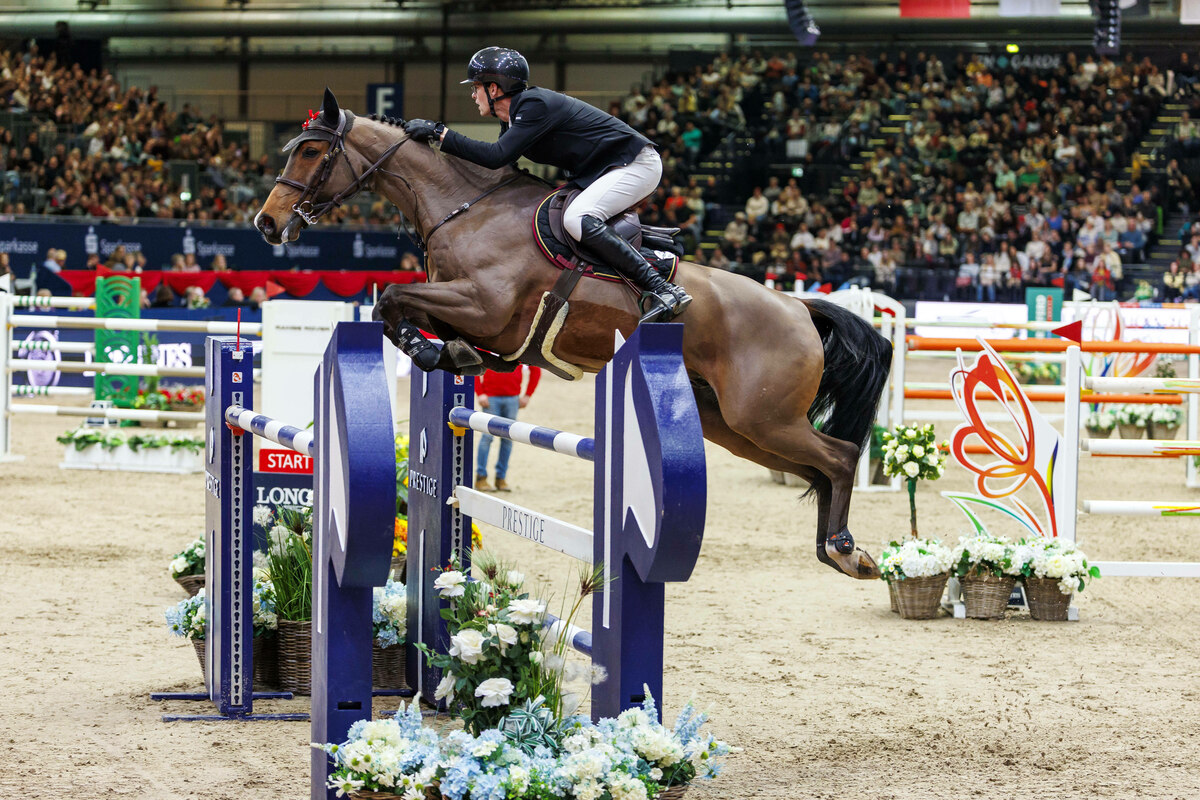
Pennywise flies over the 1.35 meter high obstacle with a lot of air under his stomach: calm, confident in the jump, his ears always pointing forward with interest. Looks like the gray horse is having fun. In any case, it doesn’t seem as if his rider Sofia Westborg from Sweden needs to help much. This is not a given, especially not in an international young horse test like this weekend at the World Cup tournament as part of the “Partner Horse” in Leipzig.
Many of the seven-year-olds are very excited, dancing heatedly as they wait at the edge of the course for the start signal; Riders have difficulty holding their horses.
Reins, spurs, whip – in equestrian sport they are called “aids”, and what you do with them is called “giving aid”. For decades, the boundaries of this assistance have been redrawn, renegotiated and redefined in international equestrian sport: What still counts as sporting influence – and what is above it? Where does violence begin and where does sport end?
For a long time, blood was the clear boundary. Blood in the rider’s area of influence, i.e. on the mouth, flanks, girth position or at the point of the spurs, was a knockout criterion: horse and rider were thrown out of the competition. An amateur rider in the visitors’ stands remembers the introduction of the rule in the 2010s. “I think that with this no-blood rule, the awareness has been increased to act on a per-horse basis,” she says.
In the future, decisions will be made on a case-by-case basis
In November 2025, the rule was changed again by the World Equestrian Federation FEI. And Leipzig was the first major international tournament in Germany where the new requirement had to be applied: blood on the horse no longer automatically leads to exclusion – instead, a committee now decides on a case-by-case basis.
One viewer, herself a rider, believes the idea of a case-by-case assessment is overdue. “Sometimes it really is the case that a horse bites its tongue.” But as soon as blood is due to pain and excessive force, all discussion ends for them. “Then we have to stop.” But this is exactly where the lack of clarity in the new regulations begins: the blood is no longer automatically the exclusion criterion – but the question of where it comes from and how it is evaluated.
The new regulation divides the equestrian world. The German Equestrian Association (FN) has spoken out clearly against this. Dennis Peiler, General Secretary of the FN, says: “We see the need for an absolutely clear regulation that does not allow any interpretation.” From the FN’s perspective, the old no-blood rule was not only clear, but also practical. Cases in which traces of blood were found in the area of spores or mouth are rare internationally. Peiler refers to FEI figures: In significantly less than one percent of cases, the horse and rider were excluded.
Majority of national associations support new regulation
But at the FEI General Assembly In November 2025 in Hong Kong, the majority of national associations voted for the new regulations. It goes back to an initiative by the show jumping riders’ advocacy group, the International Jumping Riders Club – and only applies to international jumping competitions. One of the most prominent supporters is the German show jumper Ludger BeerbaumBoardmember im Jumping Riders Club.
It’s about making exclusions more proportionate, says Beerbaum – and Hardship cases like those at the Olympics To be avoided in Tokyo in 2021. Because there was a “trace mark”, riders were disqualified and medal dreams were destroyed.
A “mark” is a bloody spore print on the horse’s flank. Whether a bloody wound leads to disqualification will be decided in the future by a three-person committee made up of the steward, the responsible veterinarian and the head of the ground jury. Beerbaum is convinced: “Not a single horse on this planet will suffer anymore as a result of this rule change.”
More pressure on veterinary doctors through innovation
The head tournament veterinarian in Leipzig, Michael Köhler, sees it differently. Köhler is also chairman of the Horses Committee of the Federal Veterinary Association. Even if “the interpretation of the sports law matter allowed this,” that would be the case against animal protection. An attitude that other responsible people in Leipzig also represent.
And Köhler points to a fundamental problem: There would be more responsibility and more pressure on veterinarians in international operations, especially when prize money, sponsorship interests and sporting expectations are at stake.
The FEI innovation exacerbates the problem: instead of the old automatism, there are now warnings – a kind of “yellow card”. Anyone who becomes suspicious again within twelve months faces a ban. A means of pressure that did not exist before. The non-public list of those who have already received their first “Jumping Recording Warning” is already long, says one of those responsible in Leipzig – not without malice. Maybe the show jumpers didn’t do themselves any favors with their rule in the end.
By the way: Pennywise and Sofia Westborg deliver a well-rounded, almost beautiful ride in Leipzig – that’s not enough for placement.