

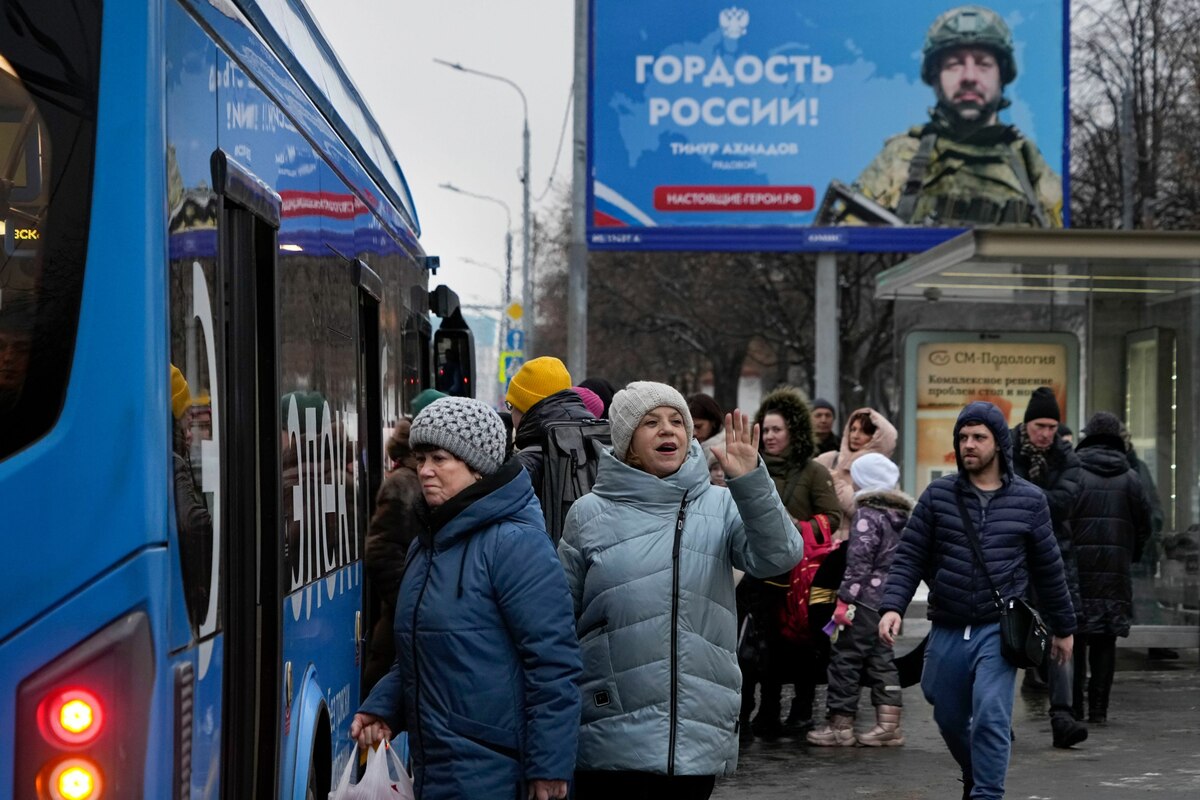
Russian leader Vladimir Putin has lured more than a million Russians to the front with enormous promises of money and other things. The death economy has boosted Russia’s economic growth. But a study “Deathonomics” presented this Monday comes to the conclusion: “Russia’s cynical calculation for short-term profit,” as author Vladislav Inzosemtsev calls Putin’s business model, “will cause serious damage to Russian society and the economy.” The study comes from the Paris-based Institut Français des Relations Internationales and is available to the taz in advance.
“Given that many people in Russia lead miserable lives with no prospects,” said Cyprus-based Russian economist Inozemtsev, “death is becoming the most economically effective way to live one’s life in Putin’s empire.”
The Kremlin is betting on enormous sums of money – and specifically on prisoners, the impoverished, the over-indebted and people from the outskirts of the vast empire. Or, as Inozemtsev cynically puts it: The Kremlin is “buying the lives of Russians who had virtually no economic value – and paying them more than these people could have earned by the time they retired. This policy led to a significant injection of cash into the economy and the sharp increase in wages in most sectors, which boosted consumption.”
Russia experienced demand-driven economic growth in the years after the full invasion of Ukraine in 2022. Especially in previously economically weak regions, from which most of those recruited for the army came. A third of Russian prisoners went to war, mostly unemployed and people with low levels of education from economically backward regions. An economic miracle with new houses, expensive cars and modern restaurants in previously impoverished villages – paid for in blood.
“Meat Grinder” and “Coffin Bounty”
Just Deathonomics. The enormous recruitment bonuses (up to 4 million rubles, the equivalent of 52,000 euros), an annual salary of 5.2 million rubles, debt relief and other benefits, as well as a payment to the surviving relatives of a fallen soldier of 5 million rubles, popularly known as the “coffin bonus”: on average, the costs per mercenary amount to over 200,000 euros. That’s a good 13 average annual salaries (99,400 rubles), tax-free. In some cases, Inozemtsev even has 24 times as much, on which normal working people would still have to pay taxes.
“Putin is buying soldiers almost no matter what it costs“, says Russian military analyst Alexander Golz, who works at the Stockholm Center for Eastern European Studies. Around 40 percent of those surveyed in a survey said that a family member should join the army under these conditions.
According to estimates by military experts in Ukraine, the warfare known in Russia as “meat grinding” – running towards the enemy in huge waves of human attacks without regard to casualties among one’s own soldiers – requires almost 40,000 new soldiers per month. Inozemtsev: “Even increasing personnel costs to unprecedented levels has not made the Russian army more effective. This is the most serious shortcoming of Deathonomics.”
Inozemtsev, a former professor at Moscow’s Higher School of Economics and then founder of the Center for Analysis and Strategies in Europe in Cyprus, sees the huge payments as a “significant stimulus for the ailing Russian economy.” Every year, 2 percent of the gross domestic product would be spent on these salary payments and death benefits alone.
Economist: “Deathonomics doesn’t solve a single problem”
From an economic point of view, this calculation has so far worked out somewhat for the Kremlin. But state-orchestrated large-scale investments in Russia – an alternative to the death economy – almost always turn out to be a non-starter: so far, none of the Yakovlev-MC21 medium-haul aircraft, boastfully touted as an alternative to Airbus and Boeing, have been delivered to airlines. Production of Russia’s own semiconductor, the Baikal-M chips, was canceled.
Deathonomics does not solve “any of the most pressing problems,” says Inozemtsev: “It will neither overcome the technological gap, nor change demographic dynamics or Russia’s position in global markets. Nevertheless, this scheme promotes a certain ‘growth without development’.” These growth rates are “paid for with bloodshed and deaths, but the Russian leadership is completely unimpressed.”
In addition, the huge increase in purchasing power caused by mega-pay and “coffin bonuses” has resulted in sharply increased inflation. As a result, the Russian Central Bank has set the key interest rate at up to 21 and most recently 16 percent. The high military salaries and sharply increased wages in the defense industry have meant that civilian production is no longer competitive, loans have become unfinanceable, and bankruptcies and “bad” loans have increased massively.
The result: Russia’s industry is in recession and government revenue is falling dramatically. The one before the war from gas and oil revenue surpluses Rainfall reserve fund (FNB) filled with almost $800 billion is melting like snow in the sun. With the further wave of spending, economists expect an empty budget at the end of the year and rapidly increasing budget deficits in the country, which has so far been spoiled by surpluses.