

Immediately after Renée Good, poet and mother three children were shot dead in their car in Minneapolis by ICE agent Jonathan Ross on January 13, Junauda Petrus made her way to the scene of the crime. Hundreds had already gathered there to protest against the deadly ICE operation and to mourn the tragedy together.
Peter is the as Poet Laureate acting “city clerk” of Minneapolis, an award that she sees as a responsibility. “I want to stand up for my community and actively care for it,” she says. “Right now we need comfort, mental support and care. It’s important to me to give hope and help create places where you can retreat and where you can find inspiration.”
Across Minnesota, artists, poets, musicians and designers have been using their talents for weeks to actively demonstrate against mass detentions by ICE and US Customs and Border Protection (CBP). 3,000 officers have been deployed in the state of Minnesota since December 2025 as part of “Operation Metro Surge”. Two US citizens were shot in broad daylight because they observed the brutal actions of ICE raids on the streets of Minneapolis: According to Renee Good died the nurse Alex Pretti on January 24th in a hail of bullets.
The art of the town clerk is political
Petrus’ art has always been politically motivated. She wrote the poem “Can We Please Give the Police Department to the Grandmothers” in response to the 2014 shooting of African-American Michael Brown, who was killed by police officer Darren Wilson in Ferguson, Missouri. It soon became a rallying cry for the Black Lives Matter movement. A play and a picture book followed.
The artist recently attended a meeting of former and current city and state clerks from across Minnesota. In response to ICE’s continued presence, they read from their own works and took turns reciting Good’s poem “On Learning to Dissect Fetal Pigs“(On learning to dissect pig fetuses), which was awarded the Academy of American Poets Prize in 2020. With the reading, they set an example for the power of the word at a time when activists, authors and journalists in particular are being targeted by the US government.
Sheila Regan is a journalist and art critic living in Minneapolis.
Freedom of expression is particularly risky for immigrants. When it became known that non-white people in public spaces were being randomly checked by ICE squads and had to show their identification documents, Steve Ozone’s partner urged the photographer to stay home during Operation Metro Surge. Ozone, who has Japanese and Chinese roots, still rushed to the scene of Good’s shooting.
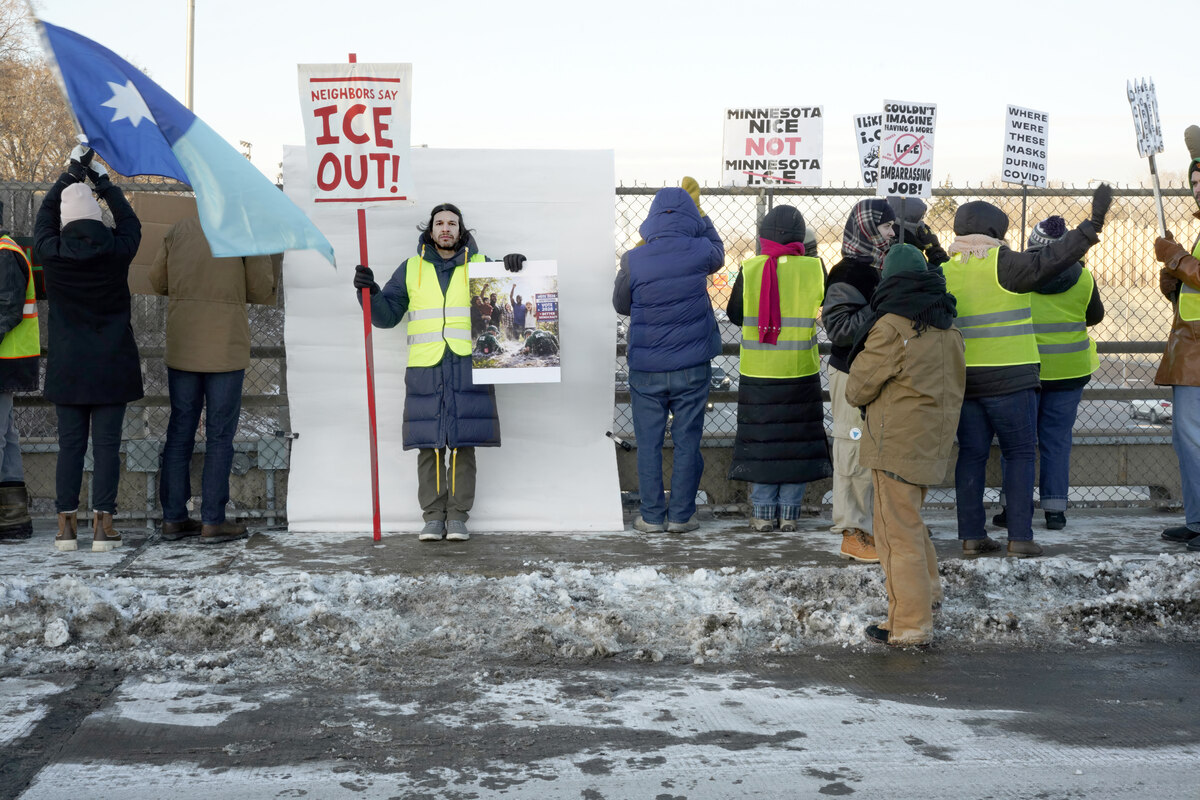
“Massive use of tear gas burned the eyes,” he reports. Without further ado, Ozone joined a protest group that regularly gathers on a city highway bridge in Minneapolis. There he set up an open-air portrait studio, complete with a white background, to photograph demonstrators in front of it. “I look for pictures that no one has shown before,” he says.
Photographer Elizabeth Thompson documents the operations
Like Ozone, photographer Carrie Elizabeth Thompson also photographed the invasion by thousands of ICE operatives. Thompson drives through her neighborhood almost every day on civilian patrol with her neighbor, a former US soldier, in a vehicle equipped with 14 dash cameras. “We patrol the streets and can take pictures at the push of a button when needed,” says Thompson.
The two follow the ICE officers in their cars and film them arresting people at random. Thompson supplements photos of these motorized raids with shots she takes with her Nikon handheld camera. In this way, she has already documented some hair-raising situations in Minneapolis. At one point, she photographed a protester kicking a tear gas grenade back toward an ICE militia officer. “I pulled the trigger when his car was completely covered in gas,” she says.
Singer-songwriter Valentine Lowry-Ortega of the band Oceanographer works at Pillar Forum, a cafe that also hosts concerts and has become a meeting place for volunteers monitoring ICE activities. Civil society activists warm up here as they wait for information about ongoing operations in the area. Lowry-Ortega has joined a patrol herself, follows events via an encrypted messenger app and is there immediately when she is needed.
I think it’s important that we come together as a community
Marlena Myles, artist
Additionally, she helped organize a benefit concert to raise funds for families affected by ICE raids. At the same time, Lowry-Ortega is preparing new songs that she composed at the Cedar Cultural Center in Minneapolis. The music deals with her Venezuelan identity. “It feels weird promoting my own work,” she says. “I often ask myself whether I can actually ask people to come to a concert at the moment. And then I remember: Oh yes, my music is also about my experiences as a child of immigrants. Maybe that’s exactly the story that people need to hear now.”
Artist Sam Gould creates protest banners
For artists like Sam Gould, art becomes a means of protest. Together with his fellow campaigners, he made a huge banner. It took 14 people to carry it through the streets of Minneapolis during a demonstration last weekend. It was made using a public printing press designed by artist Piotr Szyhalski.
The banners “script the public space and bring poetry directly to the people,” says Gould. “This is a very direct and at the same time poetic intervention, with which we create a brief moment of reflection in a place that can overwhelm you.”
Marlena Myles also turned to screen printing in response to ICE’s violent raids. The Spirit Lake Dakota artist has already been involved in the past, for example helping artist Rory Wakemup build a waterproof teepee during the protests against the construction of the Access Pipeline in North Dakota. She learned a lot from her mentors.

Art as a means of protest: protest banner by the artist Sam Gould and his colleagues
Photo:
Sam Gould
“I never thought of myself as a leader,” she says. The screen-printed design she created now plays a major role in the movement. Its message: “ICE OUT OF MNISÓTA MAKHÓČHE: NO ONE IS ILLEGAL ON NATIVE LAND”.
The indigenous community is also involved
Screen printing workshops were held at an event organized by Anishinaabe artist Courtney Cochran and her fashion design studio at the American Indian Center in Minneapolis. Those interested could print their own T-shirts and posters. “I think it’s important that we as a community come together in safe spaces and not waste our time at home doomscrolling and feeling helpless and alone,” says Myles. “It makes you feel like you’re part of a team.”
The events are extremely popular, with many printed T-shirts and signs appearing at the daily protests. “It activates the human spirit,” says Myles. “It brings out the best in people in response to the worst in people.”
Some Minnesota artists are expressing their resistance simply by their presence. Matt Allen, better known as hip-hop producer Nur-D, was headed to the intersection of 26th Street and Nicollet Avenue when he learned that Alex Pretti had been shot there by two CBP officers. Allen was immediately doused with tear gas, shot with rubber bullets, brutally abused by emergency services and finally taken into custody.
“You will have to kill me”
In a video, his voice can be clearly heard as emergency services restrain him under duress: “You’re going to have to kill me. You’re going to have to kill me. You’re going to have to kill me.”
In that moment, Allen acted less as an artist and more as a U.S. citizen speaking words that could have been his last. “There is a level of clarity that comes from knowing that everything that comes needs to be heard and felt,” he said. “In moments like this you can be completely honest.” The artist benefited from his performance skills: “I know how to speak loudly in front of a group because I have trained myself to reach all the way to the back of the hall,” says Nur-D. “I conveyed an important message, but I don’t think I was artistic about it. It was about survival and making things right.”
Translated from English by Beate Scheder