


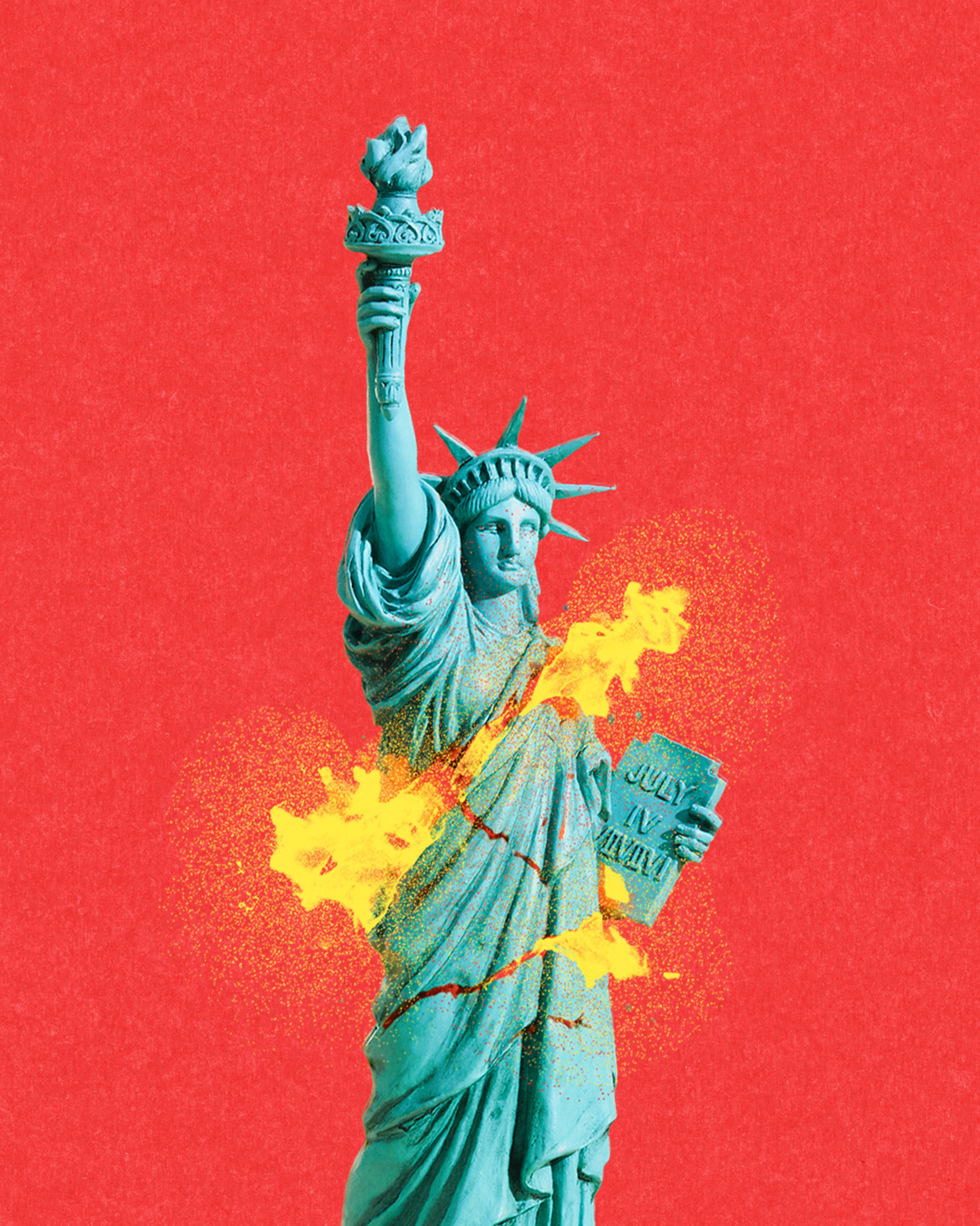
Is America an empire? That was that question on the minds of many U.S. citizens 25 years ago, in the wake of the September 11, 2001, terrorist attacks on the United States. And it is a question being asked again today, as the war with Iran drags into its seventh month, and Donald Trump continues to fantasize about annexing Canada and Greenland—to say nothing of the application of the “Donroe Doctrine” and the “Trump Corollary” in Venezuela and (coming soon) Cuba.
In the years after 9/11, a standard left-wing interpretation was that Osama bin Laden and his suicidal hijackers had struck a blow against American imperialism in the Middle East. Surprisingly, some neoconservatives within the George W. Bush administration agreed. “We’re an empire now,” an unnamed “senior adviser” to President Bush told journalist Ron Suskind in 2004, “and when we act, we create our own reality. And while you’re studying that reality—judiciously, as you will—we’ll act again, creating other new realities, which you can study too, and that’s how things will sort out. We’re history’s actors. . . and you, all of you, will be left to just study what we do.”
This was not the official line, of course. “We’re not an imperial power,” said President Bush in April 2005. “We’re a liberating power.” In his brilliant new history of the modern Middle East, The Cauldron, Simon Sebag Montefiore shows the ambivalence Americans have always felt about their imperial role in the region. At the height of the 1973–74 Arab oil embargo, Henry Kissinger threatened to seize the Saudi oil fields. He was bluffing. Nearly 30 years later, partly on Kissinger’s recommendation, Paul Bremer found himself installed as Grand Poo-Bah in charge of the Coalition Provisional Authority in Baghdad. It was May 2003. Within seven months he had to admit, in an email to his wife: “We are already halfway out of [here]. . . . We are not ready for empire!”
And yet, and yet. There’s just something about unleashing a storm of steel against the Persians, as the United States has this year, that does seem kind of empire-y.
“A republic, if you can keep it,” was Benjamin Franklin’s wry definition of what he and the other participants at the Constitutional Convention had created, after winning their war against the British Empire. Two hundred and fifty years after the United States first declared its independence, the imperial scenario seems closer than ever. Just reflect on the scene at the White House back in June, when gladiators fought in a temporary Colosseum for the amusement of President Donald J. Trump. To quote the British author Robert Harris—author of Agrippa, his new novel set in the time of Octavian/Augustus—“You can really see [Trump] in a toga with a gold laurel wreath on his head. . . . He is an imperial kind of president.” It’s not a new analogy. The German magazine Der Spiegel splashed a cartoon Trump-Caesar on its cover in January last year with the headline: “Der Imperator.”
Read more