


By Virginia Canter and Christopher Swartz
The president’s marquee cryptocurrency legislation, the so-called CLARITY Act, failed 50-49 to advance past a key procedural vote last Tuesday. The key sticking point? The president’s refusal to separate his personal financial interests from his responsibility to the American public.
For more than a year, we and other ethics experts have warned that the president’s immense financial stake in the cryptocurrency industry makes it impossible to trust that this White House-endorsed crypto legislation is aimed at protecting the public interest. As reported on his recent financial disclosure report, Trump made over $1.4 billion from crypto alone last year. The simple solution to this conflict of interest would be for the president to divest his cryptocurrency holdings; when the House voted on this bill in July last year it could have required that. It did not. Instead, the House passed the CLARITY Act without any ethics safeguards at all.
Senate leaders could have easily fixed that omission. They did not. Instead, the White House and Senate Republicans pushed off discussion of ethics provisions for months, returning in July of this year with a version of the law that added ethics provisions that were more permission than restriction.
The new so-called ethics provision placed restrictions on covered officials issuing and sponsoring tokens, but would have let the president continue to hold cryptocurrency tokens and receive funds through licensing and revenue-sharing arrangements, the primary source of his crypto-derived wealth. As we said in July, these illusory reforms would have “selectively shield[ed] Trump’s vast crypto enterprise from oversight.”
On Sunday, less than 48 hours before the Senate was to vote on the CLARITY Act, Senate Republicans advanced yet another set of narrowly-drawn ethics provisions packed with caveats. These would take a year to come into effect, giving the president enough time to restructure his vast enterprise of holdings and renegotiate deals to avoid having to get rid of any interests at all.
Most senators saw right through the haze. Their vote against the CLARITY Act stands as a watershed moment against the president’s unprecedented self-dealing.
Why it Matters
Trump’s ongoing financial stake in the crypto industry has shaped policy after policy, creating a regulatory environment ripe for fraud and abuse.
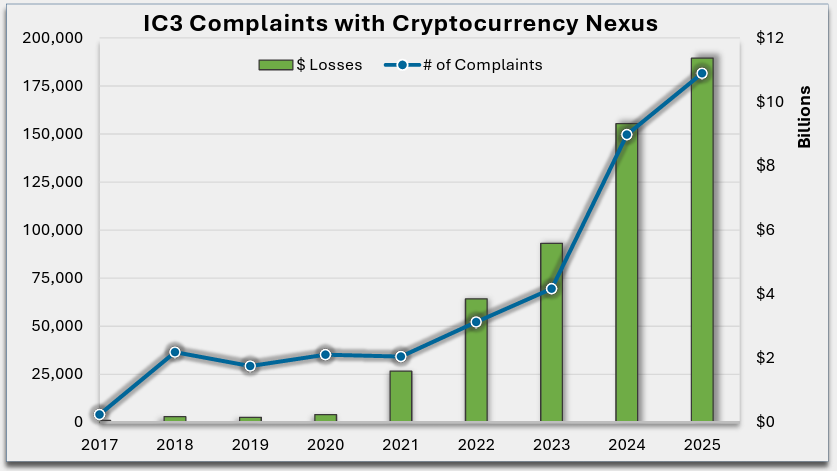
Cryptocurrency fraud is reaching epidemic levels. In 2025, the FBI’s Internet Crime Complaint Center received more than 181,565 complaints concerning cryptocurrency fraud, which resulted in losses estimated at more than $11 billion—more than half of all reported losses from online crime, a 21 percent increase in complaints from 2024, and a 22 percent increase in losses from 2024. Most of those complaints came from people over age 40, with the biggest single group being adults over age 60.
As this unprecedented spate of fraud was occurring, the president’s Working Group on Digital Asset Markets called for the “Federal government to operationalize President Trump’s promise to make America the ‘crypto capital of the world’ and adopt a pro-innovation mindset toward digital assets and blockchain technologies.”
The dichotomy between the administration’s cheerleading and the exponential rate of fraud can only be understood against the background of the president’s own financial interests. These include more than $636 million from his meme coin $Trump (which he made while almost a million everyday investors lost $3.8 billion) and 15.75 billion tokens in World Liberty Financial, Inc. For Trump, the administration’s wholesale retreat from regulating the cryptocurrency industry is not a policy resulting from the disinterested evaluation of the merits: it is a product of his vast interests in the very market he is supposed to be overseeing in the public’s interest. As Professor Richard Painter explained when testifying on the CLARITY Act before the United States Senate Committee on Banking, “Public officials cannot ethically or competently regulate crypto markets while investing heavily in crypto themselves.”
The CLARITY Act advances the same decidedly pro-industry mentality. To pass it would be to ignore the effect of the president’s deep conflicts of interest on the text of the law, while at the same codifying and blessing that conflict. The Senate’s no vote sends the message that Congress will not ratify Presidential self-dealing, and will give the Senate time to go back to the drawing board to work out legislation that starts from the correct first principles.
In 1952, former Illinois Sen. Paul Douglas wrote a short—but important—book called Ethics in Government. Issued after he served as a member of the Fulbright Subcommittee investigating corruption at the Reconstruction Finance Corporation in 1950, Sen. Douglas’s book catalogs the myriad ways in which government officials abuse their power. Among the most obvious: using “their public office as a means of making money in an allied private business in which they are engaged.” As Sen. Douglas concluded, “Certainly the principle is clear. The official should not use his public office to further his private business.”
That is the type of clarity that the American public is seeking.
The Senate’s no vote on the CLARITY Act without proper conflict of interest rules is the first step in the right direction. Now it is time for Congress to step up and complete the task: direct the President to divest his sprawling interests in his family’s cryptocurrency enterprise. That is the only way that the American public can have faith that the regulation of the cryptocurrency industry will be aimed at protecting their pocketbooks and not the President’s.
Virginia Canter is Chief Counsel and Director for Anticorruption and Ethics at Democracy Defenders Fund
Christopher Swartz is Senior Counsel and Deputy Director for Anticorruption and Ethics at Democracy Defenders Fund