


Drop Site is reader-funded. No paywalls. No advertisers. No billionaire owners. Just journalism that answers only to you. If you value this work, please consider making a tax-deductible donation today.
Palm Beach County, Florida, the world’s largest government investor in Israeli government bonds, held nearly a quarter of its investment portfolio in Israeli bonds before $67.5 million of the securities matured on November 1, far exceeding its own investment limits. The county did not reinvest the proceeds because its existing holdings were already above the permitted ceiling, according to its interim comptroller. The repayment reduced the county’s exposure but left 22.5% of its portfolio invested in Israeli government debt, still above the allowed investment cap of 15%.
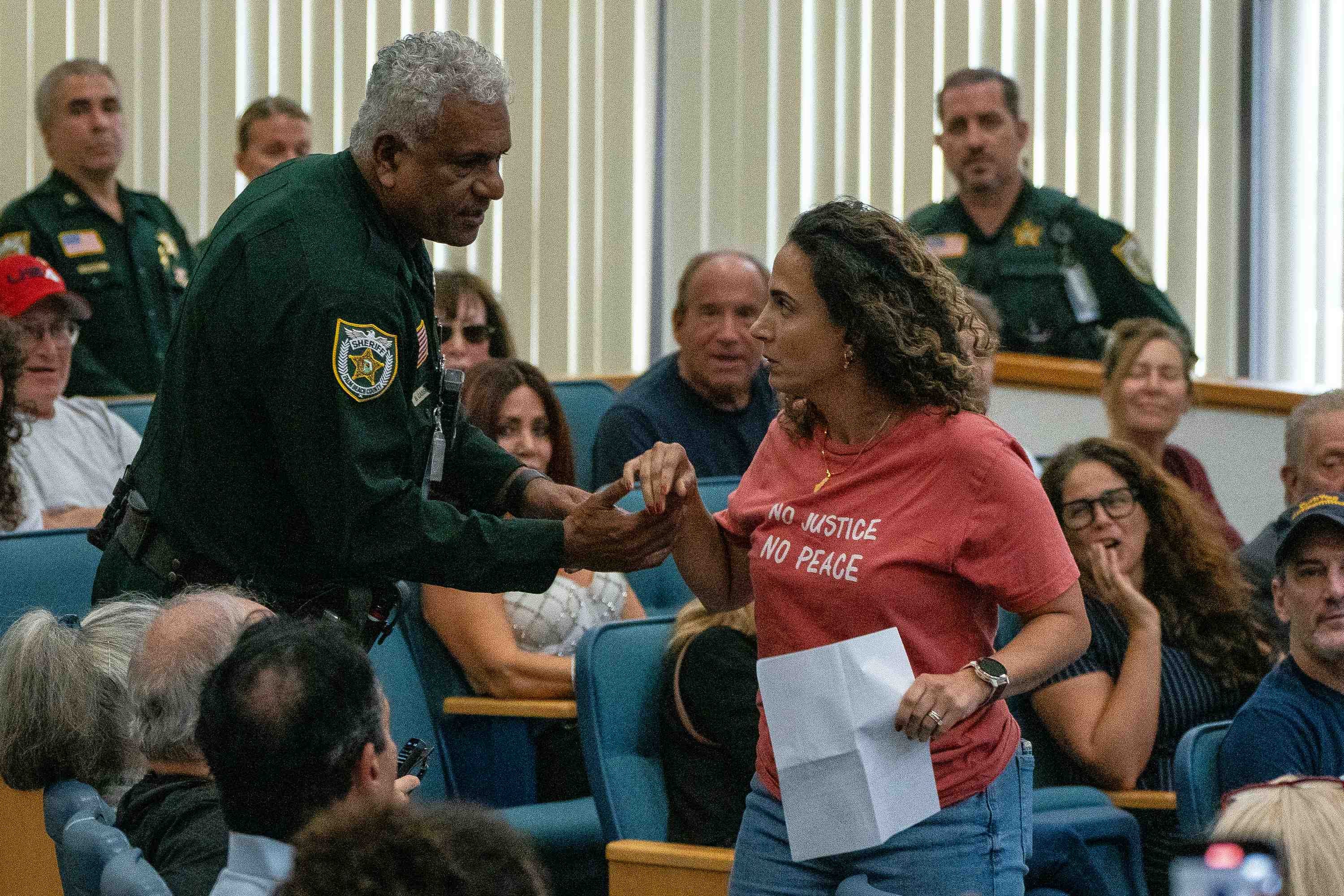
The investments had prompted months of protests by residents, who have also faced arrests and removal from public meetings while attempting to challenge the county’s financial support for Israel.
At a September 15 budget hearing, Palestinian American legal scholar and human rights attorney Noura Erakat was arrested and charged with misdemeanor trespassing after refusing orders to leave the chamber. Sheriff’s deputies also removed other attendees who had sought to speak against the investments. County officials had limited public comment to one minute per speaker and ruled discussion of Israel bonds outside the scope of the budget hearing. Erakat and civil rights organizations condemned the arrest as an infringement on free speech, while county officials maintained that investment policy was not on the hearing’s agenda.
Lydia Ghuman, executive director of the Internationalist Law Center, accused county officials of using vague public-comment rules to suppress opposition to the investments. The rules allow officials to curtail comments for conduct deemed “disruptive” or that “obstructs the meeting progress,” language that officials use to target criticism of Israel bonds, Ghuman said. “They now use this as grounds to ensure you can be taken away by the sheriff and the microphone silenced,” she told Drop Site.
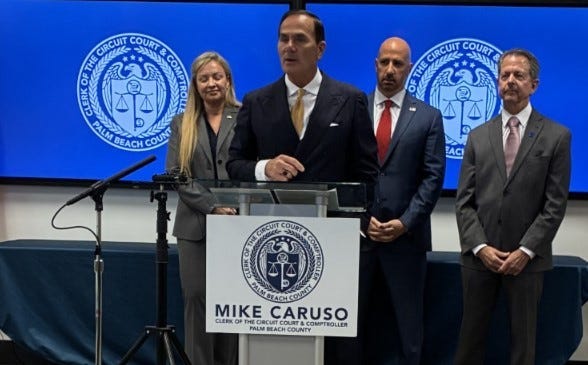
Interim Clerk and Comptroller Shannon Ramsey-Chessman, who assumed the position after the former County Clerk Michael Caruso was suspended following his August arrest on child sexual abuse charges, confirmed in a statement to Drop Site News that Israeli government bonds represented 24.2% of the county’s investment portfolio immediately before November 1, falling to 22.5% after the $67.5 million maturity. Caruso has pleaded not guilty to the child sex abuse charges.
“Because we will continue to be at the policy’s maximum allowable investment percentage after the maturity of $67.5 million in bonds on November 1, we are not permitted to reinvest at this time,” Ramsey-Chessman told Drop Site in an earlier statement. “However, we will review reinvesting once we may do so within the compliance cap.”
The last development in the Palm Beach divestment fight comes amid a growing national campaign to withdraw public money from investments connected to Israel. In Providence, Rhode Island, more than 76% of voters on November 3 approved a ballot measure requiring the city “to divest from countries and companies profiting from genocide, apartheid, ethnic cleansing, and prolonged military occupation.” Organizers describe it as the first binding municipal divestment law approved directly by voters.
In Massachusetts, Cambridge’s city council voted on October 28 to divest $24 million in municipal funds from companies associated with apartheid and genocide, while Easthampton’s council unanimously adopted a divestment resolution on October 22. Somerville is scheduled to consider a binding boycott and divestment ordinance on November 12, following voter approval of a divestment ballot question last year.
More than 30 U.S. cities, counties, and states have taken divestment measures over the past three years, according to the Internationalist Law Center.
“These divestment wins across the country signal that Israel bonds, and genocide, are in fact poor investments that harm taxpayers,” said Ghuman.
The county’s holdings, which reached approximately $1 billion in January, fell to roughly $932.5 million following the repayment, assuming no other changes in principal. But the new figures raise questions about how Palm Beach County came to hold such a large concentration of public funds in Israeli government debt, even as officials repeatedly sought to increase the limits governing those investments.
Ramsey-Chessman defended the county’s investment practices, saying the clerk’s office had always evaluated investments according to three factors: safety, liquidity, and rate of return.
“Our previous investments in Israel Bonds were focused on the significant investment income for county taxpayers, at a time when other investment opportunities were not performing at the same level,” she said.
The county’s repeated efforts to increase the investment ceiling have also raised questions about whether the investments were motivated solely by financial considerations.
The investments expanded under former Clerk and Comptroller Joseph Abruzzo, who publicly described them as reflecting the county’s commitment to Israel.
Ramsey-Chessman attributed the unusually high percentage of Israel bonds in the portfolio to changes in the county’s investment policy and seasonal fluctuations in the amount of money available for investment.
“Keep in mind that when we made our last purchase in March, the allowable cap was 18%, and we invested up to that cap,” Ramsey-Chessman said.
The county receives most of its property tax revenue in late November and December, she explained, leaving its investment portfolio at its lowest point of the year before those payments arrive. As the overall portfolio shrinks, Israel bonds account for a larger percentage of its value, even without additional purchases, according to the interim comptroller.
“Not Really Good Practice”
Tom Sgouros, a municipal finance expert, said seasonal fluctuations in tax revenues are predictable, but the larger concern is the county’s concentration of investments in a single issuer. “It’s not really good practice to hold a quarter of your investment portfolio in one investment, period,” he told Drop Site News. “Diversification does not mean buying different bond issues from the same issuer.”
The county’s investment policy measures the allowable percentage of Israel bonds at the time of purchase. That means a subsequent increase in their share of the portfolio does not necessarily constitute a violation of the purchase restriction. Nevertheless, the figures show that nearly a quarter of the county’s investment portfolio was concentrated in Israeli government debt before the November repayment, a level substantially above the current ceiling intended to limit such exposure.
An investigation by Colby Donovan published last month revealed that Palm Beach County exceeded its own investment limits when purchasing Israel bonds on three occasions since January 2024. On January 6, 2026, the county purchased $350.5 million in Israeli government bonds, bringing its holdings to $1 billion, or 20.04% of its investment portfolio, despite an 18% cap. The investigation, based on county trade records and custodian reports, found that the county exceeded its allowable allocation by approximately $101.7 million. It also found that the county’s automated compliance checks did not monitor Israel bonds as a percentage of the overall portfolio.
In October 2025, the county commission approved a temporary increase in the allowable Israel bonds allocation from 15% to 18%, permitting further purchases before the limit was scheduled to revert to 15%. In February, the county’s Investment Policy Committee considered making the higher ceiling permanent. That proposal failed in a 3-3 vote, although the committee approved a temporary extension of the 18% limit through March 2.
Last month, Palm Beach residents and organizers said they had persuaded two members of the county’s Investment Policy Committee to vote against a proposal to increase the allotment to 20%. Campaign organizers met with Ramsey-Chessman and her staff on October 15 to present their objections to the investments.
But the November non-reinvestment was not a discretionary divestment decision. Ramsey-Chessman said the existing investment cap prohibited the clerk’s office from purchasing additional Israel bonds, regardless of the campaign’s demands. The October 15 committee vote had preserved that restriction by rejecting a proposal to raise the cap from 15% to 20%.
The county is scheduled to receive repayments on four additional occasions: January 2027, February 2027, March 2027, and August 2028. If those payments are also allowed to mature without reinvestment, the county could eventually eliminate its entire portfolio.
The November repayment came just two days before voters elected Democrat Yvette Drucker, a former Boca Raton deputy mayor, as the county’s new clerk and comptroller. Drucker defeated Michael Caruso, the suspended incumbent.
Drucker, who was scheduled to take office November 10, campaigned on maintaining the county’s investments in Israel bonds, but has also said she would evaluate investments based on financial considerations rather than political or ideological tests. She will oversee future investment decisions involving the county’s remaining holdings.
Palm Beach residents, including Palestinian Americans whose family members were killed or displaced in Gaza, challenged the county’s investments in Israel bonds, arguing in a lawsuit that local public money should not finance the Israeli government and that officials were making investment decisions for political rather than financial reasons.
The residents’ legal challenge was dismissed in July, when Palm Beach County Circuit Judge Glenn Kelley ruled that the plaintiffs had not established sufficient grounds to bring a taxpayer lawsuit. Their attorneys appealed in late August.
“Our tax dollars are supposed to be used for the benefit of our own community, and I believe that the Comptroller did not have our community’s best interest in mind when he made these investments,” one of the plaintiffs, identified in court documents as Jane Doe, said in a sworn declaration.