



You may recall there is a Part 1 to this post. If not, you may want to read it now instead.
We are trying to address Pushed Away Production in America. How can we get production back to our shores?
The cost of shooting on an IA (IATSE) film in the US has become prohibitively expensive to the point that if you’re a responsible producer or filmmaker with a set budget, you can either shoot your movie in the US for, say, 20 days, or shoot it in Australia or Hungary or wherever for 40 days.
How do you responsibly make the argument to shoot it in the US and make a worse quality film if you can make it abroad for the same budget with richer resources? Seriously. And shouldn’t our BTL labor and vendors have the choice of working on those films than have no choice at all?
To answer this question we have to confront the elephant in the room and that is the cost of labor.
Consider the following from anonymous producer #2… let’s call them… Thirving Alberg!
How Do We Bring Production Back To America?
So what is the solution? For one thing, the unions should be inviting producers and studios to the table to ask them what can be done. We all have seen Producers United trying to have a conversation with all the various stakeholders (and mostly it goes nowhere unfortunately) on the issues that matter most to producers.
The cost of labor in America (along with our issues that come with it) is even bigger than the fact that only production assistants and producers do not receive health care on most movie shoots. And it’s the unions that have the most to lose right now. You’d think the unions should be the most interested in initiating a conversation and soliciting ideas. Seriously.
Secondly, the unions can work on making it easier for Producers to deal with them on the little stuff that breaks a producer’s back. This alone would be huge. There are significant situations now with audits and the delayed return on deposits. Producers complain about getting what seems like reckless charges and unfair minimums. Producers should not have to think twice before making every decision about locations, crewing, minimums, etc. in the most draconian and extortive manner. They too want to work at home, be it the city, state, or country.
So what can be improved? Minimum crewing. Minimum work periods. An inability to fire someone without a weeks notice. An obligation to hire a music editor, which they say is a rule even though you can’t find it in any contract, but which they require and enforce anyway. It’s this sort of thing.
The IA audits productions sometimes years after the film has been completed — when all the institutional memory on the film has long passed and everyone has moved on to other projects. With everyone (accountant, payroll accountant line producer, UPM) on other projects, the producer has no defense for the decisions made years ago. In addition, all the bank accounts have been closed, all the contingency spent, the financiers have also moved on, so the producer is left liable to pay. This can routinely total tens of thousands of dollars — and the producer is helpless to fight it, and has nowhere to recoup it. What’s the solution? Put a time limit (30 days? 90 days?) when the IA can audit? If they don’t audit in the period, then no money will be due. Make sense to me. Make sense to you?
What else drives the producer folks nuts? The bond deposit is a big cash flow issue. The payroll bond is there to make sure that people are paid, but it is routinely not returned for months after the work is done and the payroll has long been finalized, and… everyone has moved on. Why does this happen? No good reason that I know of. It creates a cash flow issue with finishing the film, because payroll bonds are not supposed to be budgeted items — they’re supposed to be returned. And who ends up or deferring their fees so the film can be finished? The producer, of course. Sometimes you have to wonder, how we all keep from going under.
Need more? The residual bond is another issue. Guess why. The guilds hold onto their bonds indefinitely, even when it’s clear that the film is no longer generating revenue. The guilds demand bonds even when they’re in first position to get money in the CAMA. Why? Because they can — they’re can delay the start of production unless they get their way. Even when the guilds say that they will return the bonds, they issue an email saying that it may take them 6 months to write the check. Can you imagine if a producer said to the union that they may take 6 months to write the union the deposit check? That’s not going to happen, but I was raised to believe what was good for the goose, must be good for the gander.
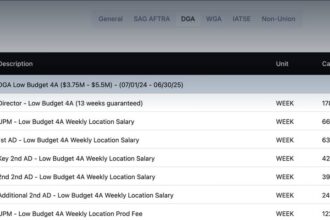
How’s this one for improving things here at home? Our Unions can adjust the tiers to compete with foreign productions. Sure, they’ll never match those overseas, but they can make the decisions to move abroad less financially undeniable. The tier system was designed to regulate rates at different budget levels and give a variety of opportunity types to membership. But it has become system of rates that are incompatible with the budget levels to which they are currently assigned.
The unions will likely look at a proposal to adjust the tiers as trying to pay their members less — however, that only works from the premise that these movies would ever be shot in the US. What it would in fact do, is bring more movies —which currently don’t exist as employment opportunities for IA members — and bring them back to production locales in the US. It would create an ecosystem of sustainability and choice in locations that are increasingly hollowed out, and would allow people to return to work.
Producer friends of mine made a low budget movie in LA last year in tier 1A which was crewed by folks who are used to working on scale projects. They worked on this tiny movie because it was the only movie shooting. At the same time, there were probably dozens of tier 2 and tier 3 movies that would have liked to shoot in LA, but had to shoot abroad to make things work So, these crew members worked for even LESS on this tiny movie. Who’s the winner there? We could have had multiple productions here and everyone would have won.
If the tier levels increased, then it doesn’t mean that any crew member is obligated to work on any film — but it would give them the choice that they currently don’t have. A tier system that drives out production is no help to anyone. Why would the union willingly deprive their members of the chance to work on mid-level films for rates that they would be happier to take, rather than finding another job doing something else?
These three issues- audit timelines – both for bond return and additional audits post delivery; contract clarity and transparency; reevaluation of tier levels to make filming in US more competitive would all go a long, long way to keeping the American Film Industry strong. The idea is for all stakeholders to be proactive and not fall into the usual trap of too little too late.
For the IA member, it’s not a question of slashing costs — the budgets are what the budgets are. It’s a question of whether a movie will exist as an opportunity for them at all. For the “Above The Line” talent, it’s an inconvenience to shoot abroad, but for the crew members, it’s a total loss of employment.
For a movie to shoot in the US now, it has to have a super compelling reason —like it takes place in a location that can’t be reproduced elsewhere, or the budget doesn’t matter. But that is the rarity, and the bulk of movies now are moving abroad, even when it has to take on the cost of replicating US locations.
We all know that it’s practically impossible to roll back entitlements — health, pension, and welfare. We don’t expect unions to lower their fringes or their worker protections, nor really should they ever be asked to. But the unions have the most to lose with this current situation, and from the talk I hear, they seem the least interested in addressing it — which is a grave disservice to their rank and file membership.
This article — like Part One before it — had to be sourced anonymously as producers do not want to be penalized for speaking the truth. For the good of our industry we need to bring people together and have a serious conversation. No calvary or savior is coming to the rescue here. We have to look the hard situation in the eye and recognize we can solve it. It starts with sitting at the table and finding our common ground.