

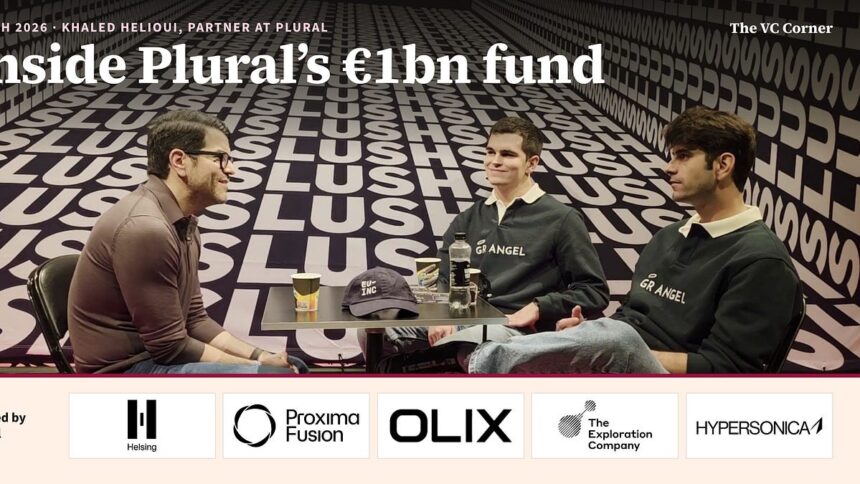
Plural just closed €1bn for its third fund, four times the size of its first, about four years after a group of European founders started the firm to back companies like Helsing, Proxima Fusion, OLIX and Hypersonica. The close, announced on November 16, landed days after Sequoia shut its London office.
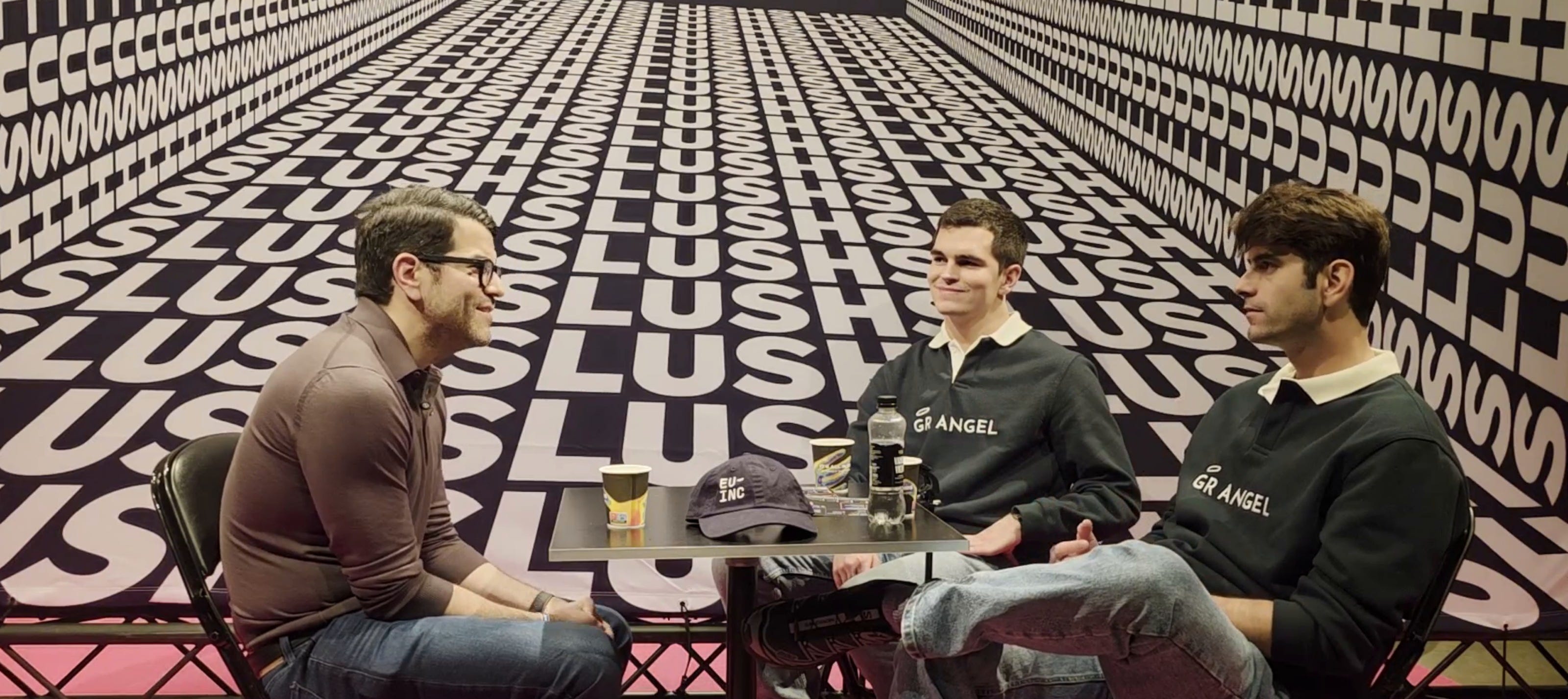
Guillermo Flor and I sat down with Khaled Helioui, one of Plural’s six partners, at Slush in Helsinki this week. Khaled put what was left in his bank account into Uber after meeting Travis Kalanick in 2011, and later ran the turnaround at Bigpoint as CEO. He was also in Helsing’s seed round, years before its $18bn valuation.
His bar for a new company fits in one line: “If we don’t see 100X plus, we’re not investing.” Startups with great momentum still get a pass when the biggest outcome he can project tops out at $30bn to $40bn, which most venture investors would happily take.
The number that surprised me most came at the end of the conversation, when Khaled walked us through how a €1bn fund still means each partner signs only 2 to 3 new companies a year.
We cut the interview into 9 clips. Each one sits below with the context you need and links to the VC Corner and AI Corner resources that go deeper on the same topic.
What Plural is
Plural is a London-headquartered venture firm with offices in Tallinn and Paris. It launched in June 2022, a few months after Russia’s full-scale invasion of Ukraine, and its homepage states the mission plainly: GDP-level impact on Europe through the companies it backs.
Six partners run it, and every one of them built or ran a company first:
-
Taavet Hinrikus, co-founder of Wise and Skype’s first employee
-
Sten Tamkivi, co-founder of Teleport
-
Ian Hogarth, co-founder of Songkick
-
Khaled Helioui, former CEO of Bigpoint
-
Carina Namih, co-founder of HelixNano
-
Pierre-Dimitri Gore-Coty, the former Uber executive who joined as a full-time partner in October 2025
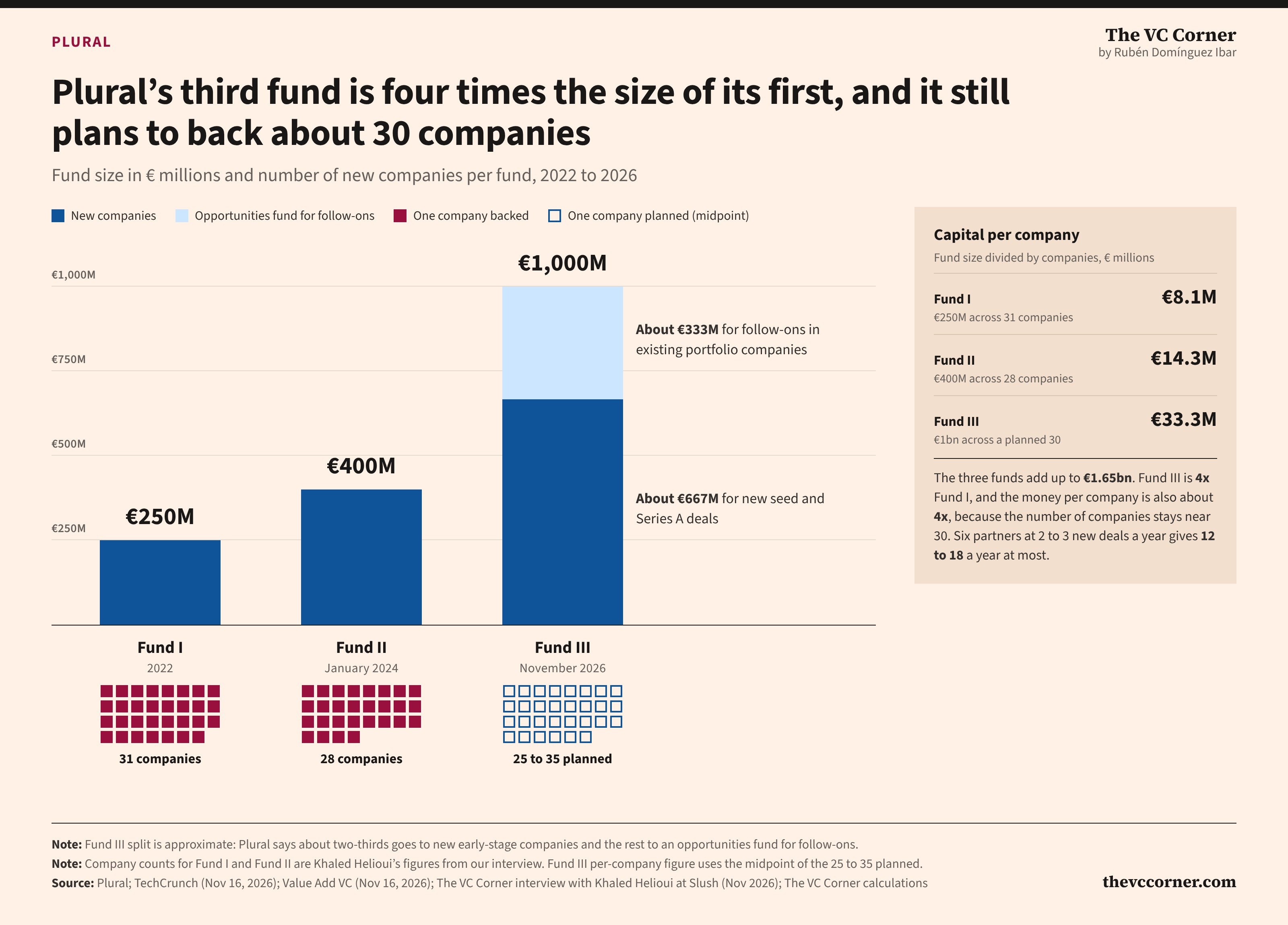
The funds grew fast. Fund I raised €250M in 2022, Fund II raised €400M in January 2024, and Fund III now brings €1bn, for €1.65bn across the three. About two-thirds of the new fund goes to seed and Series A companies, and the rest sits in an opportunities fund for follow-on rounds in existing companies. Plural says Fund II backers committed more than 125% of their earlier money to Fund III, with endowments and foundations above 30% of the capital.
Fund III targets energy, AI infrastructure, defence and health. In the announcement, Khaled said the firm believes these founders can build Europe’s first trillion-dollar company. That ambition shapes every answer in the clips below.
To see who writes checks into funds like this one, start with our Family Office Database and the list of 260+ institutional LPs that back VC funds.
Plural’s biggest bets
Five Plural companies raised about $3.1bn between July and November 2026, and Plural put money into every one of those rounds:
-
Helsing (defence AI): a $1.8bn Series E at an $18bn valuation in July. Khaled backed its seed round with two Plural partners.
-
Proxima Fusion (stellarator fusion power plants): €411M at a €2.4bn valuation in July, with Google and RWE as strategic investors. Plural first backed CEO Francesco Sciortino at pre-seed in 2023.
-
The Exploration Company (reusable spacecraft): a $450M Series C in September, the largest Series C ever raised by a European space company. CEO Hélène Huby is building a reusable capsule called Nyx.
-
OLIX (AI inference hardware): a $312M Series B at a $3.3bn valuation in August, with Reed Hastings in the round.
-
Hypersonica (hypersonic missiles): a €100M Series B in November, co-led by Lightspeed and General Catalyst, after its HS-1 prototype passed Mach 6 over more than 300 km in February.
The wider portfolio adds Isometric in carbon removal, Monumental in construction robots, Ore Energy in long-duration batteries and Oriole Networks in AI data-center networking. If OLIX is the bet you want to understand, our inference engineering playbook explains where inference costs go, and the Cerebras Series A deck teardown shows how a chip company pitched before its IPO.
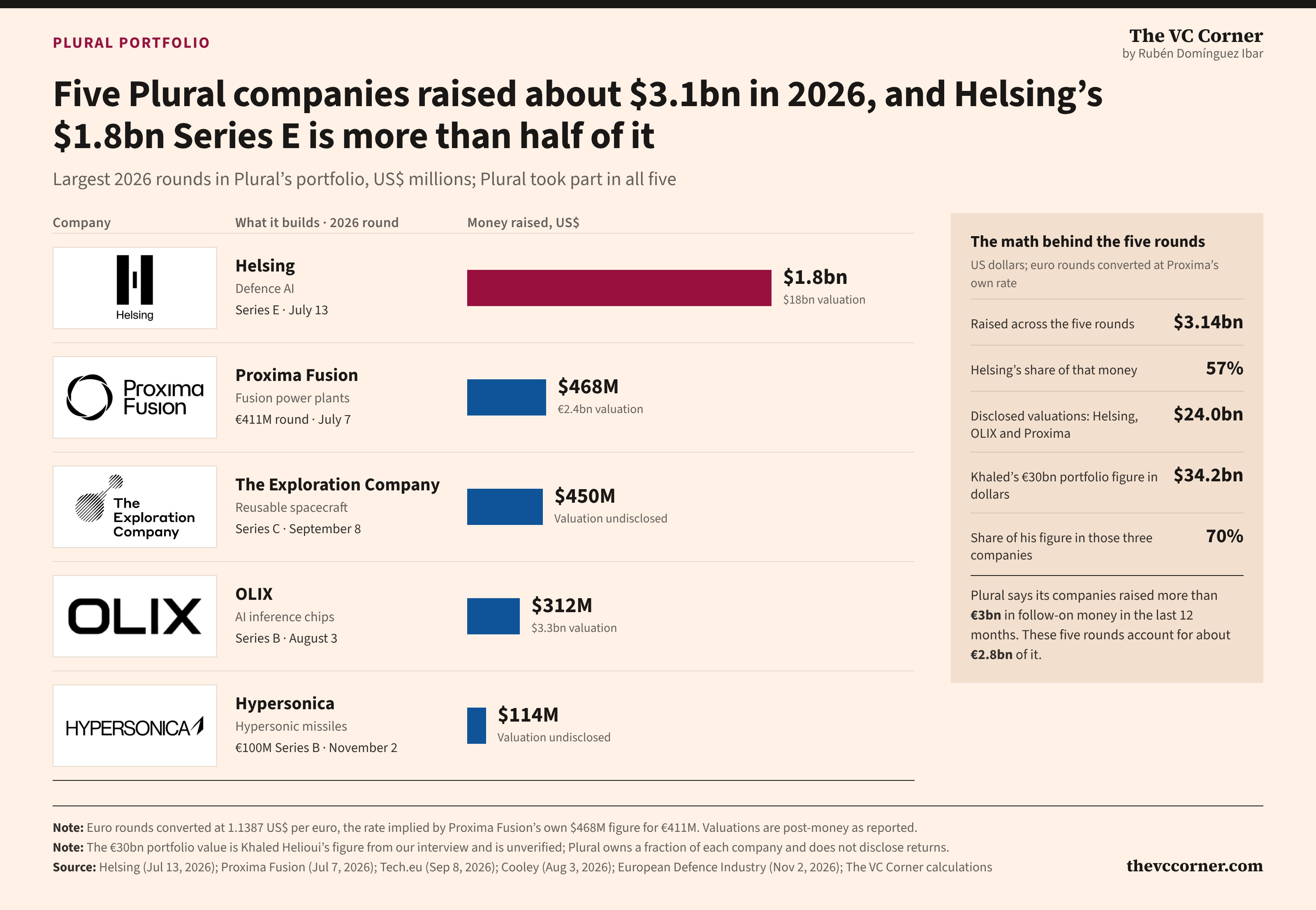
I would read one number with care. Khaled puts the combined value of Plural’s companies at about €30bn. Helsing alone is about €15.8bn of that at its July price, and Helsing, OLIX and Proxima together account for roughly 70%. Those are last-round valuations, Plural owns a slice of each company, and the firm keeps its returns private, so the €30bn tells you Plural holds a few very large winners on paper while the cash for its LPs arrives later, at exits.
Who Khaled Helioui is
Khaled joined the German games company Bigpoint in 2012 as Chief Games Officer, running a department of about 450 people, and became CEO within months as browser games lost ground to social and mobile. He restarted it with new leadership and a new board, and the four-year turnaround ended with a sale to Youzu.
He has backed founders for about a decade. Before Plural he invested as an angel alongside Taavet Hinrikus, Sten Tamkivi and Ian Hogarth, and at Plural he led the firm’s investments in Helsing, The Exploration Company and Isometric, plus a check into Augur. His Slush speaker page says he invests only when he has a direct relationship with the founding team, and his Plural profile names governance as the lesson that mattered most from running a company.
What he told us, in 9 clips
1. Three Red Bulls and an early Uber check (London, 2011)
Khaled arrived at a charity: water event in London in October 2011 after a night without sleep and ordered three Red Bulls at 8pm. The man next to him asked who orders three Red Bulls at a charity event. It was Travis Kalanick, and by the end of the conversation Travis was asking him to quit his job and help run Uber in Europe.
Khaled turned the job down and spent the weekend walking around London with Travis anyway. What stayed with him was how Travis thought: second, third and fourth degree effects, the whole model worked out in advance, and zero doubt that Uber would win. Then he met the team preparing the London and Paris launches, and every person blew him away.
I put literally whatever I had in my bank account, which was not much, but whatever I had left, I invested in the company.
He told us that bet taught him what to look for in founders.
2. The cap table gap that started Plural
Khaled’s numbers on the problem: about 60% of US VC partners have built a company, against 8% in Europe. Silicon Valley grew out of chipmakers whose winners became investors, and Europe skipped that cycle.
As angels, Khaled, Taavet Hinrikus, Sten Tamkivi and Ian Hogarth kept backing ambitious founders whose other investors had never built anything. Khaled described the founders they met this way: “there’s a huge gap between your ambition and your level of risk appetite and your investors.” With 0.1% to 0.5% of a cap table, an angel has almost no say when that gap starts to hurt, and the frustration became Plural.
The group also felt that if Europe kept riding the same wave it would grow obsolete, with the damage reaching prosperity, the democratic model, sovereignty and security. The angels ended up starting a fund none of them had planned to start. If you are about to raise, run your round through our SAFE conversion calculator before you pick who sits on your cap table.
3. The €300bn target and the 100X rule
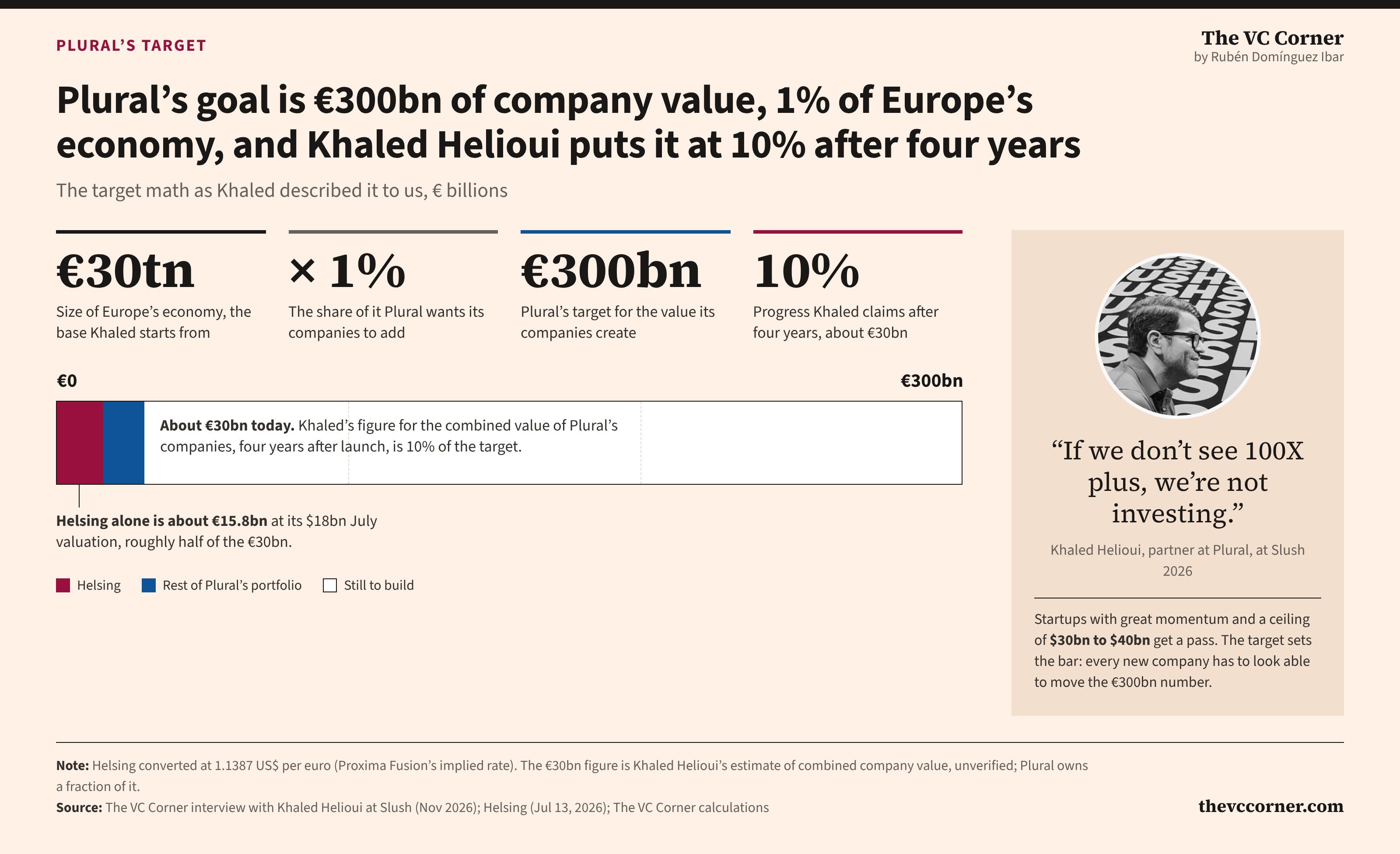
The math starts with Europe’s economy, which Khaled puts at €30tn. Plural wants its companies to move it by 1%, which is €300bn of value, and he calls that target the guiding rule that everything at the fund derives from. Four years in, he puts the portfolio at about €30bn, or 10% of the way.
If we don’t see 100X plus, we’re not investing.
The target sets the bar for every check. Plural regularly meets startups with amazing momentum that Khaled can only project to a $30bn or $40bn outcome, and it passes on them. Plenty of funds are happy with a 30X or 40X on those deals, he says, and Plural leaves them to it.
Pitching a company with that kind of ceiling? The 16 unicorn pitch decks before the billions and the Venture Capital Method show how investors back into a 100X.
4. How he spots a founder who can get there
Every founder tells Khaled they are ambitious, so he checks three things: the market, the track record and the learning curve. The market comes first, and Plural looks at energy, defence, space, AI infrastructure and manufacturing.
The track record and the learning curve show up in specific people. He pointed to Francesco Sciortino at Proxima Fusion, whose growth over three years surprised him when he watched Francesco speak on European sovereignty at a Munich Security Conference event. At Hypersonica, Khaled says, Philipp Kerth and Marc Ewenz went from first concept to a launch in nine months.
These are people that are very opinionated, they’re very aggressive. They always like have a form of urgency that is like they hate wasting time.
He wants people who spike in ways that feel borderline uncomfortable, and he says other investors have started calling that profile “a Plural founder.” Our breakdown of what top VCs check in due diligence shows how other firms run the same test.
5. Three IPOs worth as much as 60 years of tech IPOs
Khaled expects three IPOs this year, one in space and two in AI research, to be worth as much as the last 60 years of US tech IPOs combined. All three took long cycles, heavy technology risk and huge amounts of capital, and his point is blunt: a fund that was early in none of them is irrelevant.
“Where is alpha coming from right now?” he asked. His answer is AI, a shift in hardware development and geopolitical instability, which together overhauled the software playbook of the last bull market. Funds that want to return 20X have to take that kind of risk.
For the space side of that story, read our breakdown of SpaceX’s IPO documents and day-one results. For the AI labs, OpenAI’s 2018 AGI roadmap and the deck Anthropic used to raise $580M with no product are on The AI Corner.
6. Skin in the game and soul in the game
You only learn what drives a founder when an acquisition offer lands, Khaled says, so Plural spends a lot of time on each founder’s life story before investing. The question he wants answered is whether they are fundamentally convinced and cannot help doing it, or stumbled into an opportunity.
Helsing is his example. When he invested, he knew the founders would have thrown a $100M offer back at whoever made it, because they cared about one thing: European defence and protecting democracies.
There’s a skin in the game, there’s also the soul in the game.
Several Plural founders have already turned down offers worth hundreds of millions to stay on the mission. For a fund that needs 100X, an early sale is a failed bet.
7. Delaware, fragmentation and other red herrings
We asked Khaled how Europe becomes a better place to build. The usual list came with the question: a fragmented market, different laws in every country, and founders incorporating in Delaware to escape European regulation.
I think, honestly, in all candor, all of these are red herring. Even if these are blockers that prevent you from building a company, frankly, you’re not going to make it.
His test is short. Did any of it stop Wise, Skype or Spotify? If you are weighing a US move anyway, our Europe to America expansion playbook and the list of Europe’s exited founders are the two places to start.
8. Build where the feedback is fastest
Khaled is fine with a company starting in the US when that fits. He rejects the idea that the US always makes more sense, which he calls a self-fulfilling prophecy, and his advice is to go and build wherever it makes sense for that specific company.
Defence is where he sees Europe ahead. Europe has a hot war on its doorstep, and for many US defence companies, he says, Ukraine is a market they cover. “Our truth is coming from the field and we iterate from the feedback we get,” he said of the European teams.
For the investment side of hardware and robotics, The AI Corner’s physical AI investment OS maps where the money is going.
9. €1bn, and still 2 to 3 new deals per partner
We opened this one with the obvious question: what changes now that Plural has €1bn? Khaled’s answer: the strategy stays exactly the same. Fund III will back 25 to 30 companies, maybe 32 or 33, against 31 in Fund I and 28 in Fund II, and it should be deployed in two to three years.
The one thing that doesn’t scale is the time we can spend and the focus that we have.
Each partner makes 2 to 3 new investments a year on average, because Plural commits more than capital and takes its word seriously. The bigger fund pays for a recruiting team that has placed more than 40 people in portfolio companies, C-level hires included, and the rest of the fees go to communications and research. To model what that does to a fund’s returns, use our VC fund economics waterfall model and the fund math most people get wrong.
What I’m taking from Slush
Guillermo and I run GR Angel together, and Slush is where we do these interviews every year. This one was about a fund that got four times bigger and kept the same number of seats at the table.
Plural is making a concentrated bet on about 30 founders per fund who would rather turn down $100M than sell early, in sectors where one company can be worth more than a whole software vintage. Helsing at $18bn shows the bet can work, and the next three years of Fund III will show whether it repeats.
Find the investors
-
80 Seed AI Funds That Invested in the Last 180 Days: The Scored Sheet and the Syndicate Map
-
973 VC Funds Under $200M, Cleaned and Scored: The Fresh Fund Sheet and the Fit Finder Prompt
-
The 100 best-performing VC firms, ranked
Decks and memos from companies that went big
-
SpaceX: how to Build and Pitch the most ambitious company of our time
-
Peter Thiel’s only fundraising document
-
Monzo Just Posted £1.7B in Revenue. Here Is the Pitch Deck That Started It All
-
The Fund That Backed Revolut at £300K. Now Raising $320M for What Comes Next
For investors doing the work
-
Everything You Knew About VC Fund Math Is Wrong