

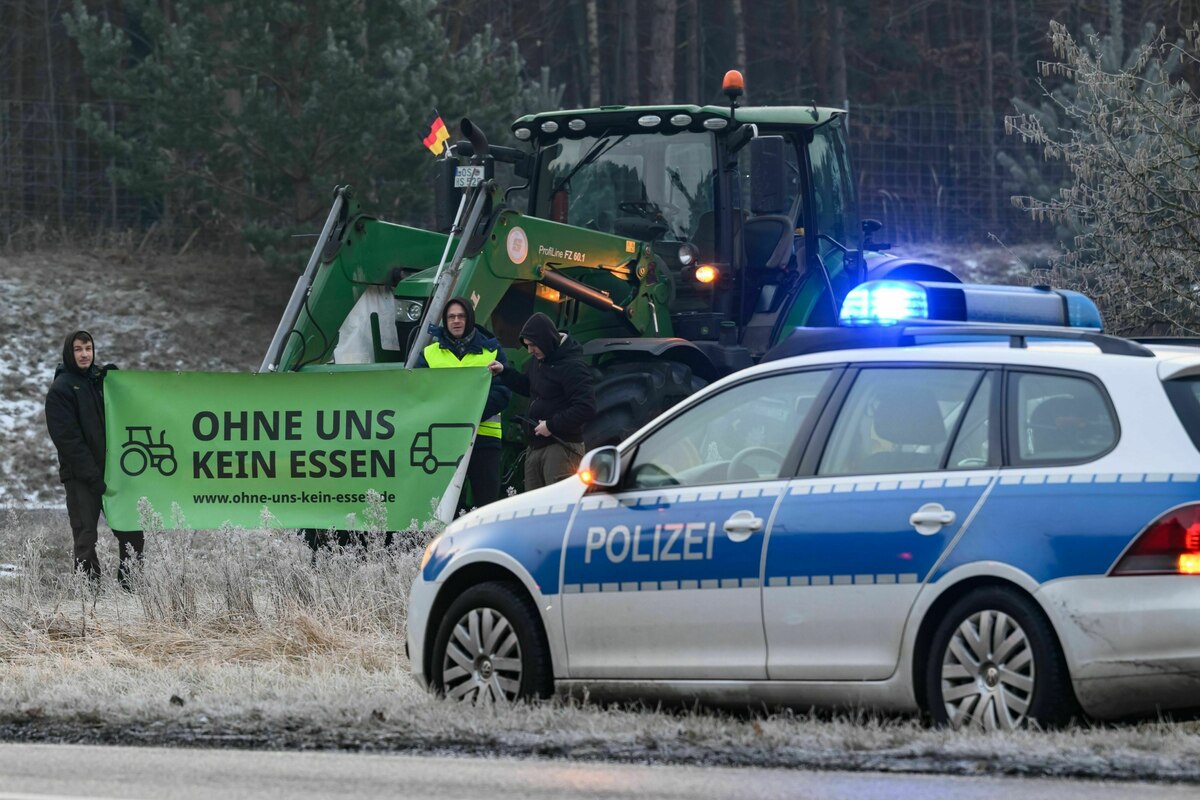
The police in Brandenburg have again on Friday Blockades of highway entrances by farmers approved with tractors. “There were registrations for meetings,” said Lea Enzenroß, spokeswoman for the Brandenburg police headquarters, to the taz. She doesn’t know anything about any bans. The same thing happened with similar actions two weeks ago. “At that time there was a requirement that only motorway entrances were blocked.” If departures had also been scheduled, there would have been a “risk of traffic accidents in the event of a backlog”. Demonstrations in Brandenburg must be registered with the police.
In contrast, the police took more rigorous action during the road blockades organized by the climate group Last Generation from 2021 to 2024 in Germany. “We kept registering individual actions. And we found that in the vast majority of cases they were simply not approved, especially not on the streets,” said Marius Schneider, press spokesman for the “Resistance Collective”, one of the two successor organizations of the Last Generation. According to his own information, he has been active at Last Generation since 2022.
“Unfortunately, in many cases the police were also violent towards the protesters,” said Schneider. For example, “pain grips” were used that Berlin-Brandenburg Higher Administrative Court just declared it disproportionate.
Schneider criticized the police for applying double standards when it comes to blockades by farmers and climate activists. “We encountered a completely different atmosphere with comparable campaigns.” This discrepancy is all the more noticeable because, unlike the farmers, the “climate gluers” were able to justify their choice of demonstration location on the streets in terms of content. Car traffic is one of the sectors that emit the most carbon dioxide, said Schneider.
Actions against agricultural policy
The farmers’ blockades, on the other hand, are primarily directed against agricultural policy and the EU trade agreement with four countries in the South American Mercosur group. What this concern has to do with highway entrances remains unclear. A statement from the organizers of the blockades on January 8 left this question open. This also applies to a video by the spokesmen of the actions on Friday.
In Mecklenburg-Western Pomerania, the authorities prevented blockades by farmers at the beginning of January. A district office, for example, banned a planned action on the A 11, which is what that was Greifswald Administrative Court confirmed. “Gatherings on federal highways” are “basically only possible under strict conditions because of the considerable dangers associated with them,” the court explained. “In the present case,” the applicant “did not present a sufficient factual relevance of the meeting topic to the meeting location.”
The risk of accidents during highway blockades is real: there was one on January 10, 2024 Truck driver killedafter he drove his truck into the end of a traffic jam on the A 66 near Fulda that had formed because of a farmers’ protest on the highway.
Only a few participants
When asked about the behavior of the authorities in Mecklenburg-Western Pomerania, Brandenburg police spokeswoman Enzenroß replied: “I cannot comment on other federal states.” Why were blockades by climate activists banned and those by farmers not? “You can’t say that in general. Every single application is checked. This is always a case-by-case decision,” said the spokeswoman.
took part in the actions in Brandenburg only a few people. Because only smaller groups called for the blockades, not the dominant Brandenburg state farmers’ association. The Brandenburg Farmers’ Association, which describes itself as the state group of “Free Farmers”, and “Land creates a connection between Mecklenburg-Western Pomerania” were involved in the actions on January 8th.
On Friday, farmers Thomas Essig and Mario Ortlieb, who belong to the farmers’ association, called. In one Youtube-Video of the two, Essig said it wasn’t just about the farmers, but generally about the “political situation”, for example about taxes “on these criminals that we have right now, who are throwing money out of the window for things that should actually benefit us”. Immediately afterwards, Essig added that peace flags were also welcome at the demonstrations.