

No one should have to be ashamed of the injustice that was done to them. Those who, as Stasi officers and party cadres, as guards in prisons, as educators in youth centers, as teachers, judges and people’s police officers or as nurses and doctors, were guilty of crimes against women who had done nothing except want to live a self-determined life should be ashamed.
Societies tend to blame the victims of their violence because their suffering reminds them of their opportunistic turning a blind eye and participating. Those who were once terrorized should suffer in silence, not cause trouble and not disrupt the course of events. Instead, money is being made today with Ostalgie and votes are being collected in politics through kitschification of the GDR.
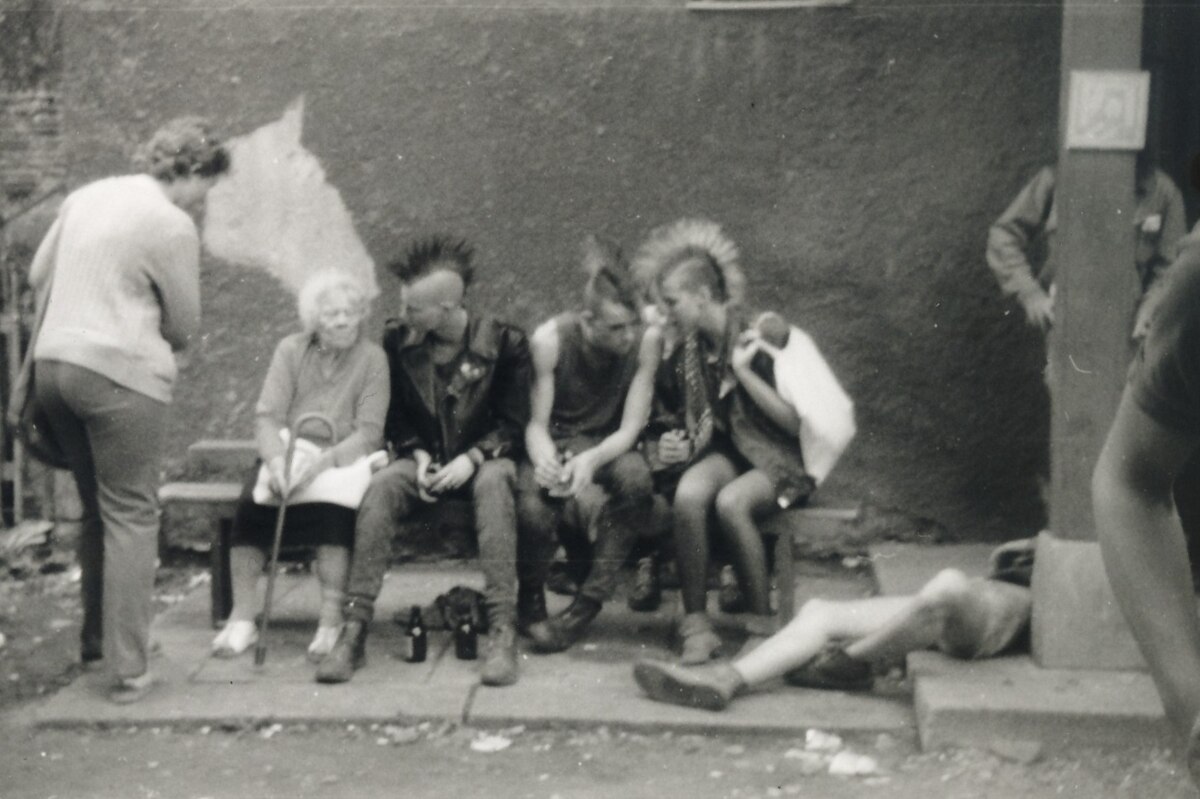
There is no other way to explain why many of her circle of friends at the time don’t know about their time as punks in the GDR want to talk, as Kim from Karl-Marx-Stadt tells in Geralf Pochop’s book “Dance on the Volcano”, which is dedicated to the biographies, experiences and reflections of “resistant punk women in the GDR”. There are significantly more women than men who are ashamed of their GDR punk days, says Kim. “They are ashamed of the way they were or the way they lived. Many people don’t want to talk about it. They also don’t want photos to be circulated, even though it was great back then.”
The 23 women who talk in this book about their family circumstances, about their childhood and youth, about their punk days and the associated repression do not know this shame or have overcome it. In any case, no one saw themselves as a victim back then, writes Geralf Pochop, once a punk and squatter himself, in his foreword. Jana Schloßer, singer of the band Nameless, confirms this: “I knew for sure: we would be treated like criminals, but actually it is a crime to treat us like that.”
“Intelligence is on our side!”
The extent of state violence that punk women were physically and psychologically exposed to in the “anti-fascist” “peace state” of the GDR is still difficult to bear when reading their stories. In the end you are impressed and grateful for the radical openness with which the women talk about their own injuries and their resistance.

According to the Stasi, Kim was the “inspirer” of the Karl-Marx-Stadt punks
Photo:
Kim private archive, BStU
Because they open up, we learn, on the one hand, how inhumane this regime acted against people whom it branded as “negative-decadent” or even “fascist”, and on the other hand, how the punks, with their solidarity, rebelliousness and resilience, contributed significantly to consigning this system to the dustbin of history. Conny Mareth from Leipzig reports: “That was also fun, that they had so much power and yet there were these moments in which we had the scepter in our hands. For a brief moment. The laughter on our side! The intelligence on our side!”
Like everywhere, young people in the GDR became punks because they understood instinctively or through observation of those around them that there was something fundamentally wrong with the world. They came from sheltered parents, some of whom supported them, and from dysfunctional families who were easy victims of the Stasi’s machinations and betrayed their own children.
Discriminated against, isolated and “degraded”
The first generation of punks felt the consequences of Minister of State Security Erich Mielke’s order to the state authorities in 1983 to show “toughness against punks” on your own body. But the younger ones also had the experience of being harassed by the People’s Police and Transport Police, sent to educational institutions by the authorities, monitored by the Stasi and forced into lousy, sometimes health-damaging jobs or sentenced to prison sentences using various rubber-stamp clauses. In state institutions they were disciplined, mistreated and sometimes tortured. Discriminated against, isolated and “decomposed” in their social environment, as the Stasi used terror slang.
Anyone who was interrogated by the police and Stasi never knew what consequences that would have. “I was often afraid that I would end up in prison or in a youth center. I was also afraid that my life might not turn out the way I had imagined. I realized then that if you are different, don’t conform and have your own opinion that doesn’t fit into the socialist worldview, you can expect a very difficult life in the GDR,” says Silke “Nina” Schrödter from Weimar. Kim from Karl-Marx-Stadt, who was considered an “inspirer” of the punk scene by the Stasi there, had written on her leather jacket: “Only those who move can hear their chains rattling.”
The trembling of fear from Stalin to Honecker
Most girls who become punks are initially apolitical, but are quickly politicized by the repression. So were the SED and Stasi officials simply stupid by unnecessarily creating enemies whose spirit of resistance they further fueled through their violent measures? Or did they rather understand very well that punk could be dangerous for them?

Conny Steiner in 1987, shortly after her release from prison. A fellow prisoner had previously cut her hair with nail scissors
Photo:
Conny Steiner
Jana Schloßer suggests this: The “trembling fear of loss of power” ran through the entire era of the dictatorship of the proletariat, “from Stalin to Honecker”. When “a rigid system like a dictatorship begins to crumble, it can’t do any harm if opposition not only bubbles underground, but also becomes visible on the surface. And that’s what we were: unmistakable, shrill and often unmistakable.”
Conny from Leipzig worked in the Leipzig commission and wholesale book trading company. Politburo secretaries called from time to time to order George Orwell’s “1984” and “Animal Farm.” Did Willi Stoph want to use this reading to find out about the conditions in the country or to find out why no one in the GDR was allowed to read these books?
What are people supposed to think?
Almost all of the women report that they were constantly told on the street that they would have been gassed in the past. But they also remind us that many normal people admired the punks for not conforming. They showed that things could be different in a society in which everyone was afraid of “what people will think”. Schloßer points out that the punks were well networked with other forces critical of the system: “We had contacts with the environmental and peace movement, with the church anyway, and with artists who couldn’t or didn’t want to adapt to the norm in their creative work.”

This text comes from the weekday. Our weekly newspaper from the left! Every week, wochentaz is about the world as it is – and as it could be. A left-wing weekly newspaper with a voice, attitude and the special taz view of the world. New every Saturday at the kiosk and of course by subscription.
The role of the church and its “open work” is repeatedly acknowledged in women’s contributions. Many concerts and the few punk festivals in the GDR took place in the protected space of churches.
The collective amnesia began in 1989
The Leipzig punk women talk about what it felt like when the mass demonstrations began there. Conny was already in the West, saw “these thousands walking around the ring” on television and wondered where the demonstrators had been the months before. “All these piss-balls were running along. Now that it was almost certain. Less than four weeks before, they would have reported some of them to the Stasi.”
Your colleague Connie Mareth: “Everything changed when the calls for Germany, the calls for reunification and the racist slogans became louder and louder. One Monday we decided not to run anymore.” Instead, the punks are now going in the opposite direction – and now have to hear from good Leipzigers that they are “Wandlitz children” who the Stasi have probably forgotten. The collective amnesia of GDR citizens about their own involvement in maintaining the system began as early as autumn 1989.
Nazis again in East Berlin
As punks, women were terrorized just as much as men. As women, they report sexual assaults, which, according to their reports, were rare in the scene, but common at the hands of “normal” men and the state authorities.
The craziest chapter of this book is the last one. In it, Liane Pförtner, daughter of a GDR punk woman, deals with the closed venereology ward at the Mitte Polyclinic in Halle (Saale), one of several facilities in the GDR popularly known as “gonorrhea castles,” which served to “re-educate” women who were classified as dangerous to public health.

Geralf Comprehension: “Dance on the Volcano. Resistant Punk Women in the GDR”. Hirnkost, Berlin 2025, 392 pages, 32 euros
The terror system prevailing there cannot be described as anything other than fascist, both in terms of its orientation and its torture practices. In 1983, Nameless sang: “Nazis back in East Berlin.” This could mean the neo-Nazi activities in the capital of the GDR – but also the regime as such.