

On a frosty January evening, 40-year-old Alla Kostenko comes home from work. Freezing rain in Kyiv had turned streets and sidewalks into slides. There was no electricity in her district that evening. The houses were in darkness and there were no street lights. Only a glimmer of light came from the window of a grocery store, a generator was running there.
And just then Alla hears a young woman’s voice in the darkness: “Grandma, are you lost?” Alla actually wants to go home quickly. But she realizes that she can’t just move on now. So she moves closer to the direction the voice is coming from. A young woman with a dog tries to look after an old woman. She is not wearing a jacket, but is wearing slippers, and appears very disoriented.
Alla calls the police. The man in the radio control center asks them to stay on site until the patrol car arrives. Meanwhile, Alla and the girl ask the old lady simple questions. What her name is, where she lives, where she is going. The woman had difficulty remembering her name and year of birth, but she no longer knows her address. When she realizes that she no longer knows the answer to even the simplest questions, she becomes afraid.
The girl doesn’t have a phone with her, she just wanted to take her Jack Russell terrier for a walk and wasn’t dressed warmly enough herself. Nevertheless, she now massages the old lady’s hands and shoulders against the cold. Then the police come and take the old woman to the station to locate her relatives.

The large-scale Russian war of aggression against Ukraine began with the invasion on February 24, 2022. The annexation of Crimea took place in March 2014, and shortly afterwards the conflict broke out in the eastern Ukrainian regions.
We don’t know how this story ended. But was the woman hypothermic? And did the stress of war, blackouts and fear on the dark street unnoticed worsen her dementia? Most likely the answer to both of these questions is, “Yes.” As was the question of whether Russia was to blame. Albeit indirectly, but clearly: “Yes.”
Icy genocide
In January 2026, a strong Siberian anticyclone reached Ukraine from the northeast. Dry arctic air and high air pressure blocked the warm Atlantic air masses. The temperature fell to minus 20 degrees, in some places even to minus 25 degrees. In another reality, this could have been an almost fairytale winter with bright sunshine, crunchy snow and a frost that until recently was normal in winter in these latitudes.
But nearly four years of all-out war have changed the perception of cold. Russia has used the frost as a means of pressure. When temperatures are low, attacks on energy infrastructure are particularly destructive. As a result, Ukraine is facing an unprecedented humanitarian crisis. In the middle of winter, people are left without electricity, heating and water. This is particularly bad in the areas close to the front and in the capital Kyiv.
The price of heat
Dry news reports about “Kyiv sinking into darkness” fail to reflect what is really happening in the city. In everyday life it quickly becomes a struggle for basic things such as warmth, water, communication and normal everyday life.
In mid-January, three people died of carbon monoxide poisoning because a generator was running in their apartment. Against the background of ongoing power cuts and cold weather, Kyiv residents are constantly looking for ways to warm up and get at least a minimum of electricity. Under these conditions, any mistake, be it due to fatigue, panic or ignorance, can cost your life. And unfortunately, such tragedies didn’t just happen once and not just in one place.
But would it happen if people weren’t in the survival mode that millions of Ukrainians have been pushed into by Russian attacks on energy infrastructure?
Money came, windows didn’t
At the beginning of October, the retired couple Zinaida and Oleksandr Loskutov moved into their grandson’s apartment. They had just unpacked their moving boxes when a Russian rocket exploded right next to the house on October 22nd. High-rise buildings in four neighboring districts were affected by the blast wave.
The Loskutovs were lucky. The day before the shelling, Zinaida had taped the windows with tape, as if she had foreseen the disaster. The tape held part of the glass panes together so that no splinters flew into the apartment. But the windows themselves, along with their frames and even the kitchen door, were literally torn out of the wall.
The temperature in the apartment has been 7 degrees plus for three weeks
On the same day, employees of an aid organization came to temporarily close the windows with plywood panels. Zinaida applied for state compensation for the destroyed apartment. The money came into her account quickly. But how were you supposed to get windows and doors to the 11th floor when there was almost no electricity in the house and the elevator didn’t work?
The January frosts made repairs almost impossible. Even for craftsmen, it is difficult to install and seal windows under these circumstances. The Loskutovs insulated the plywood panels with foil, boards and foam, but that helped little. The temperature in the apartment has been 7 degrees plus for three weeks. “Falling asleep dressed warmly, under three blankets and with several hot water bottles is still possible,” says Zinaida Loskutova. “But staying in the apartment all day is unbearable.”
She studies at the University of the 3rd Age – an international educational movement for older people where pensioners can attend lectures, exchange ideas, learn digital skills and languages and take cultural and health courses for free. For Zinaida, this is also an opportunity to keep herself occupied and not be alone with her fears.
Don’t complain
Maya Nagornyak is currently taking an online course in psychology. She is over 50 and a lecturer at the Institute of Journalism at Taras Shevchenko National University in Kyiv. She took time out from teaching to pursue her second degree.
When the power went out in her apartment, she had to run to a small café for the Zoom conference, which has electricity and Wi-Fi thanks to a generator. In her house, on the 14th floor at that, everything depends on electricity. If it fails, there will be no more water – the pumps will not be able to transport water upwards.
“It’s just 8 degrees plus in my apartment. It’s hard to concentrate,” says Maya Nagornyak. She tries not to complain – especially because she constantly thinks about the circumstances in which her husband, a German teacher, has been living at the front for four years. Maya says he was surprised at how much people complained in the house chat. Compared to the freezing cold in the trenches, the inconveniences in the city are completely different.
The city is at its limit and so is the technology
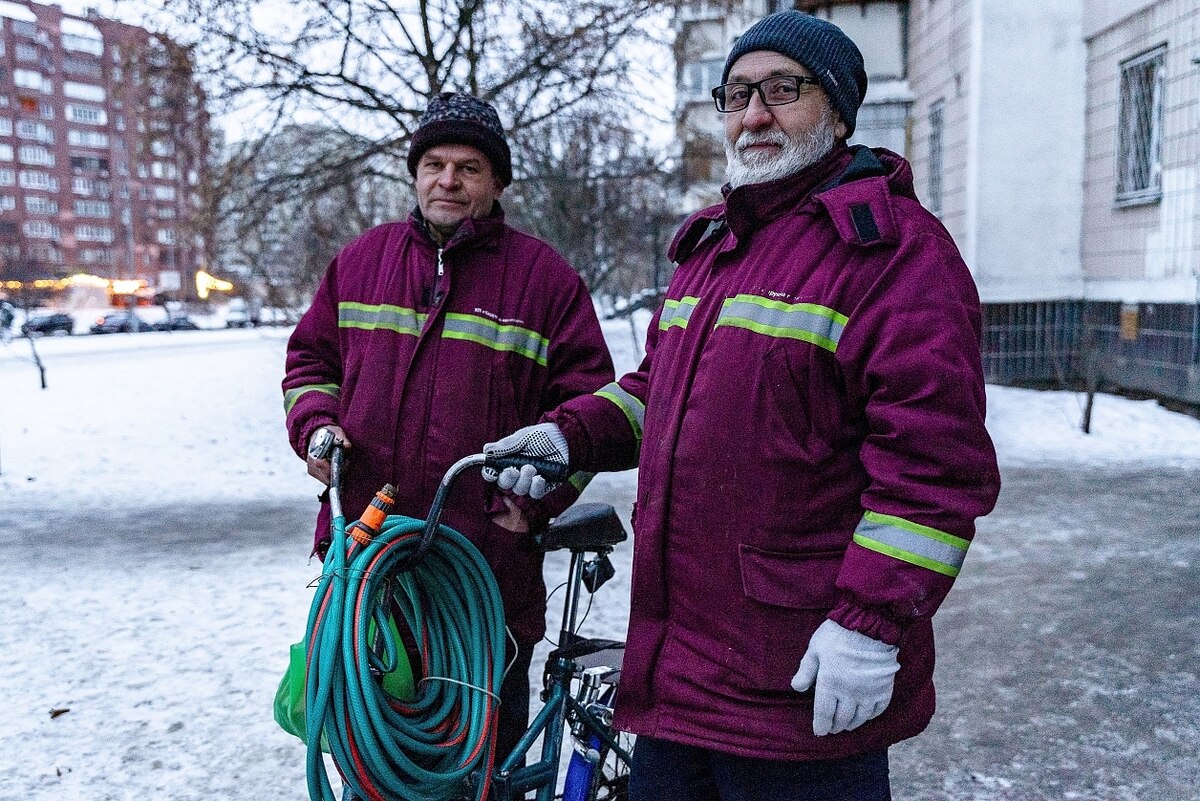
The utility employees are also at a loss: People are increasingly forgetting that the lack of electricity, heating and water is not due to “poor service” but to the Russian attacks. The mechanics, many of them already of retirement age, work seven days a week, around the clock. You are exhausted and nervous.
They start at five in the morning and walk up and down thousands of stairs every day. The elevators are out of service and the calls don’t stop. The cold only makes the situation worse – accidents often occur. You constantly have to crawl around in cellars or under roofs, warm the pipes with heating mats and weld or replace burst pipes, explains Andryj Hrushetskyj, an employee at the water company.
His partner, Volodymyr Lasorenko, tells of a tragedy last week: two plumbers from an emergency team died of overwork. “Previously one team was responsible for two residential buildings, now for twenty,” he says. “It is simply impossible to respond to every one of the many emergency calls.”
Points of indomitability
For three days, Ihor Serhyenko has been working as a medical psychologist in one of the “Points of Indomitability” in Kyiv. These are large tents in which people pass the time until the power comes back on. Serhyenko has been working for the psychological service of the State Emergency Management Service of Ukraine (SES) for 17 years.
According to his observations, the simplicity of the Kyiv population’s needs reveals the exhaustion of the city. Most of the time, people wanted to charge their phones, drink tea, warm up and talk to each other. “Older people want to read or do crossword puzzles,” he says. “I ordered magazines, books, crossword puzzles, modeling clay, colored pencils and coloring books for the children,” says Serhyenko.
Meanwhile, the schools are closed – the indoor temperature is only around 6 degrees. As a result, Serhyenko said, some children spend entire days in the tents while their parents work.
Little by little, these meeting places develop into small communities: people quickly learn the rules, help each other and keep order. And in times of war – especially when it’s cold and dark – this becomes just as important as generators and electrical outlets. The city is held together somehow – through simple, everyday gestures of mutual help.
From the Russian Gaby Coldewey and Barbara Oertel