

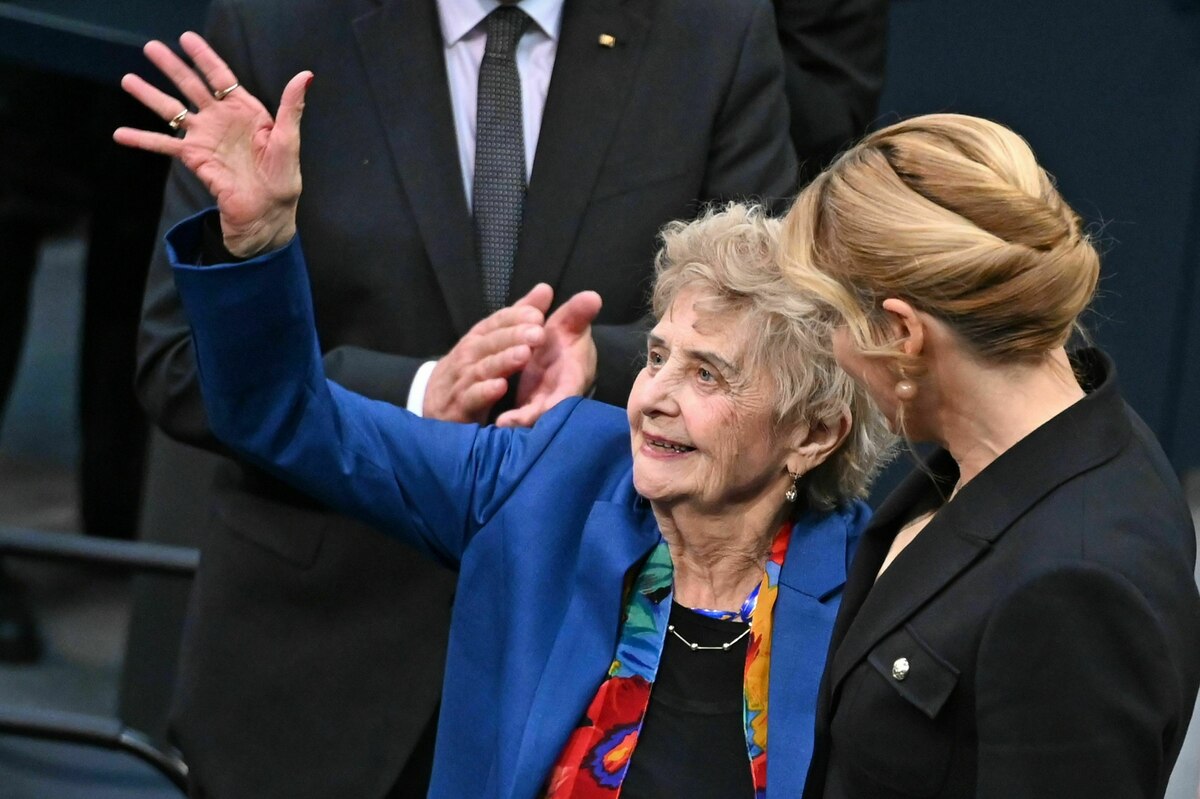
“I have no brothers, no sisters, no aunts and no uncles”. This is how Tova Friedman begins her speech in the Bundestag on Wednesday on the occasion of Holocaust Remembrance Day. It has become a tradition for the German Parliament to mark the anniversary of the liberation of Auschwitz in 1945 a Jewish contemporary witness or at least the descendant of one invites you to give a speech. In 2026, this guest of honor will be a child and an old lady at the same time. Tova Friedman survived Auschwitz as a five-year-old. Today she is 87 years old, lives in the USA and was famous as a Tiktok starwhich explains to young people in short sequences what happened to the Jews in Europe back then.
All members of parliament are present in the Bundestag, as is the federal government and the chancellor. The visitors’ gallery is packed when Tova Friedman steps up to the lectern. It tells the story of the Polish-Jewish girl who, according to the National Socialists, should no longer have existed. Friedman reminds us that 1.5 million children were murdered in the Holocaust, “who were not as lucky as I was.”
The day before, Felix Byelyenkow, chairman of the Jewish community, stands in the snow in Brandenburg an der Havel. His own presence is not decisive, he says. What is more important is that despite the biting cold, many people found their way to the memorial. There may be 150, perhaps 180 people who gather at the steles as darkness falls to remember the Nazi “euthanasia” murders in the city of 70,000 have gathered. You can find that little or a lot. Byelyenkow, his warming hat pulled low over his face, thinks it’s a lot, and Ran Ronen from the Central Council of Jews in Germany is also impressed. “Every Jewish family has to mourn victims, every one,” says Felix Byelyenkow.
We would like to show you external content here. You decide whether you also want to see this element:

On January 27th, politicians across the country commemorated the murder of the Jews. They find words of horror and declare that what happened is a warning to us all. But there are not only the speeches from the Federal President, the invited guests, prime ministers and parliamentarians, whose words can be seen on television in the evening. There is also a civil society that in many German communities is not spending this day in the living room, but is speaking out, loud and clear. Just like in Brandenburg an der Havel.
There are no AfD representatives in Brandenburg
There at Nicolaiplatz, the memorial director Sylvia de Pasquale first reminds us that it is about “protecting the dignity of every individual” – and at the same time asks for the presence of undemocratic politicians. Everyone knows who is meant. The AfD became the strongest party in the last local elections in Brandenburg/Havel. None of their representatives show up.
In the Bundestag, the AfD members are not so easy to push aside. They are present. And they will in the end the speech by Tova Friedman Just like everyone else present, they give the guest speaker a standing ovation – as a sign of approval and at the same time as a signal that Friedman’s admonishing words are certainly none of their business, absolutely none of their business.
The 87-year-old begins to tell the story. Her report is about a girl who ends up in a Nazi work camp with her parents after the Jewish ghetto in Tomaszów Mazowiecki is cleared, two days before her fifth birthday. It learns to hide over a false ceiling and to be as quiet as a mouse, almost invisible. Who teaches the mother not to look her tormentors in the eye, not even her guard dogs. Playing is forbidden. The warehouse is emptying. The girl asked her mother: Where have all the people gone? The mother says: “Selections”.
And Tova Friedman says: “On a beautiful summer day I was allowed to leave the dark room. Where to? To Auschwitz.” She was now five and a half years old. Her father told her to be a good girl.
More than 9,000 murdered
In Brandenburg, Mayor Steffen Scheller (CDU) spoke on Tuesday afternoon. There is “a responsibility that grows from history,” says the 55-year-old. “Distortions of history” are no longer uncommon. This must be countered.
Brandenburg an der Havel was a place of particularly cruel Nazi crimes. As early as 1933, the new rulers set up a concentration camp in the abandoned prison in the middle of the city, which existed until 1934. Five years later, the National Socialists built a gas chamber in the building. More than 9,000 people with mental illnesses and disabilities were murdered there by October 1940. Like the worker Hugo Klein, born in 1913, who was killed after being placed in two sanatoriums in Brandenburg. In a letter to his father, the alleged “state nursing home” fantasized about fatal peritonitis.
Many of the perpetrators were soon able to bring their experiences to German-occupied Poland – in the Treblinka, Belzec and Sobibor extermination camps, where more than a million Jews were murdered. The medical director of the Brandenburg institution, Irmfried Eberl, became the first commander of Treblinka, and the office manager Christian Wirth became boss in Belzec. You can find out more about it at a memorial just a few steps away. And not far away there is another horror place in Brandenburg-Görden. The prison there was a Nazi execution site – over 2,000 death sentences were carried out.
One can also remember a predecessor of Mayor Steffen Schiller. The man’s name was Wilhelm Sievers. On November 9, 1938, wearing the uniform of an SS Obersturmbannführer, he organized the pillaging of the synagogue in Brandenburg/Havel. The work of destruction was carried out by the local fire department.
Tova Friedman’s new name in Auschwitz: 27633
It’s quiet in the Bundestag. Friedman continues reporting. In Auschwitz she was given a new name: 27633. That was the number that another Jewish prisoner had to tattoo on her. Her mother told her: You get a bowl, a cup and a spoon. If you lose them, you will no longer receive any food. And that she should never cry. Friedman says, “I didn’t cry.”
She also didn’t cry when she and other children were driven into the gas chamber, which she left alive, probably because of a technical defect. She didn’t cry when her mother hid her under a corpse to avoid the death marches when the SS dismantled the camp.
On the spot where the buildings of the Brandenburg concentration camp once stood, there is now a slim woman with dark hair. It is the actress Patricia Litten. She says: “It always starts with the marginalization of people, from a supposed ‘us’ against a constructed ‘them’.” Humiliation, criminalization, demonization followed.
It was “pretty difficult for her to be here,” says Patricia Litten. Her uncle Hans Litten was one of the people who were tortured in the Brandenburg concentration camp. The courageous Berlin lawyer had defended Nazi opponents in court in the Weimar Republic and even dared to force Adolf Hitler personally onto the witness stand, where he became extremely confused in his arguments. Hitler vowed revenge. Hans Litten committed suicide in the Dachau concentration camp in 1938. His mother Irmgard had fought for her son for years. Patricia Litten will read from her book “A Mother Fights Against Hitler” in the evening.
“Hans Litten didn’t stay silent, he just looked,” said his niece Patricia that afternoon. “It’s up to us what future we have to live in.”
“Jews are again seen as scapegoats”
A day later, Tova Friedman was no less combative in the Bundestag. She doesn’t just leave it with the story of the five-year-old child under the Nazis, but rather, despite all the praise for the Germans, demands consequences from the resurgent anti-Semitism. “A lot of the world has turned against us,” she says. A grandson had to hide his Star of David on the university campus. “Jews are once again seen as scapegoats. Anti-Semitism has not disappeared, it is hidden behind anti-Zionist language,” she complains. The “epidemic of hate” must be taken seriously.
Tova Friedman calls out to the plenary: “Now is your chance. You have to win back your country. Don’t allow anti-Semitism to grow again.” And: “Be a little stricter!”
Those who could possibly be concerned by this appeal do not notice it or do not want to notice it. They applaud. The Federal President thanks you. Friedrich Merz leans down to the little woman and shakes her hands.
Steffen Scheller, the mayor of Brandenburg an der Havel, said a very important sentence during the lecture: that remembrance should not be limited to memorial days.