

A cuboid, 102 meters long, with five floors and 82 apartments. Always at the same distance a sequence of windows, balconies and another window. Everything framed by gray concrete. The building block in Ludwigsfelde, a medium-sized town south of Berlin, couldn’t be more ordinary. With more than 650,000 apartments, the WBS 70 prefabricated building type is the most commonly used in the GDR. The residential building in Ludwigsfelde only trumps its identical siblings in one thing: its energy efficiency.
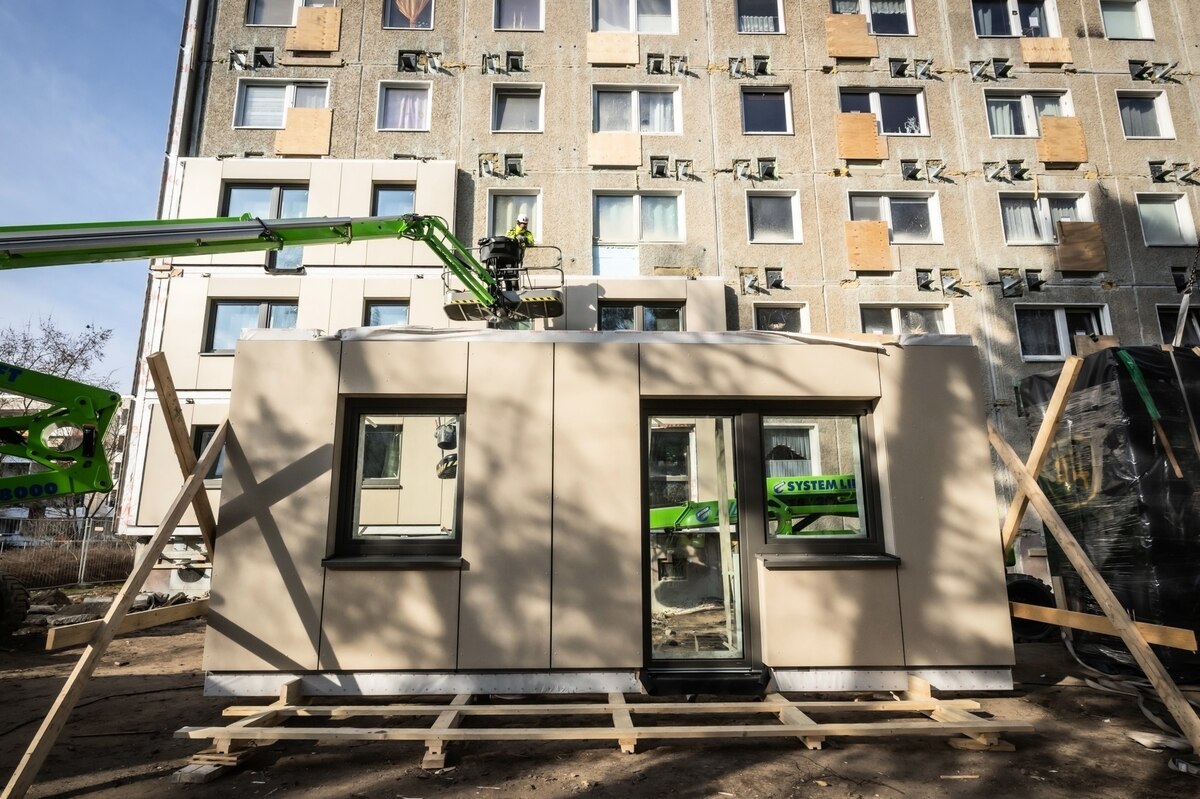
A year ago, the building was energy-efficiently renovated in a very short space of time, thanks to industrial renovation technology. Instead of the rough gray plaster, the house is now surrounded by a new cladding made of large insulation panels. And the photovoltaic system installed on the roof generates electricity for the residents.
What applies to this one WBS-70 building could potentially be applied to all of them. After all, the fact that one house is the same as another is a basic idea of industrial housing construction. Ludwigsfelde could therefore be a blueprint for the energy-efficient renovation of all prefabricated buildings. And some experts even hope that such projects could alleviate Germany’s great need for renovation overall.
The climate goals are far away
So far, the existing buildings in Europe are still far behind the energy standards that they actually have to meet – if the European Union wants to achieve its climate goals. That’s why the EU announced in 2020, a “wave of renovation” through which 35 million existing buildings across Europe are to be improved by 2030.
At the moment the wave is threatening to disappear. Germany also missed its targets in 2025. The building sector in this country is far from being climate neutral by 2045 and accounts for 30 percent of CO2-Emissions responsible. They arise during the construction, renovation and use of buildings. 35 percent of the total final energy consume buildings in Germany.
The residents quickly notice how energy efficient a house is. You will notice this by how well the apartment retains heat in winter or, at the latest, by the heating bill. For comparison: loud a calculation by Schwäbisch Hall The annual energy costs in an unrenovated apartment are on average around 42 euros per square meter. If you replace the windows, improve the insulation of the building shell and install a photovoltaic system on the roof, the costs can drop to 7 euros per square meter per year.

You are reading a text from our future department. If you want more positive perspectives, Subscribe to TEAM FUTUREthe constructive newsletter on climate, knowledge, utopias. Every Thursday you will receive an email from us with strong thoughts for you and the planet.
The benefits are enormous, but Germany still falls far short of the renovation rate of 2 percent per year that the federal government has set as a goal. The rate is currently declining and stands at 0.7 percent. The main reasons for this are material costs, inflation and a lack of skilled workers.
Projects like those in Ludwigsfelde give hope for a trend reversal because they combine two aspects – industrial construction with serial renovation. The latter is also known as an “energy leap”. The concept was developed in the Netherlands in 2013 and combines industrial renovation technology with regenerative technology such as photovoltaics. It differs from conventional energy-saving renovation in one thing above all: speed.

Instead of attaching insulation materials to the house wall by hand along a scaffolding, facade elements are prefabricated in the factory following a 3D scan of the house, like a construction kit. Windows and photovoltaic systems are inserted directly. The panels then only need to be anchored to the house wall.
The more similar, the better
This becomes all the easier and more efficient when one building is similar to the other – as with the WBS-70 bars. The prefabricated building is therefore perfect for serial renovation, says Nico Gorsler, head of the construction and housing sector at Energiesprong Germany. Plate after plate, so to speak. “These are very simple structures with a high repetition factor, which are ideal because of the rectangular building shape alone,” says Gorsler.
As part of the German Energy Agency (Dena), he and his team are supporting the development of this type of renovation on behalf of the Federal Ministry for Economic Affairs and Energy. Dena aims to contribute a renovation rate of 0.5 percent by 2030. That would be 200,000 residential units annually.
It seems obvious to combine industrialized housing construction with an industrial renovation method. As early as the 1950s, the GDR in particular began to think about mass housing construction. This is how entire settlements emerged, one of the largest in Berlin-Marzahn. In total, around 2 million apartments were created using this large panel construction method, which includes not only WBS 70 but also the P2 or QP series.
Nico Gorsler sums up the potential in his head: “If we achieve our annual goals of serial renovation, we would already be busy with the foreseeable wave of renovation of prefabricated buildings for ten years.” This represents enormous potential for the market in this area. “This means that the overall infrastructure for energy-saving renovation can grow,” he says. And that would benefit the renovation rate.
With each subsequent project, the planning effort is reduced slightly
Nico Gorsler, division manager at Energiesprong Germany
Nevertheless, Kati Jagnow, professor of energy concepts and system optimization at the Magdeburg-Stendal University of Applied Sciences, does not yet see it as sensible to renovate using the Energiesprong principle, at least for this type of building. “These buildings are not the ones in the worst condition in Germany,” says Jagnow, who herself grew up in a WBS 70 house.
Most people had already integrated an initial layer of insulation into the walls during construction – even if it was only a few centimeters thick, says Jagnow. The reason for this was the oil crisis of the 1970s, which led to more attention to thermal insulation in both the Federal Republic of Germany and the GDR.

This text comes from the weekday. Our weekly newspaper from the left! Every week, wochentaz is about the world as it is – and as it could be. A left-wing weekly newspaper with a voice, attitude and the special taz view of the world. New every Saturday at the kiosk and of course by subscription.
In addition, there was a first wave of renovations after the end of the GDR with a special funding program that improved a third of the stocks. This included replacing windows, completely renewing the roof cladding and insulating external walls. “Of course that didn’t necessarily happen according to today’s standards, but at least,” says Jagnow.
Since there is not unlimited money available, it makes sense from an economic perspective to first serially renovate the buildings without any insulation. For example, in houses from the 1960s and even older. However, in order to really estimate what effect an additional energy-saving renovation would have according to Energiesprong, you would have to know what kind of building have already been renovated in a conventional manner. But “there is no data yet” on this combination, says Jagnow.
Even though the WBS-70 building in Ludwigsfelde didn’t have the worst starting point, its energy-saving renovation made a difference. Consumption was reduced to a third from 99 kilowatt hours per square meter per year. According to Dena, thanks to the photovoltaic system installed on the roof, the building is even considered a zero-emissions house. As such, it only uses as much as it can produce and offset in renewable energy.
A question of cost
“The next WBS-70 building is already being planned in Ludwigsfelde,” says Nico Gorsler. Here you can expect costs to be 10 percent lower compared to the first property. With an investment of 6 million euros, that makes a significant difference. “With each subsequent project, the planning effort can be reduced a little. This saves time and ultimately money,” explains Gorsler. The hoped-for scaling effect begins. This is an important point because although The federal government promotes energy-saving renovationsit is – whether conventional or serial – still expensive.
Despite lower consumption, these costs can affect tenants if they are transferred to basic rent. Ideally, this will be balanced out in the total rent, but there is no guarantee. The German Tenants’ Association and the Öko-Institut published this as early as 2024 a studywhich examines the social compatibility of energy-efficient renovation. One result: To date, federal funding has not sufficiently taken into account the unclear distribution of costs between owners and tenants.
A look at Berlin shows that hardly any serial renovation has been carried out, especially in social housing. According to the Berlin Senate, of the state-owned housing associations, this was only achieved in one building. The reason is that the concept is not yet the most economical option. Conventional renovation assumes a price per square meter of between 500 and 1,400 euros, while for serial renovation it is currently between 1,250 and 1,850 euros.
Financing is often difficult. “Depending on the region, it’s a tightrope act,” says Nico Gorsler. It’s important to him to look at the renovation holistically: “It’s not just about energy quality, but also other issues, such as affordable living space and accessibility.” However, he assumes that serial renovation could be implemented in the future without paying any rent, with costs of less than 1,000 euros per square meter.
According to a Dena survey, costs in the serial sector have already been reduced by 30 percent compared to before 2023. And this despite the fact that prices in the construction industry rose. For Gorsler, this means that serial renovation – unlike the conventional method – has not yet exhausted its full price-performance potential due to the possibility of further improving processes.
It’s not just the technology that decides whether the project in Ludwigsfelde will become more. “Owners of large holdings in particular would have to invest in serial renovation so that the market has security through long-term contracts,” says Professor of Energy Concepts Kati Jagnow. In this respect, the renovation of prefabricated buildings could contribute to reducing the individual project costs due to their volume alone. This would help all buildings – and ultimately their residents.