

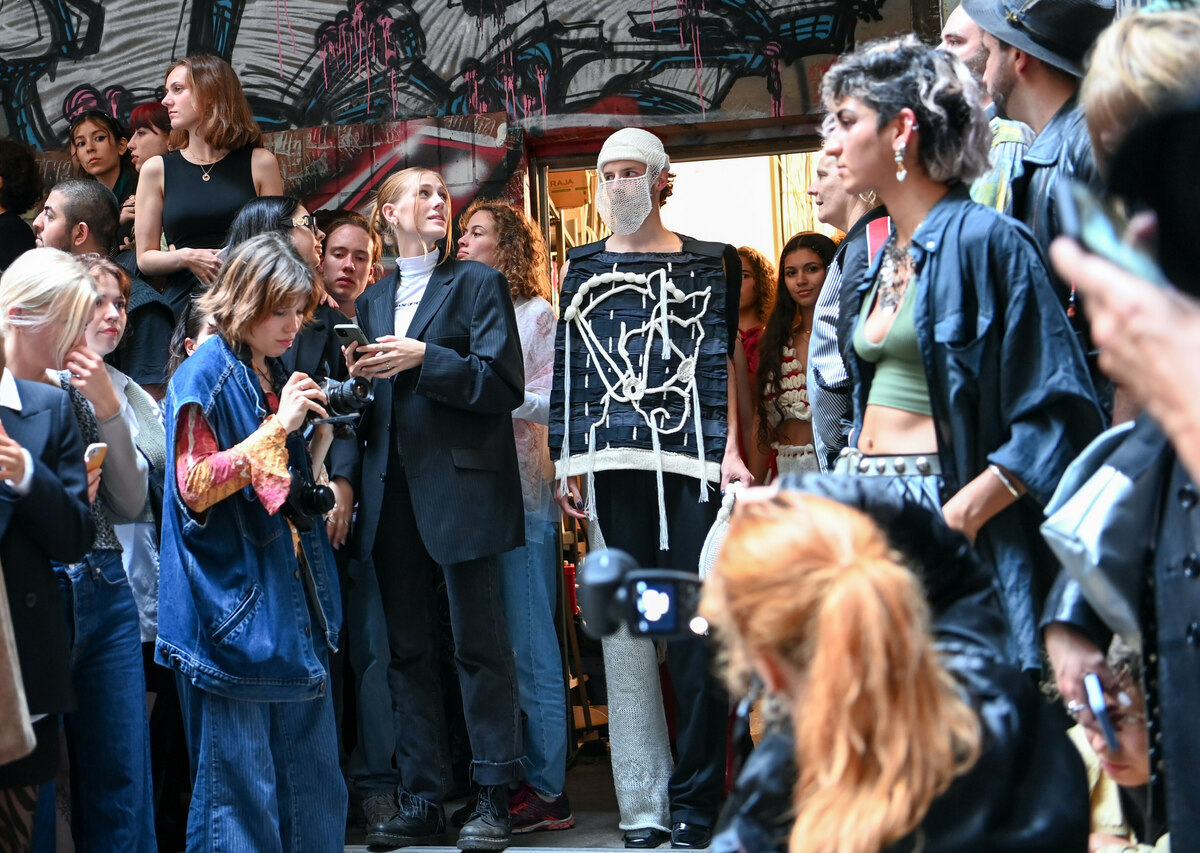
It’s a sentence typical of Berlin’s overestimation of itself. “What is going on in Paris and Milan today was going on in Warsaw yesterday,” says a large poster in front of the Red City Hall in the heart of Berlin. That’s actually a bit of a stretch: Only the Berlin luxury label Ottolinger has made the leap from the catwalks of Berlin to the higher spheres of the international fashion world. With her functional dress look, Ottolinger brought the anti-style of the Berlin raver scene into the world of haute couture. The label returns to the runway in Berlin at Fashion Week on Saturday evening.
Because in principle it cannot be denied: the international response to Berlin Fashion Week is much more modest than that of the world stages in Paris, New York and Milan. But the absence of big players leaves a lot of space in the program for funding programs.
Several formats during the week are dedicated to the industry’s young talents: the “Berliner Salon”, the programs “Newest”, “Intervention” and the “Next Gen” show from PLATTE.Berlin, curated by Szenegröße Sven Marquardt. The Berghain bouncer and photographer is presenting looks from six young fashion designers at the start of Fashion Week on Friday. Opposite the Berlin fashion magazine sleek He says that his work is intended to raise “questions about the creative future of Berlin,” “whose Senate has severely cut funding for art and culture, particularly affecting public art universities.”
Hotspot of the Berlin fashion scene
The location for the “Next Gen” show is on the ground floor of an old prefabricated building on Alexanderplatz, on the other side of Karl-Liebknecht-Straße. PLATTE.Berlin is a small hotspot of the Berlin fashion world: The concept store showcases collections from young, local artists. Their “pieces” hang on industrial clothes rails along the old exposed concrete walls. They give a good picture of what Berlin chic is: black boots, bomber jackets, crop tops, trench coats.
In unusual places From January 30th, fashion shows will take place at selected locations throughout Berlin as part of the Berlin Fashion Week’s multi-day program. This also includes the picture gallery, the Liquidrom, a ruined lecture hall at the Charité. The Peruvian Embassy also serves as a venue for a label that presents “innovative organic leather goods from Peru”.
Two weeks a year Around 30,000 visitors visit Berlin Fashion Week twice a year. For comparison: Berlin’s agricultural fair, the Green Week, which has just ended, was visited by almost 350,000 people this January.
Female bosses In addition to its focus on sustainability, Fashion Week also boasts a comparatively high number of women-run fashion houses exhibiting in Berlin. (taz)
One of the six young designers from “Next Gen” is Niclas Hasemann with his label “haseman.n”. The 26-year-old completed the renowned fashion course at the University of Pforzheim and knows Fashion Week well. He wears a patterned bucket hat, a sweatshirt; his own designs. Plus a dark trench coat. The “mantra” for his designs is “quietly”: he is “not interested in fast-moving things,” wants to make his work appear longer – and “keep his footprint small.”
As an aspiring fashion designer, it is “rather difficult but bearable” with the money. The rent in Berlin doesn’t allow him to have a studio. He finances himself largely outside the industry, but is lucky: funding has “pretty much influenced” his career so far.
What’s special about Berlin is that the fashion scene is so young and there is less competition with the big fashion houses
Niclas Hasemann, fashion designer
The Berlin Senate supports Fashion Week with 4 million euros annually from state and EU funds. Since the first Fashion Week in 2003 – then still known as “Mercedes Benz Fashion Week” – the state of Berlin has been supporting the event “in order to provide up-and-coming Berlin labels with professional presentation opportunities”.
Art or Commerce?
On the continued support with public money the massive cuts in the cultural sector no effect. The funding for Fashion Week comes from the area of economic development. The Berlin Senate clearly classifies the fashion world more under the label of commerce than art. And with good reason: the industry generates around 5 billion euros annually in Berlin alone and thus makes “a relevant contribution to Berlin’s economic performance,” explains the Senate administration in response to a taz query.
She continues that funding with public money follows clear criteria. Above all, the invited talents “implement their collections in Germany and Berlin”. This creates a “reliable funding ecosystem” through which Berlin is strengthened “as a business location, for example when it comes to company settlements or the influx of skilled workers”.
This seems to work quite well. Hasemann also says that he deliberately moved to Berlin after completing his studies. In comparison to the established fashion metropolises, “what’s special about Berlin is that the fashion scene is so young and there is less competition with the big fashion houses. In Paris it is so competitive to even take place,” he admits.
In addition to the classic catwalks, Fashion Week also offers talk formats, such as the “Metamorphosis Talks powered by eBay”, which are dedicated to the circular economy. In general, the week’s theme focuses heavily on sustainability. Many shows are dedicated to upcycling, the value-adding reuse of textiles, and thus send a clear message against fast fashion.
More space for young fashion creators
At the same time, multinational corporations such as UNIQLO and Zalando are present at Fashion Week. The industry giants with their global production chains make a significant contribution gigantic economic-ecological problem context of the fashion industry at. Global textile waste alone amounts to around 90 million tonnes annually and is expected to grow to 134 million by 2030. Currently only 1 percent of it is made into clothes.
In contrast, in the talent factory of Fashion Week, tomorrow’s fashion is supposed to be created from yesterday’s clothes. The “RAUMBerlin” competition already applies binding sustainability requirements to the labels exhibited, which will soon apply to the entire Fashion Week.
Because of such decisions, major labels will not be attending Berlin Fashion Week in the foreseeable future. This leaves more space for the works and themes of young fashion creators.