

taz: Ms. Urbas, you manage the Annelinn+ pilot project. This could representative of 50 million apartments are in Europe. What are you testing here?
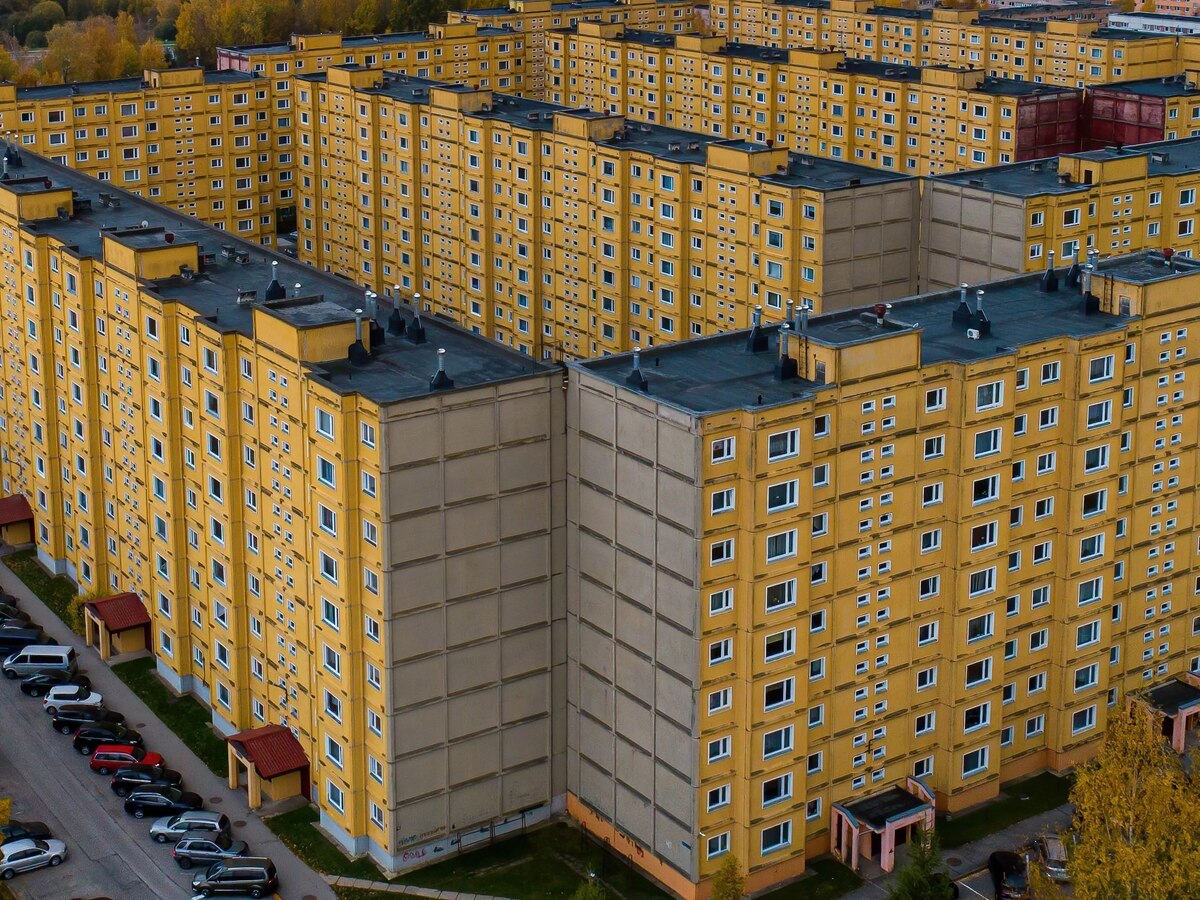
Annika Urbas: Annelinn is located in the Estonian city of Tartu, and here in the district you are practically surrounded by five to nine-story blocks of houses. They were all built during the Soviet occupation between 1970 and 1990. In our project, we now want to find out and test by 2027 how we can energetically renovate neighborhoods that, like this one, are characterized by the industrial mass construction of the Soviet Union and thereby convert them sustainably.

taz: What does sustainable reconstruction mean in this case?
City: The goal is to convert buildings so that their net consumption is practically zero because they can generate the energy they need themselves. This also corresponds to the objective of the EU project, to which Annelinn+ is part.
taz: That oPEN-Labwhich also includes projects in Pamplona, Spain, and Genk, Belgium.
City: The initiative wants to test concrete ideas in three different neighborhoods in order to build so-called PENs – Positive Energy Neighborhoods. This is the name given to sustainable neighborhoods that manage to generate more energy than they consume.
taz: For such a conversion, you use the technique of serial renovation, in which insulation and photovoltaic systems are industrially produced like templates and attached from the outside.
City: Exactly, and because the Soviet buildings are very similar due to industrial production, the process is particularly suitable here. What we successfully test on one building, we can transfer to the neighborhood.
taz: And why was Annelinn chosen for the project?
City: Around 30,000 people live in Annelinn, which is almost a third of the inhabitants of Tartu. Some of the buildings consist of up to 144 apartments – so the district is densely populated and energy consumption is correspondingly high. It is a special task to build a PEN here, as the area for energy production is small in relation to demand. But that’s exactly what makes Annelinn so interesting.
taz: What specific challenges are there?
City: The buildings have not been renovated for energy efficiency since they were built. Then their height: Estonia is already relatively tried and tested in to serially renovate lower buildingsbut this is new for buildings with more than five floors. Two things are particularly difficult with them.
On the one hand, to anchor the prefabricated insulation elements in such a way that it does not endanger the statics, and on the other hand, to install sufficient photovoltaic panels to generate enough energy for the building. The photovoltaic elements are usually installed on the roof. When it comes to the roof area, it doesn’t matter whether a building is five floors or ten high. It remains the same, only the number of people living below it is higher – and accordingly their energy requirements.

You are reading a text from our future department. If you want more positive perspectives, Subscribe to TEAM FUTUREthe constructive newsletter on climate, knowledge, utopias. Every Thursday you will receive an email from us with strong thoughts for you and the planet.
taz: What solution did you find for the problem?
City: We have developed a technology in which the photovoltaic elements are integrated into the prefabricated facade elements and can therefore be attached vertically, i.e. on the building wall. So the area becomes larger.
taz: And for the static problems?
City: With our newly developed technology, the insulation elements from the fourth floor are no longer attached to the foundation, as before, but are supported by a supporting element in the middle of the building.
taz: You can imagine such a renovation being quite strenuous. How does this work for the residents?
City: We get feedback that this type of renovation puts a lot less strain on people. The traditional way in Estonia requires that a building be wrapped in a huge plastic bag for practically a year due to weather conditions. It’s not pleasant to live in a house like that.
The serial renovation only took us two months – without a plastic cover and, above all, without scaffolding. The elements were attached by crane. And the serial approach had another advantage: one Study from Tartu University of Technology shows that buildings with prefabricated elements are warmer than with a classic renovation in which the insulation material is attached by hand.
taz: How many buildings have you been able to renovate using this method so far?
City: We originally wanted to renovate three residential buildings, each with nine floors, as part of the project. Unfortunately, not everything went according to plan. On the one hand, this has to do with the war in Ukraine and, on the other hand, with the ownership structure of living space in Estonia. You have to know that most of the residents here also own their apartments; after the end of the Soviet Union, they were transferred to them.
If renovations are to be carried out, more than half of the residents of a house must agree and pay for it. Grants can cover half of the renovation costs. Because of the war in Ukraine Inflation in Estland but increased so much that financing was no longer feasible for many in the buildings originally selected.

This text comes from the weekday. Our weekly newspaper from the left! Every week, wochentaz is about the world as it is – and as it could be. A left-wing weekly newspaper with a voice, attitude and the special taz view of the world. New every Saturday at the kiosk and of course by subscription.
taz: So it had to be rescheduled.
City: Exactly. In the end we were able to win at least two buildings, but only with five floors. They are part of the city’s social housing. One of the blocks was already renovated last November. We successfully tested our new technologies on this building, which were actually intended for the taller apartment blocks. However, from the test results we can conclude that this type of energy-saving renovation is also possible for nine-story apartment blocks. This is a very important insight.
taz: What has changed for the residents in Annelinn since the renovation?
City: We have already checked the new energy class for the building that was renovated in November. The renovation made it possible to significantly reduce consumption: from 189 kilowatt hours per square meter per year to 99 kilowatt hours. That’s a jump from energy class F to C. For the residents, this means immense savings in additional costs.
taz: You said that the renovated buildings in the project are social housing. What role does energy poverty play in renovation?
City: When people cannot afford to heat their homes adequately, this is referred to as energy poverty. And people who rely on social housing often feel multiple burdens. If the buildings are better insulated and can also produce their own electricity, the residents save on additional costs.
This also makes energy renovation a social issue. But of course this calculation only works if the residents do not have to take out a loan for the renovation or the rent increases drastically.
taz: The EU wants to increase the renovation rate to 2 percent by 2030. So far, however, progress has been slow. Can Annelinn’s knowledge drive the wave of restructuring?
City: Definitely. Unfortunately, the problem at the moment is financing, but we were able to find answers to the technical questions within the project. And these solutions can now be applied anywhere. Recently, for example, a facade element developed for Annelinn was transported 1,570 kilometers to Ukraine and installed there on the student dormitory at Zhytomyr State University.