

Salome enters the stage and dances. Dance like it’s your life. Her braids cut the air like whips, and the princess flung her limbs away in a possessed frenzy. As a wooden, driving house beat builds and Jim Morrison’s deadpan remixed voice “I tell you this. I don’t know what’s gonna happen, man” slurs out of the background, Salome’s left arm seems to die off. She wraps it around her body like a lifeless piece of flesh, a boneless atavism. Herod’s stepdaughter is a physical punching bag: “Break on through to the other side”.
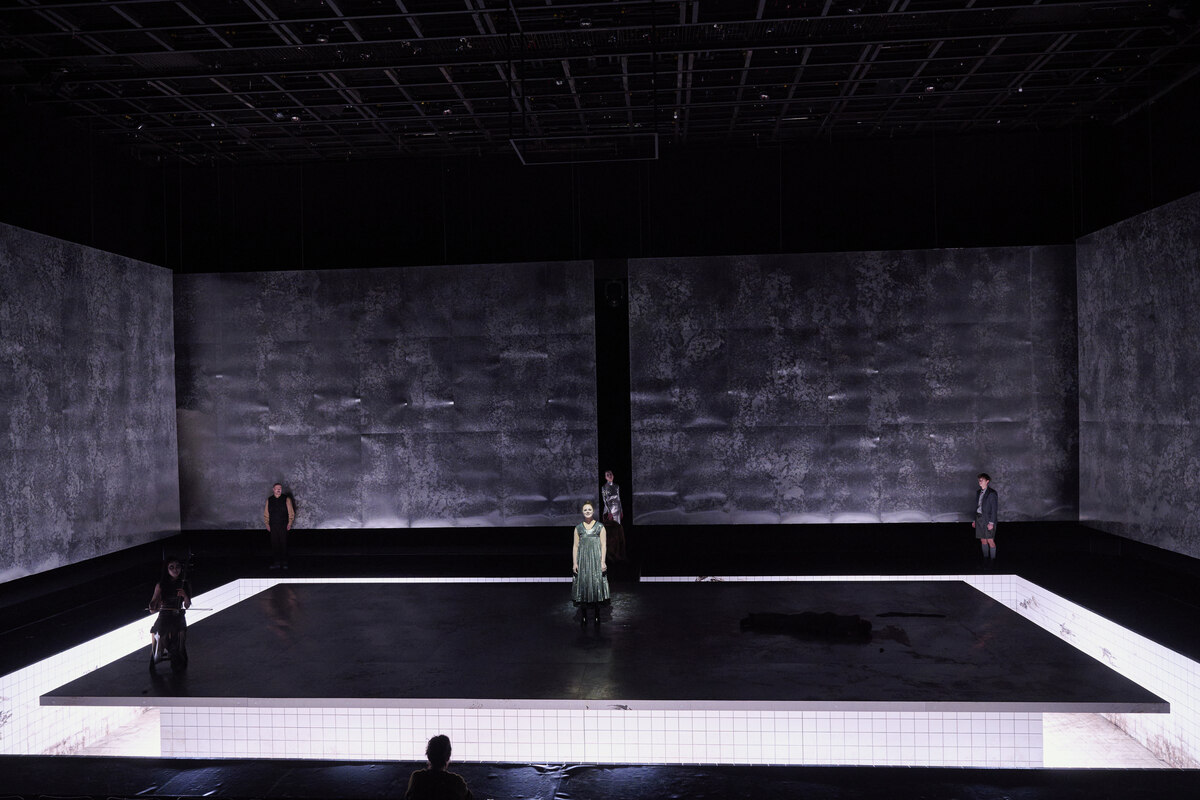
It is a fantastic, manic opening moment of this Friday evening in Berlin, when director Michael Thalheimer returns to the Schaubühne am Lehniner Platz with a production after almost ten years. The minimal stage design is framed in silver, but the oxidized sheet metal does not reflect the dull eyes of the characters, only the dull lights, which will change little over the course of the evening, shimmer milkily in it.
Surrounded by a tiled ditch, a modern sewer, the few figures will spend the evening trapped on this island: the balcony of Herod’s fortress Macherus as a slaughterhouse cell, in whose blood trough sometimes the executioner and sometimes the prophet patrol.
The young princess desires the same prophet Johannes (Christoph Gawenda) and has him brought to her. But he, this excrement-smeared angel of death, hanging impressively from the butcher’s hook, rejects the pale child. Silvery like her dress is everything about Salome (Alina Stiegler) that night. And white as the moon, which is so often conjured up in this version of Einar Schleef’s text.
The irascibility runs deep in the protagonists
But her temperament is sulky and red. Red like the blood that will still flow. Red like the wine that the ruler drinks, and red like the lust and the beauty and the flaming hatred with which the prophet John attacks Salome’s mother, who married her brother-in-law, Herod, who had previously gotten rid of his own brother by murdering him.

“She is like the shadow of a white rose in a mirror of silver.” Alina Stiegler as Salome
Photo:
Katrin Ribbe
And now he wants his stepdaughter: she should dance for him. As a bursting stage cliché, Herod (Tilman Strauss) enters the stage in golden leggings and a fur coat. Jerking wildly, sometimes whimpering, usually roaring, the ruler meanders between crawling and screaming. In general there is a lot of shouting into the audience that night. The interaction between the characters is always forward-looking, exaggerated and unfortunately not very varied.
The volleys of sentences fired into the audience, full of linguistic explosiveness, usually sound as if they had been written directly for the theater’s advertising matchboxes (“I am the disobedient”, “The moon is the moon, but here is the sewer”, “Shut up”). That in between there is really crazy, incredibly beautiful and quiet language in which colors and celestial bodies or cursed violence are almost casually invoked, and in places it is closely related to that King Solomon remembered, goes under.
Over the course of the non-stop evening, she is swept away by a doomscroll-like storm of words in which, apart from a few cheap laughs, only Salome’s actual dance promises a break to the battered brains and ears.
After all, the princess dances after all
After Salome’s mother Herodias (Jule Böwe) tries in vain to stop her child from dancing for her stepfather, the princess finally agrees when Herod promises her a free wish. But instead of falling into another sweet frenzy, a cage-like box lowers itself over the princess, and the musician Yuebo Sun enters the stage with an erhu, a pike violin, and plays a beguiling, sensual song on it.
Salome can only raise her arm, freeze her face in a silent scream and announce the impending killing with the gesture of cutting her throat.
The pouting child princess in Oscar Wilde’s drama is a lustful, cruel figure.
And now the evening is slowly winding down. After some no-yes-I-want-buts and more yelling, Salome finally gets what she so desperately wants: John’s head. While in the Bible the child primarily fulfills the mother’s wishes and the mother obediently presents her head, the pouting child princess in Oscar Wilde’s drama is a lustful, cruel figure. But the iconic scene is denied to the audience.
Precisely because there wasn’t exactly any saving on blood beforehand, one anticipates it Lovis-Corinth equal momentumwho, in his representation of Salome, used an expressive brush to have the dancing beauty lift the prophet’s eye with pointed fingers, while her heavy eyelids and milky breasts lean over the severed skull full of unbearable beauty. But on this stage you can see: nothing.
Everyone stands around for a moment, sounds of killing are conjured up, but they are not intoned. And so, because of the disappointment of the lack of a climax, one almost misses the remorseful words that are spoken in a rare, small, Schelfian choir moment: “I love you, I kiss you, but your God has abandoned you. I don’t want to eat anymore. Just kiss. Life still trembles in you, it doesn’t leave you so quickly, your eyes, your eyelids, are still twitching, there is still something like light there. The stars are still reflected.”
The fact that Salome herself dies, chopped into pieces like a beast because of her stepfather’s jealousy, is just a quick footnote. An invisible one, of course.