The Milwaukee Brewers beat the Tampa Bay Rays to win their first-ever World Series championship last week, but baseball’s biggest battle is just heating up.
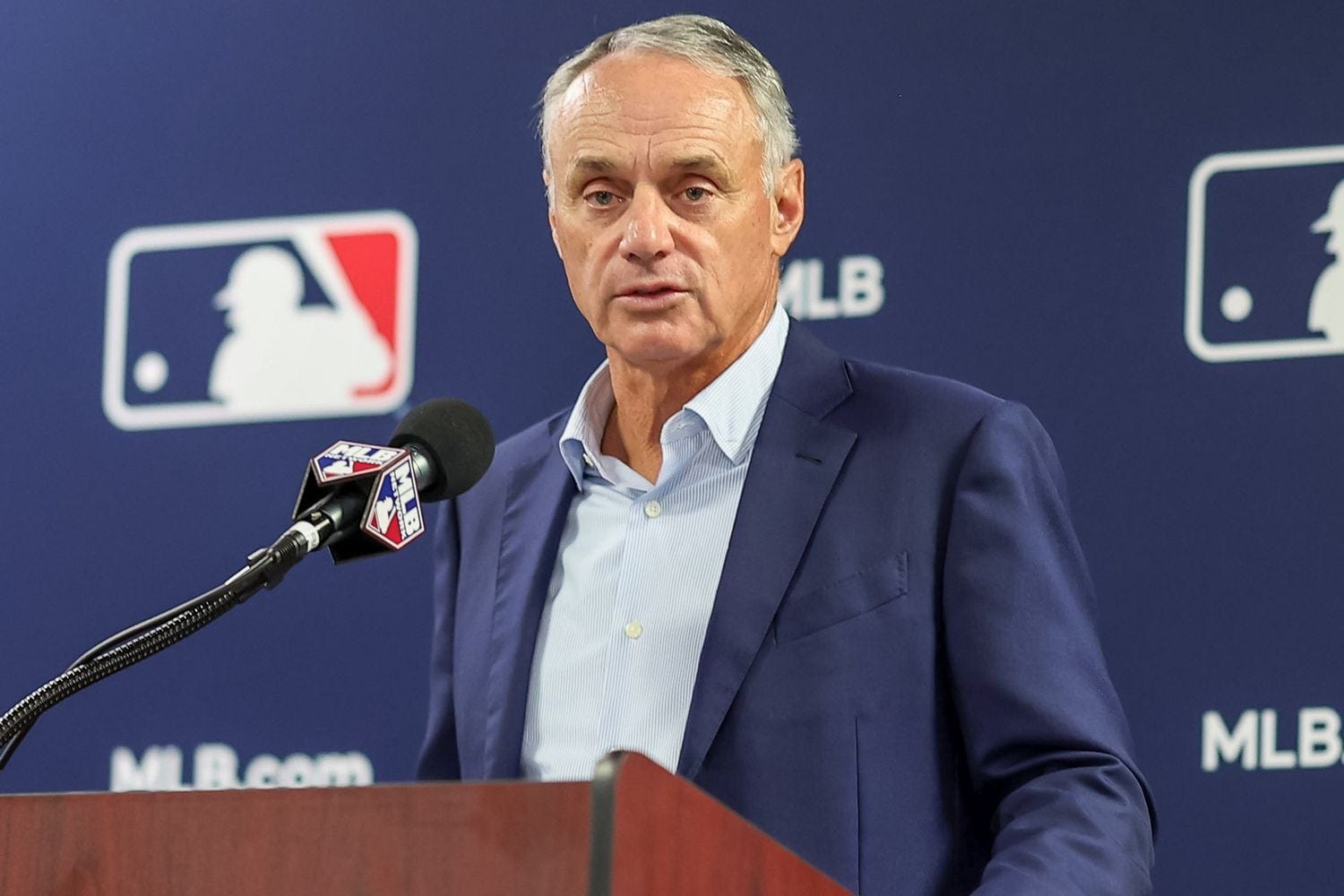
It’s no secret MLB might be headed for a lockout. With the league’s current CBA set to expire on December 1, 2026, MLB owners have made it clear they want to implement a salary cap during negotiations, and players are expected to fight it.
The current proposal would set a 2027 team payroll ceiling of $245.3 million and a floor of $171.2 million. Using these numbers, nine teams (think: Dodgers, Mets, Yankees) would need to cut $627 million in salary to get under the cap, while 12 teams (Marlins, Guardians, Nationals, etc.) would need to collectively spend $548 million more on player salaries than they did in 2026 to meet the proposed floor.
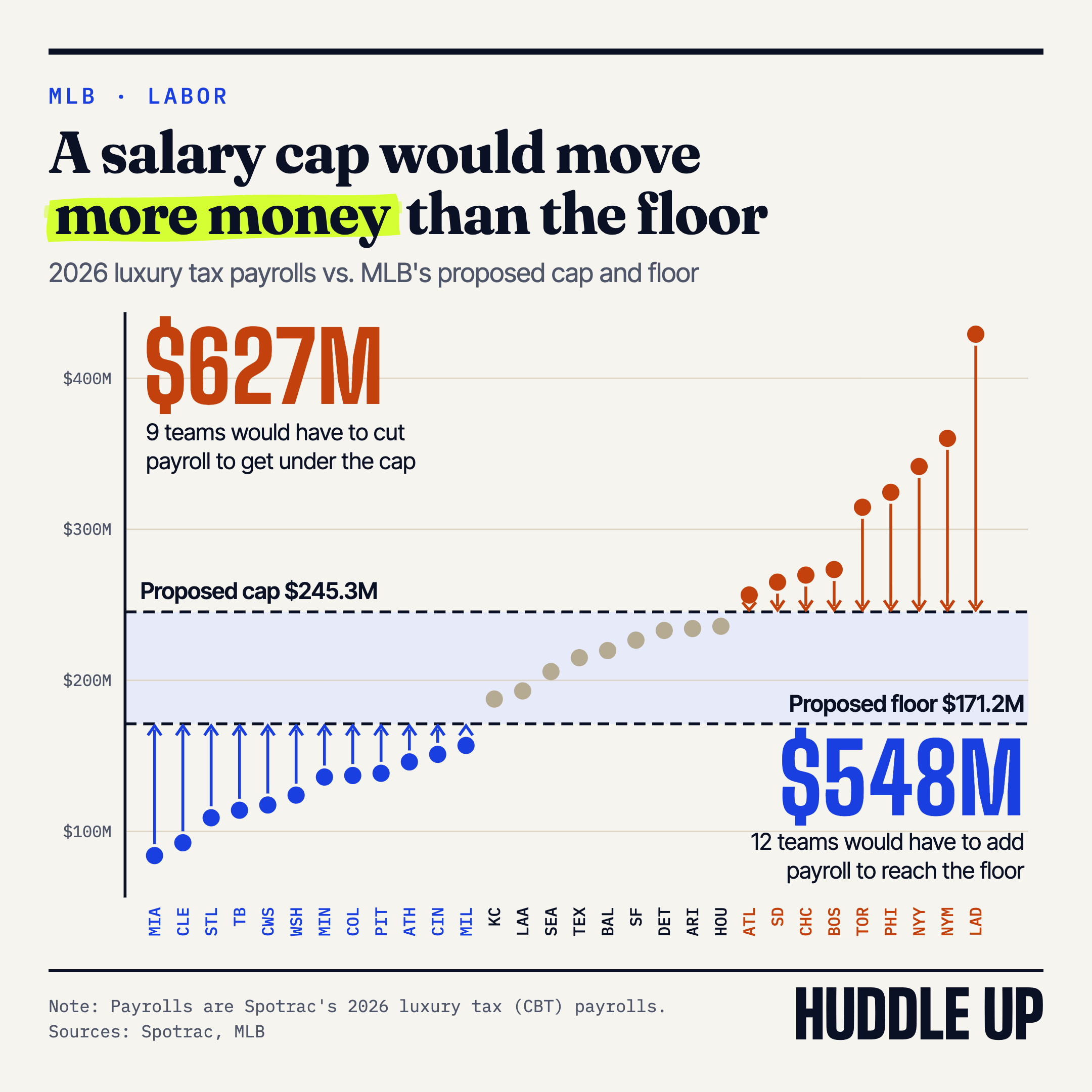
Owners say this proposal makes sense because 1) it would require notoriously low-spending teams (that usually record large profits) to spend more money on player salaries, 2) this is how other major U.S. sports leagues operate, and 3) salaries would actually increase in year one under the proposed salary cap/floor structure.
On the other hand, MLB players oppose the salary cap because it changes the bargaining environment. They say player salaries will only go up in year one because current contracts would be guaranteed, and once owners have to fit players into a strict budget based on league-wide revenue sharing allocations, a salary cap/floor system could end up costing players more than $500 million.
The tricky part is that both things can be true. But let’s not kid ourselves. We all know why MLB owners want to implement a salary cap. Predictable labor costs can make future cash flows easier to finance and a franchise more attractive to buyers. Franchise valuations would go up, and several owners would cash out.
This is a highly complex topic, and anyone who tells you they know how this will end is either naive or lying. That said, I also think everyone is asking the wrong question. Given that we know why owners want a salary cap and why players oppose it, the better question is: Who will ultimately come out on top? And to answer that question, all you have to do is look at who has more leverage.
What MLB Players And Owners Stand To Lose
In the simplest sense, the salary cap fight is essentially a contest over who can afford to wait the longest. With the current CBA set to expire on December 1, a lockout would start on December 2. Spring workouts start on February 9, and Opening Day is March 24. That gives MLB owners and players about 4-5 months to negotiate a new CBA before regular season games get canceled or postponed.
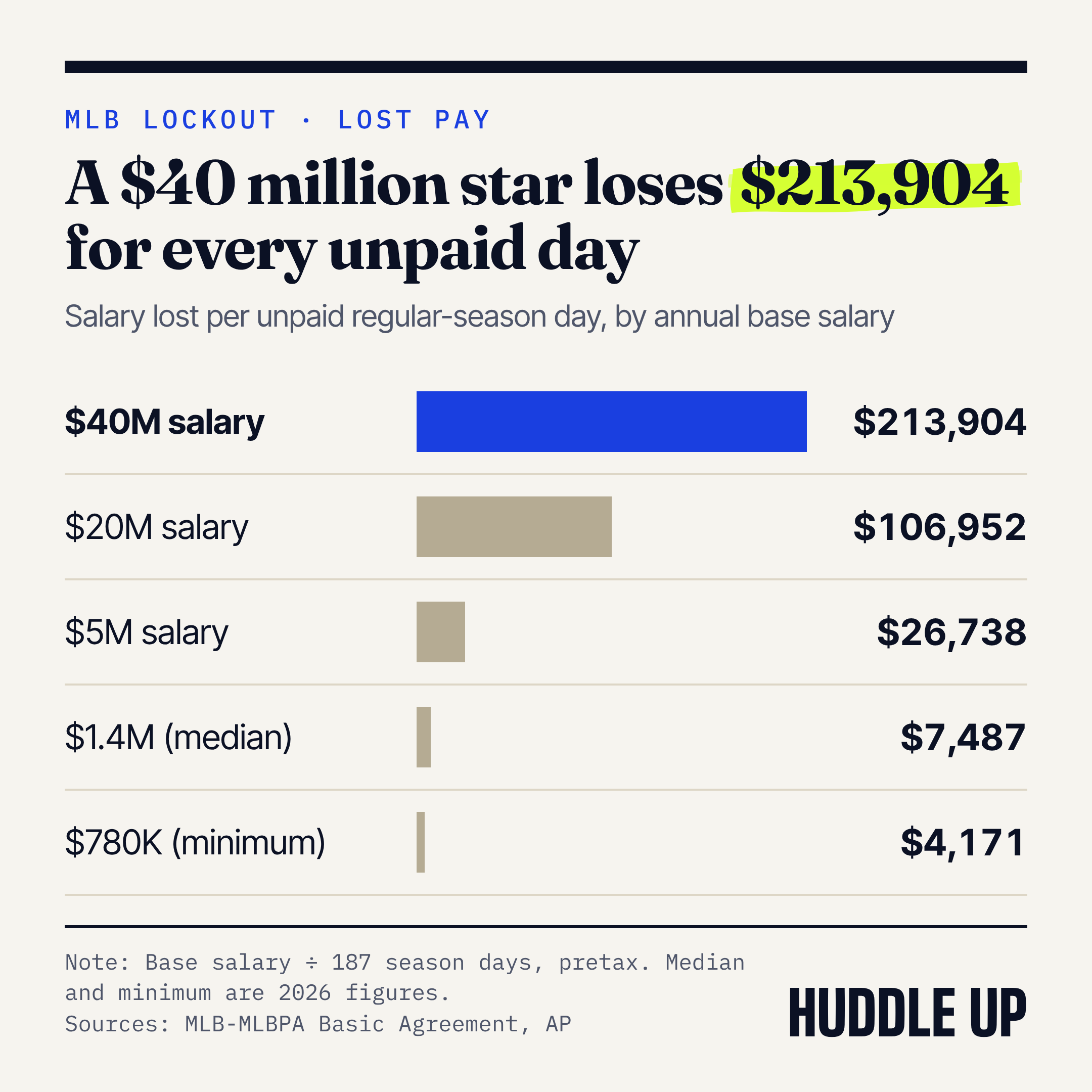
For players, salary is the largest measurable exposure. MLB salaries are based on a 187-day season, with every unpaid day accounting for 1/187th of their salary.
That makes the math easy. For example, a player making $40 million per year in salary would lose $213,904 for every unpaid regular-season day during the lockout.
But since only a handful of MLB players earn $40 million annually, the median salary ($1.4 million) and minimum ($780,000) are better examples. At $7,487 in lost income per unpaid day, the median MLB player earning $1.4 million annually would lose $224,599 in salary during a 30-day lockout, while a player earning the league minimum ($780,000) would lose $125,134 during the same timeframe.
And if you look at all MLB players collectively, the numbers get even bigger. With MLB teams paying out $5.32 billion in salary last year, players would lose $28.4 million every unpaid day and $853 million if the lockout went on for 30 days.
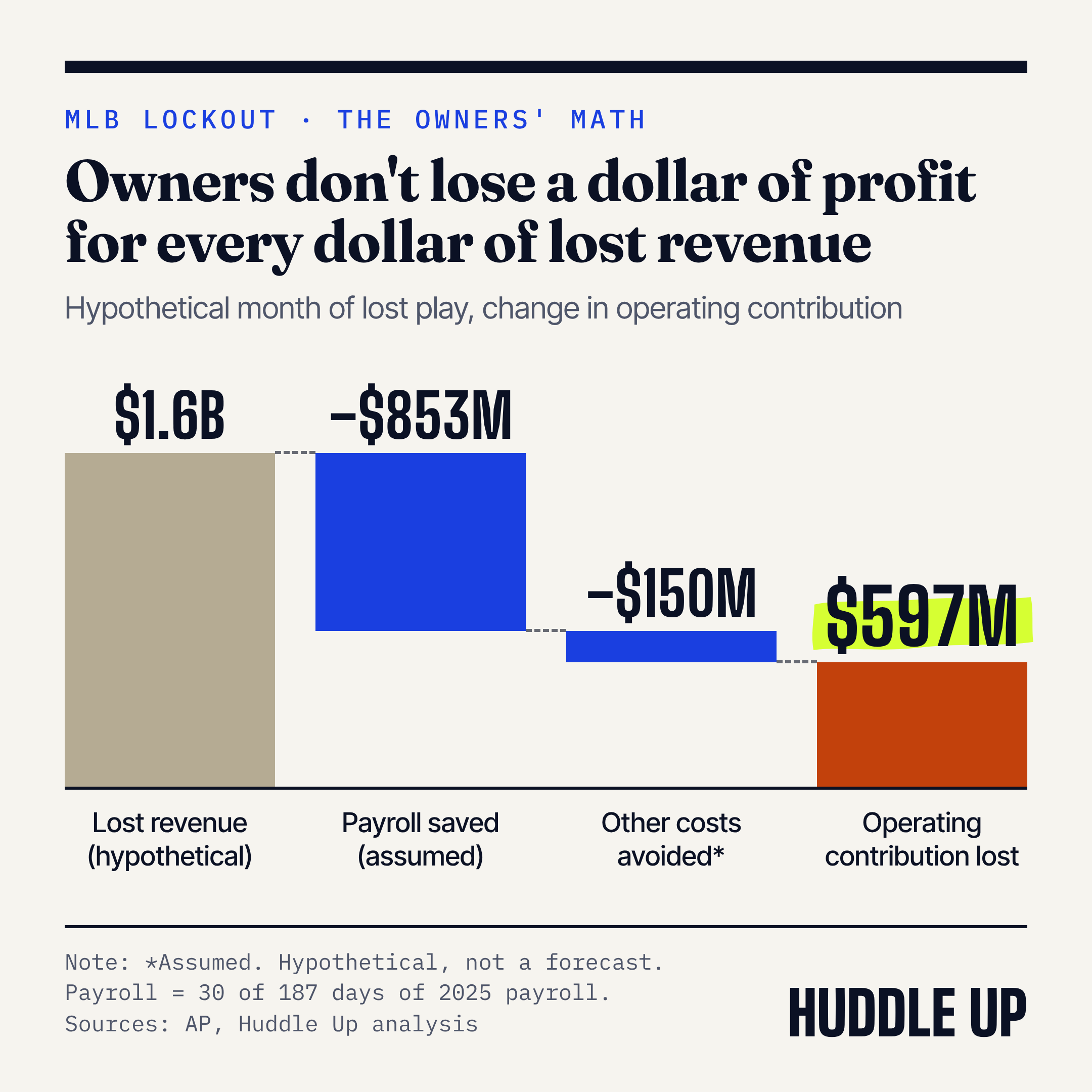
Player salaries are easy to quantify because the information is public. Calculating ownership losses is another story. The important caveat is that owners don’t lose a dollar of profit for every dollar of lost revenue (because expenses also go down).
So let’s run through a hypothetical: All 30 MLB teams collectively generate about $2 billion in gross monthly revenue during the season. If we assume 20% of that revenue will be collected regardless because of guaranteed baseline contracts, MLB’s 30 teams would lose $1.6 billion in monthly revenue during a lockout.
You can then subtract the $853 million saved by not having to pay player salaries, plus $150 million in operational and staffing cost reductions. That leaves owners with a net loss of $597 million per month during a lockout, or $20 million per club.
Comparing The MLBPA War Chest To Owner Reserves
Now that we understand how much players and owners stand to lose during a potential lockout, let’s talk about financial leverage. Since everyone has been discussing this lockout for several years, it shouldn’t surprise anyone that MLB players and owners have spent the last few years building their cash reserves.
As of December 31, 2025, the MLBPA had $519.3 million in total assets, including $415 million of cash and easily sellable investments (U.S. Treasuries), while MLB’s 30 owners have a lockout reserve fund worth $2.25 billion ($75 million per club).
Rather than requiring players to contribute a percentage of their salary to the centralized fund, the MLBPA just kept all player licensing revenue over the last two years. So instead of players receiving a share of the $106.4 million Fanatics paid the union last year, all of that money went into the MLBPA’s reserve fund. Of course, the MLBPA can distribute unused reserves after a new agreement is reached. Following the 2022 agreement, the union returned more than $200 million in licensing distributions, with some players receiving about $200,000.
If a new CBA is negotiated before a lockout, the MLBPA will pay its players what they were supposed to receive, similar to what happened in 2022 when the MLBPA released more than $200 million in licensing revenue to players.
As for MLB owners, building a $2.25 billion reserve fund didn’t require them to write personal checks either. Instead, all 30 owners agreed to sacrifice a small percentage of the money they would have received from national revenue-sharing.
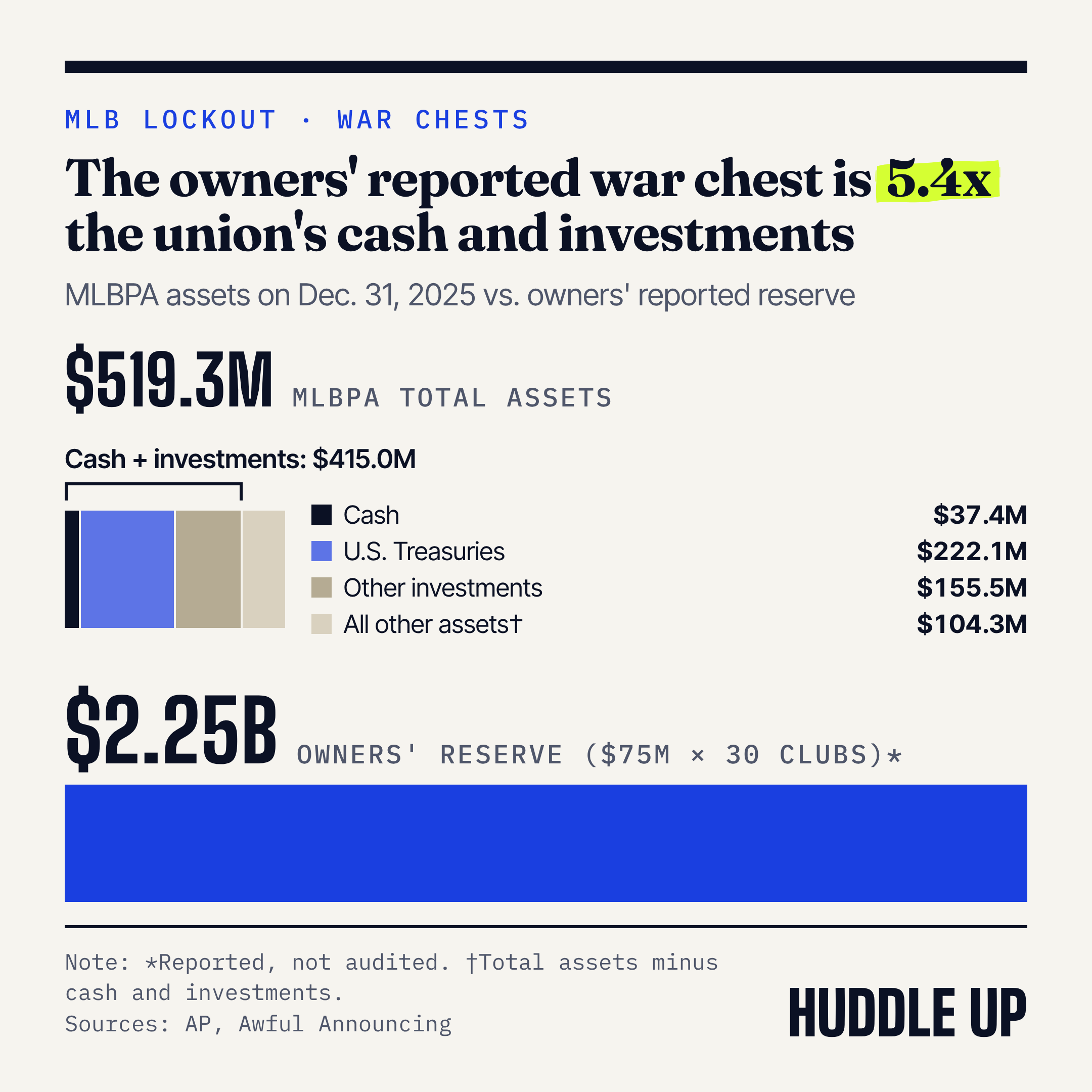
These numbers put MLB owners in a more advantageous position. That’s because a $75 million distribution (from the $2.25 billion reserve) would cover 3-4 months of team losses during a potential lockout, while the MLBPA’s $415 million in cash and investments covers only 14.6 days of last year’s $5.32 billion in player salaries.
The MLBPA has typically tried to offset this income gap through stipends. In other words, rather than paying each player their full contractual salary, the MLBPA gives each player a stipend of $5,000 per month or $15,000 per month.
The MLBPA does this because 1) it would run out of money too fast if it paid out full salaries and 2) its job is to keep a broad membership able to participate in collective bargaining, not necessarily replace a star player’s full monthly earnings.
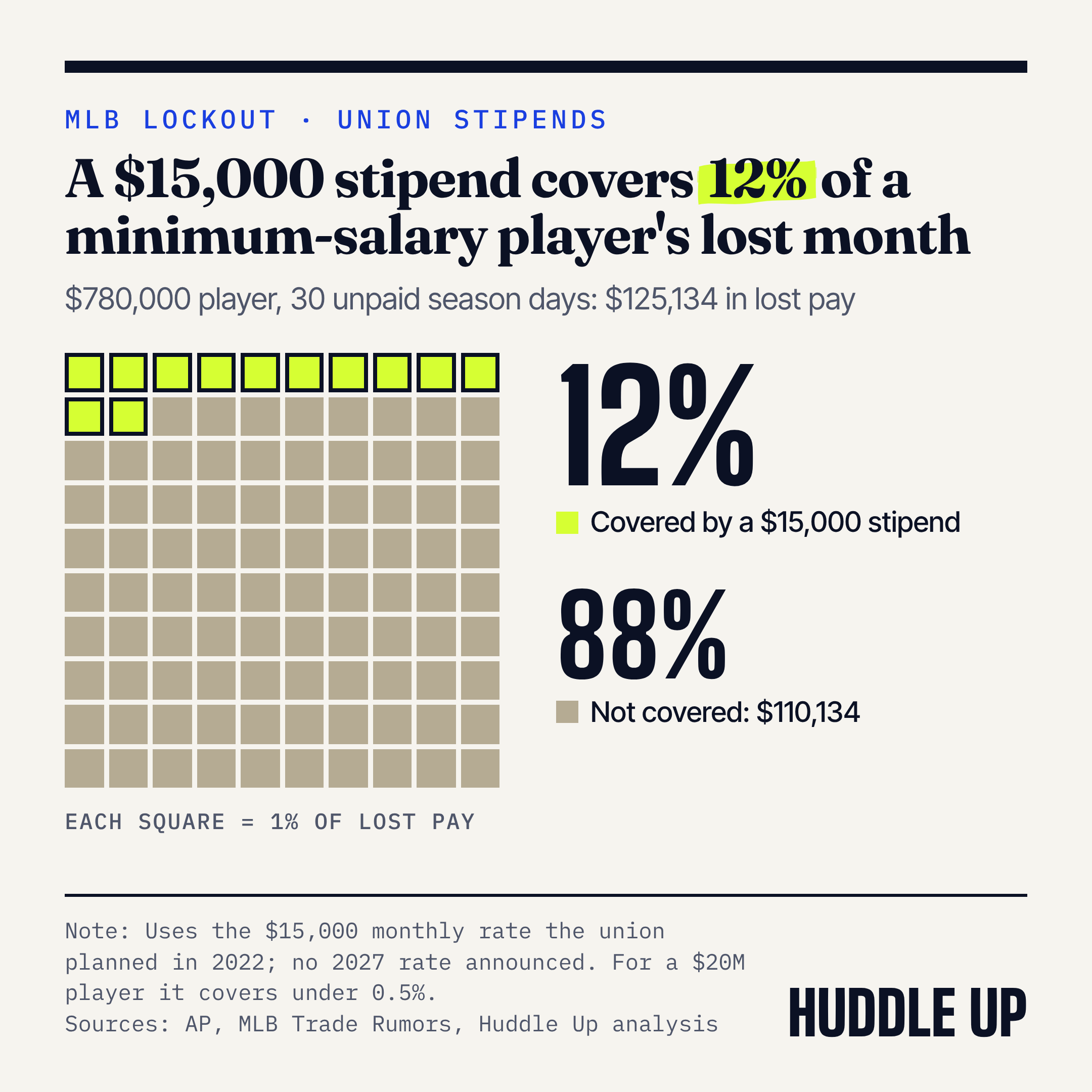
A $15,000-per-month stipend covers only 12% of a minimum player’s lost monthly pay, cutting his financial loss from $125,134 to $110,134. And while that number is largely inconsequential to the median MLB player — $15,000 covers less than two days of salary for a player earning $1.4 million annually — offering small stipends extends the MLBPA’s cash runway from 14.6 days to nearly two years.
The Wild Card: 60 Canceled Games, TV Deals Extend
It doesn’t take a genius to realize owners have more power in a lockout. Even if we ignore the fact that the MLBPA represents 1,200 professional players, not just the ones making tens of millions per year, teams like the Atlanta Braves have $116 million in cash and access to another $200 million-plus through undrawn credit facilities. That could extend their runway well beyond the initial 3-4 months.
But money also isn’t the only source of leverage. In fact, you could argue that the MLBPA’s strongest leverage doesn’t revolve around money at all. It’s the TV deal.
According to The Athletic, most of MLB’s TV contracts, which are worth more than $2 billion annually, require the league’s partners (Fox, TNT, etc.) to pay MLB in 2027 even if no games are played. That means team owners would receive 17% of the league’s $12 billion-plus in revenues without a single game being played.
This theoretically gives owners even more leverage. Players don’t get paid, but owners still get their TV money. However, there is an important caveat. While Fox, TNT Sports, and other partners would still have to pay MLB its media rights fee even if no games are played, the league’s national broadcast contracts would extend another year if at least 60 games are canceled during the lockout.
If 60 games are canceled, MLB’s national broadcast deals would extend from 2028 into 2029. The league’s broadcast partners would then pay a reduced rate for the 2029 season. But more importantly, this would push MLB’s negotiating window for new TV contracts at least 12 months down the line. That delay alone could be worth hundreds of millions of dollars in today’s lucrative sports media rights environment, and it’s something the MLBPA will certainly use to create urgency.
If you enjoyed today’s newsletter, share it with a friend.