The bottom seems to have been reached: after two years of shrinking, the German economy grew slightly in 2025. The gross domestic product rose by 0.2 percent after deducting the inflation rate, the Federal Statistical Office announced on Thursday based on preliminary estimates. The economy was stimulated primarily by the state and the people in the country. “The growth is primarily due to increased consumer spending by private households and the state,” said the President of the Federal Statistical Office, Ruth Brand.
In contrast, exports have fallen again and companies’ weak investment has also continued. This is also reflected in the banks’ lending business, as statistics from the Bundesbank that are available to the taz show.
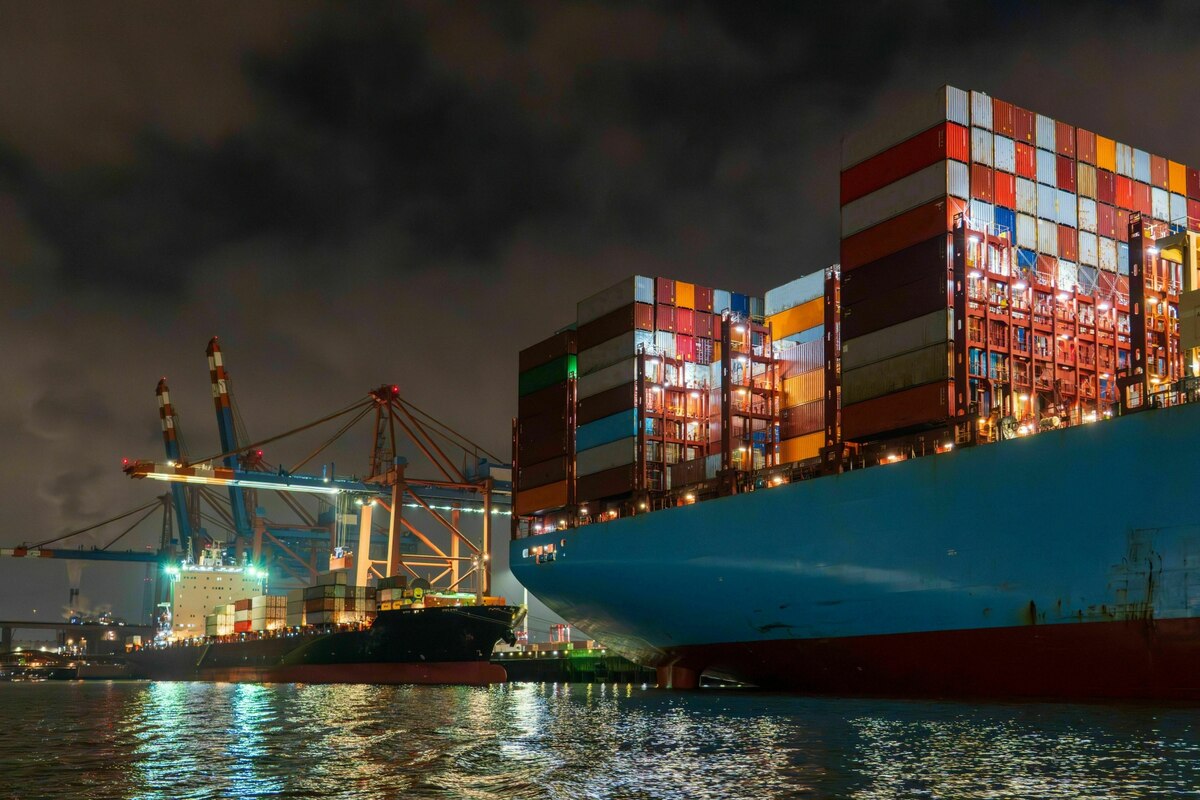
The core areas of the German export industry in particular suffered the customs battles initiated by the USA and increased competition from China. Exports to both countries fell by 7.8 and 11.9 percent respectively. Overall, German exports fell by 0.3 percent last year.
German industry in particular sold fewer vehicles, machines and chemical products abroad, with these goods making up around 40 percent of total exports. As a result, there was still a lull, especially in industry. Gross value added in the manufacturing sector fell again this year. The minus was 1.3 percent. Only in the construction industry was it larger, at minus 3.6 percent.
The weakness of the industry is now also reflected in the labor market. Reports of job cuts have not been uncommon in recent months. In industry, the number of employed people fell by 2.2 percent last year, while overall it remained almost unchanged at 46 million employees.
Companies as an obstacle
While the state and private households spent more money and thus supported the economy – their spending rose by 1.5 and 1.4 percent respectively – this development was also reflected in a lack of investment by companies. In particular, they spent less on equipment (minus 2.3 percent) and machinery (minus 3.3 percent), which proved to be a drag on the economy last year.
The weak investment is also reflected in the banks’ lending business: While the financial institutions in the Eurozone gave companies a lot of fresh money – last November, book loans increased by 3.4 percent compared to the same month of the previous year – the lending business in Germany was rather poor, as figures from the European Central Bank (ECB) and the Bundesbank show. In this country, the value of loans to companies on banks’ balance sheets grew by just 0.39 percent. This means that Germany is at the bottom of the list in the monetary union after Luxembourg.
How credit is going is an important economic indicator because fresh money is, so to speak, the grease of the economy. Companies borrow money from banks, and not just to bridge financial bottlenecks. Loans are much more important when expanding the business. Many investments are made not only with our own capital, but also with the capital of banks. In doing so, they stimulate the economy and create jobs.
In Germany, both economic growth and companies’ investments in their equipment were below average compared to the euro area. “The restrained lending fits in with this,” the Bundesbank wrote to the taz when asked. In contrast to the euro area, where the recovery in loan business with non-financial companies began as early as 2024, there has so far been no discernible trend of recovery in the corporate customer business of banks in Germany. “In the previous three quarters, lending to domestic non-financial companies was even slightly negative on balance,” said the Bundesbank.
The economy is growing in Greece
Things were different in Greece, for example. The value of loans there rose by 10.2 percent in November, and investments in equipment also increased by 12.8 percent in September. “That’s no wonder. The economy is doing really well in Greece,” says Silke Tober from the Institute for Macroeconomics and Business Cycle Research (IMK) to the taz. Unlike in Germany, new jobs would also be created by Europe’s problem child. In the summer, economic output there grew by 2 percent, while in this country it was 0.3.
For financial expert Tober, the reasons for the stagnant lending business are not just companies’ reluctance to invest: “The banks are also stricter when it comes to granting loans.” After the economy had already shrunk in 2023 and 2024 and only grew moderately last year, banks would assess the risk of default on loans to be higher than when the economy was still going well. That would make new capital more expensive for companies, if they can get money from the bank at all, and thus make investments even more difficult.
Tober is therefore in favor of further interest rate cuts by the European Central Bank. This would reduce financing costs for companies and thus stimulate the economy. Especially since the inflation rate fell further in December and is expected to be below the ECB’s 2 percent target next year. Because high energy prices and trade conflicts would continue to pose risks to the economy.
But poor lending is not an indicator that the economic downturn will continue in 2026. “The stagnation will not last. The state impulse with the special fund created for public investments and the increased defense spending is too strong for that,” says Tober. She and her colleagues from the IMK are assuming economic growth of 1.2 percent. That’s why, according to Tober, the lending business would probably grow again this year.
Optimism for 2026
Tober and her IMK colleagues are not alone in this optimism. Other economic institutes also assume that the economy will pick up again this year. The German Institute for Economic Research (DIW) expects growth of 1.3 percent, while the Munich Ifo Institute is somewhat more skeptical at 0.8 percent.
One fact also makes expert Tober positive: In contrast to the business with short-term loans, that with long-term loans has recently grown strongly again by 2.48 percent. And companies borrow long-term money from banks for one thing in particular: for investments.