

It’s Thursday, November 5. This is The Front Page, your daily window into the world of The Free Press—and our take on the world at large. Today: Joe Klein on whether the Democrats can capitalize on their midterm triumph. Audrey Fahlberg, Michael Brendan Dougherty, and Rod Dreher on the GOP blame games. Olivia Reingold on the meaning of Abdul El-Sayed’s victory in Michigan. Jesse Arm and Yemisi Egbewole on what a divided Washington will look like. And more.
But first: The highway that explains the midterm results.
There was good news for Democrats nationwide on Tuesday, but if you want to understand why they did so well—and what the party needs to do to capitalize on their victory—the legendary political journalist Joe Klein says you must focus not just on one part of the country but a single highway: the I-35 corridor that starts in Laredo, Texas, and winds its way up through Kansas, Iowa, and Minnesota.
It is, Joe writes, “where the election of 2026 took place, spiritually and politically.” It is also “where the governing strategy for the Democratic Party should now reside.” If you want to understand not just what happened on Tuesday but what the next two years hold, read Joe on the I-35 Democrats and the lessons contained in their triumphs.
—The Editors

Red Faces on the Right
It didn’t take long after the blue wave swept the country for one question to rise to the fore among Republicans: Who’s to blame?
Some of those Republicans have the cell phone number of Free Press Washington correspondent Audrey Fahlberg, who reports today on the vicious fight to evade responsibility for Tuesday’s GOP disaster.
“On Wednesday, the mood inside the White House was bleak,” reports Audrey. “Aides and other officials had expected to lose, but not this badly.” In her piece today, Audrey takes us inside the Trump administration, where aides and cabinet secretaries are already pointing fingers. Who’s responsible? Is this the end of MAGA? And what does it mean for 2028?
If you ask conservative columnist Michael Brendan Dougherty, the most plausible explanation for Tuesday night’s rout is the simplest: the unpopular war with Iran. Trump started the fight, writes Michael, made himself personally responsible for its outcome, and ensured his party would bear the cost. Republicans lost power, he argues, because their leader promised to put “America First” and did anything but.
So where do Republicans go from here? For Rod Dreher, the answer depends on their willingness to clean house. Some on the radical right, like Nick Fuentes and the Groypers, had backed the Democrats this cycle with the explicit intention of burning the GOP to the ground and rebuilding it in their image. More broadly, an angry faction of young conservatives see the defeat as a reason to embrace white identity politics. That, says Rod, would be a disaster for the Republican Party, and a disaster for the country. If anyone is serious about fixing the GOP, argues Rod, they need to make enemies to the right.
And for more on the midterms and the beginning of the end of MAGA, read Ross Douthat’s latest column:

Abdul El-Sayed and the Israel Test
In the early hours of Wednesday morning, Democrat Abdul El-Sayed defeated Republican Mike Rogers in the Michigan Senate race, one of the most hotly contested battles this cycle. Olivia Reingold spent election night at Abdul El-Sayed’s victory party in Detroit—and after the “Free Palestine” chants and victorious whoops died down, she spoke with supporters about what drove them to the polls: gas prices, concerns over “anti-Muslim” rhetoric, and Palestine. Read her dispatch on what propelled the Muslim progressive firebrand to victory, and why his win signals a seismic shift for the Democratic Party.
It’s a peculiar reality that a domestic congressional race had so much to do with Israel—and yet the Jewish state has for years been a proxy fight for the domestic grievances of both political parties. At issue in particular is U.S. aid to Israel, which Trump addressed early Tuesday with the announcement that America would pause $4 billion in military aid by the end of 2026. Liel Leibovitz, a staunch defender of Israel, has long argued in favor of ending the funding. But the way Trump’s decision came about, he writes today, makes it impossible to “consider the statement as anything but a last-minute campaign stunt.” Read his piece to understand why—and why he says the midterm results may actually be an opportunity to establish a new, and better, framework for the U.S.-Israel alliance.

What Comes Next for a Divided Washington?
Now that the Democrats will have wide margins in both houses, the question is: What will they do with them? And how will Trump operate in a divided Washington? For answers on all that and more, tune in to the latest conversation between two of our favorite Washington insiders (don’t worry, it’s a short list).
Democratic consultant Yemisi Egbewole and Jesse Arm of the conservative think tank the Manhattan Institute talk through what happened on Tuesday, and what is coming next in the capital. Tune in below:
MORE FROM THE FREE PRESS
THE NEWS
-
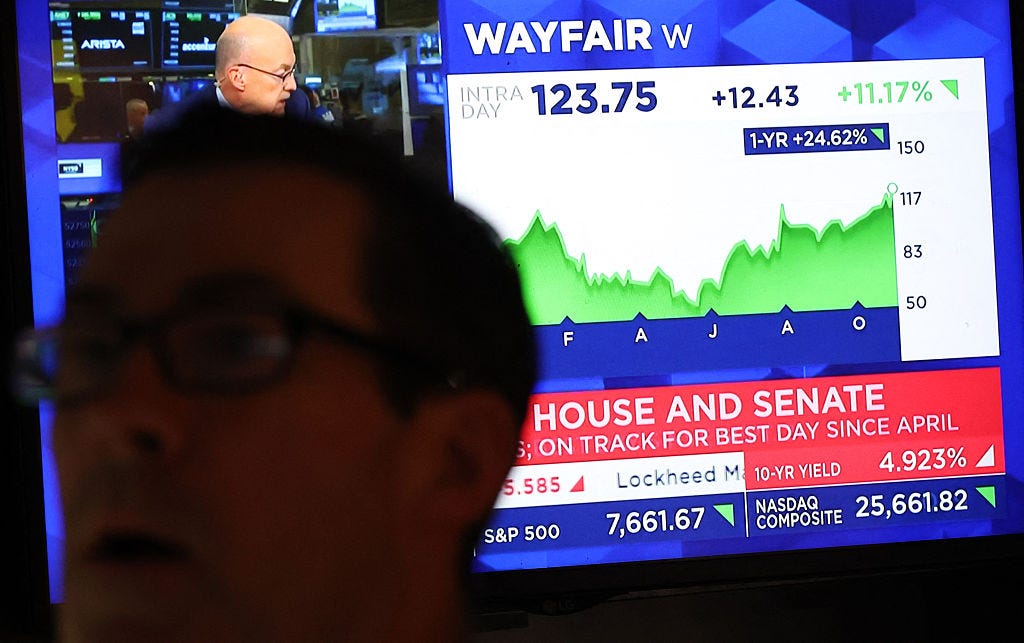
The Dow surged 1,500 points on Wednesday following the Democratic victory in both houses of Congress, with the S&P 500 seeing its largest daily gain in months. Meanwhile, shares of Elon Musk’s Tesla and Space X dropped by three and four percent, respectively. The two companies are exploring a merger, which could run into problems with a Democratic Congress.
-
New York State attorney general Letitia James is stepping back from the investigation into an alleged rape at Cornell University, handing the probe to a former Manhattan prosecutor with a background in sex-trafficking cases. James, who was appointed this fall as special prosecutor for the high-profile case by New York governor Kathy Hochul, drew criticism for her lack of experience in sex-crimes prosecutions and expressions of solidarity with the alleged victim on social media.
-
The death toll from a Russian attack on a Ukrainian aid center rose to 40 on Wednesday, according to a social-media post from President Volodymyr Zelensky—and could reach as high as 70 as search and rescue efforts continue. Russia’s defense ministry denied targeting civilians and claimed the strike targeted Ukraine’s military and as many as 25 Ukrainian soldiers were killed.
-
The Alaska Senate race has not yet been called and could span a period of weeks in a long ballot-counting process. With 75 percent of the vote in as of 5:30 a.m. ET on Thursday morning, the race between incumbent Dan Sullivan and Democrat Mary Peltola remains a toss-up. A New York Times investigation found Peltola’s campaign recruited a spoiler candidate, also named Dan Sullivan, to siphon votes away from the GOP nominee, something Peltola denies.
-
A clinical trial in the UK will be the first to assess whether simple blood tests can help diagnose cancer earlier and improve chances of survival. The tests will scan blood samples for signs of cancers and link them to organs in the body, and will screen for abdominal cancers including prostate, ovarian, bowel, pancreatic, stomach, and liver, which are frequently diagnosed too late.