

By Roberto Valadéz
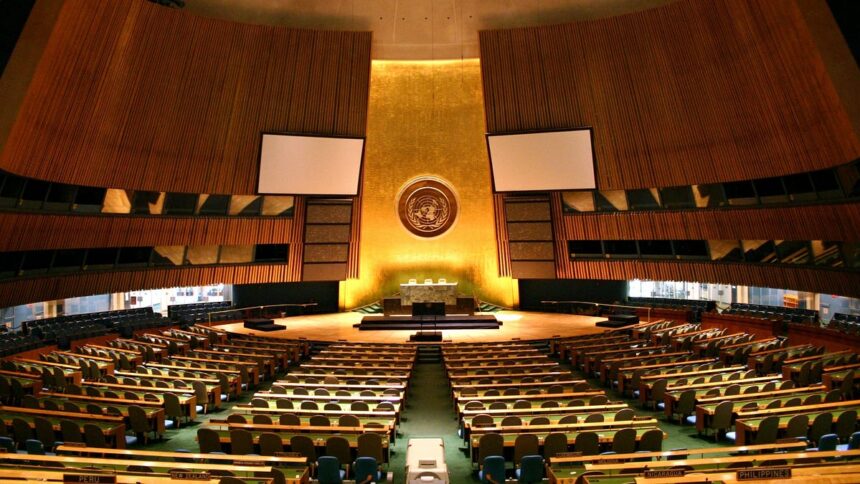
The United Nations was created for moments like this. Strained geopolitical relations. Competition among great powers. War-induced humanitarian crises. More than eighty years later, the mandate — and the promise — of the United Nations remains as imperative as ever.
Precisely because these are difficult times, the forthcoming selection of a new Secretary-General feels profoundly consequential. This moment requires that we meet it by selecting a leader who is more than an accomplished administrator. We need a diplomatic linchpin.
At the same time, a paradox exists that threatens to compromise any Secretary-General before they’ve even taken office. Whoever is selected to uphold the values, and defend the independence, of the United Nations must first secure the support of the five permanent members of the Security Council — the United States, China, France, Russia, and the United Kingdom — any one of which can veto the Council’s recommendation of a candidate.
Thus, the paradox: before a candidate can be selected, they must carefully navigate the distinctive interests of these five powers, while committing to operate independently of them once taking office.
The selection process
The next UN Secretary-General will serve a five-year term, with the possibility of reappointment. The process formally began in November 2025, when the Presidents of the General Assembly and Security Council invited member states to nominate candidates. This year’s process includes additional transparency measures under a General Assembly resolution requiring candidates to publicly disclose their credentials, vision statements and campaign-financing information. They have also participated in public dialogues with member states and civil society. The Security Council is now considering the candidates and will recommend one to the UN General Assembly, which makes the formal appointment.
The question worth asking now is not simply who gets the job, but what kind of leader this process was designed to produce.
Money is power
The next Secretary-General will lead an institution markedly less stable than the one presided over by their predecessors. Governments that once helped build the UN are openly questioning it, with their lack of support most acutely reflected in the financial crisis the UN is currently confronting. In January, the current UN Secretary-General António Guterres warned that the UN was at risk of “imminent financial collapse” as member states — notably the U.S. — failed to meet their financial obligations. By mid-year, overall arrears across the regular budget, peacekeeping and two international tribunals had exceeded $6.5 billion.
The U.S., historically the UN’s largest financial contributor, has under President Donald Trump retrenched from the multilateral system. In January, the administration directed the U.S. to withdraw from 66 international organizations, including 31 UN entities, citing misalignment with U.S. national interests.
Yet Washington has demonstrated that stepping back does not necessarily mean surrendering influence. Money is power, after all. And funding determines what can operate, what can expand and, in times of austerity, what must contract. That was made clear again last week when Washington paid $725 million toward its regular budget assessment and another $102 million toward peacekeeping. The payments removed the immediate risk of the U.S. losing its General Assembly vote because of unpaid dues, but $1.3 billion is still owed to the regular budget.
This episode captures an important contradiction in America’s current relationship with the UN — a challenge the forthcoming Secretary-General can neither ignore nor become subordinate to. They must manage the financial pressure without allowing it to consume the office’s political capital — or divert attention from immediate conflicts and crises, alongside the longer-term challenges of climate change or AI regulation.
The office is bigger than the job description
There is precedent for a Secretary-General finding a way out of the Security Council paradox: by expanding the possibilities of office once elected.
Dag Hammarskjöld, the second UN Secretary-General, is revered for reshaping the role from what had been perceived as largely ceremonial into an executive power. During the Suez crisis in 1956, he helped establish the first large-scale UN peacekeeping force, negotiating rapidly with governments and creating a model for peacekeeping that would endure for decades. During the Congo crisis, he again used the authority of the office to pursue international peace and resist being used to advance the interests of any single government. Hammarskjöld’s distinctive style of “preventive diplomacy” — keeping regional conflicts from being pulled into superpower rivalry — remains a lasting legacy.
Kofi Annan, who served as UN Secretary-General from 1997 to 2006, likewise demonstrated how expansive the role can be when the office is used as a platform for diplomacy and agenda-setting. He personally negotiated an agreement with Saddam Hussein in 1998 that opened Iraqi presidential sites to UN weapons inspectors and helped avert U.S.-led military action. He also elevated global development into a central UN priority, helping turn the Millennium Development Goals into an organizing framework for international cooperation on poverty and health.
Neither Hammarskjöld nor Annan acquiesced to the limitations imposed by the great powers of their time. They leveraged their mandate to realize what the office — and the United Nations itself — could accomplish. The next Secretary-General must follow this precedent.
The answer to a drastically changing international order is not simply to preserve the UN as it is, nor to allow its most powerful members to determine the limits of what it can become. What is at stake is the opportunity to define what multilateral leadership looks like in a new era — and to demonstrate that the United Nations can evolve without abandoning the principles that gave it purpose in the first place.
Roberto Valadéz is the former director of communications and special initiatives for the United Nations Ambassador for Global Health, where he led high-stakes global campaigns, including the office’s work on COVID-19. As the founder of True You, he now equips underestimated C-suite leaders with the tools to level up their leadership and amplify their impact by harnessing their authenticity.