

David Protein is one of the world’s most successful, innovative, and fastest-growing consumer packaged goods (CPG) companies. Situated within a holding company called Medici Brands, David Protein was founded by Peter Rahal. That name might sound familiar to you because Rahal co-founded RXBAR with just $10,000 in his parents’ basement and scaled it to a $600 million exit to Kellogg.
On the surface, this story looks simple: RXBAR was a massive success, so after Rahal’s five-year noncompete with Kellogg ended in 2022, he decided to run the same playbook again. Rahal leveraged RXBAR’s success to raise $10 million from VC firms and celebrity health expert Andrew Huberman. Prior relationships with retailers like Walmart and Target put David’s protein bars in thousands of stores on day one, and the firm generated more than $130 million in sales in its first year.
As a result, David’s parent company recently announced a $250 million Series B fundraising round at a reported $2.25 billion valuation. And since the company was founded just 24 months ago, that makes David the fastest-growing CPG brand in history to reach a $2 billion valuation, ahead of Skims (28 months), Vuori (77 months), Bodyarmor (91 months), Poppi (118 months), and Orgain (157 months).
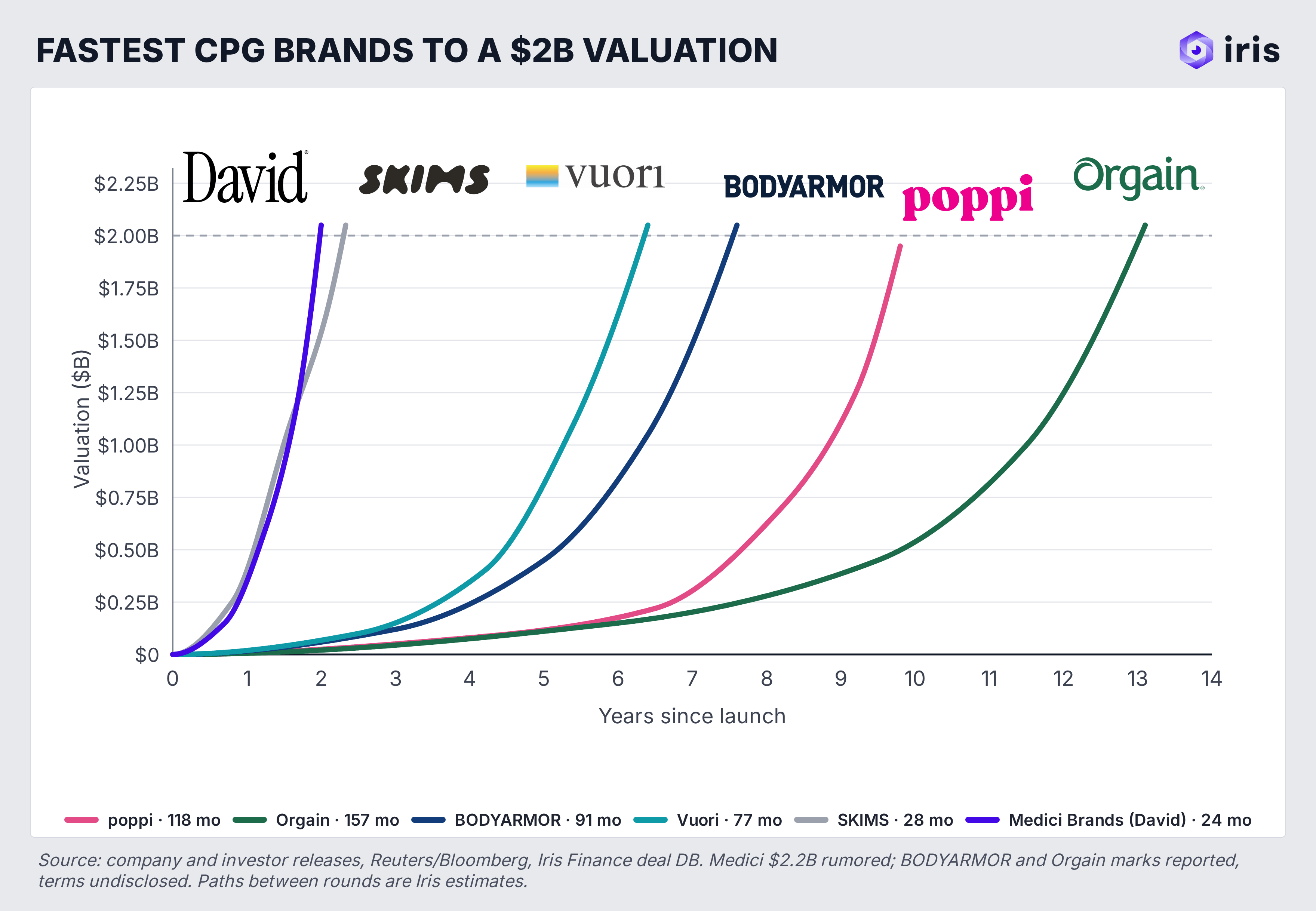
But that’s really only half the story. The truth is, Medici Brands didn’t score a $2 billion valuation because of its protein bars. Investors agreed to provide capital at a $2 billion valuation because Rahal is attempting to re-engineer popular junk foods into better-for-you alternatives without compromising on taste or texture.
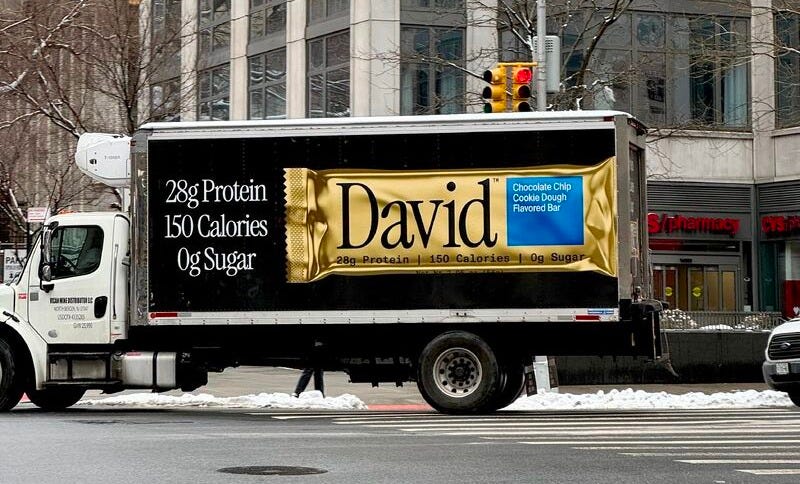
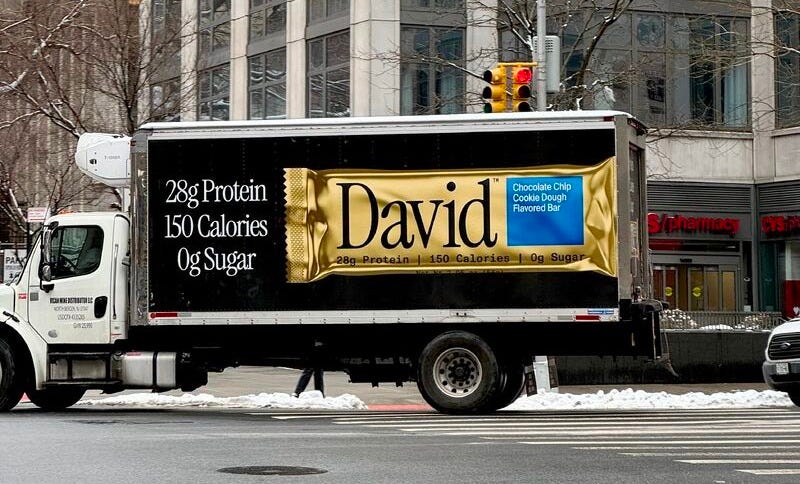
David’s macronutrients are the most important part of the story. Unlike most protein bars, which have approximately 20 grams of protein, 250 calories, and 10 grams of sugar, David’s most popular protein bar has 28 grams of protein, 150 calories, and 0 grams of sugar. At four calories per gram of protein, 75% of David’s calories come from protein, compared with just ~25% for most competitors.
So how does David do this? Well, that’s where it gets interesting. We could talk about Rahal’s marketing background — RXBAR’s ingredient-led packaging was genius, and David’s gold branding is based on the iconic PowerBar line — but the company’s early success likely wouldn’t have been possible without an ingredient chemically known as Esterified Propoxylated Glycerol, or EPG for shorthand.
The easiest way to explain EPG is that it is a modified, plant-based oil designed to act as a fat alternative. It cooks, tastes, and has the same texture as traditional fats, but since the body can’t digest it in the same way, EPG has just 0.7 calories per gram compared to 9 calories per gram of traditional fat. This matters because while today’s better-for-you alternatives usually deliver vastly different taste profiles than comparable higher-fat options, EPG helps David deliver the same taste profile customers are used to, but one with 92% fewer calories absorbed.
I know we don’t usually write about food companies, but just stick with me. David isn’t interesting because it’s a food story; it’s really more of a business story.
That’s because a company called Epogee makes EPG. Epogee holds several patents covering the process used to manufacture EPG, meaning no one else can use EPG without buying it from Epogee. And while a few other companies sourced ingredients from Epogee before David, the protein bar company became Epogee’s biggest customer. In fact, Epogee couldn’t keep up with David’s demand, as that relationship alone accounted for 150% of Epogee’s production capacity.
Being reliant on a single supplier is obviously a huge risk. You essentially become a prisoner to that company and its management team. Epogee could have hiked prices or messed up inventory, and David would have been out of luck. So Rahal did something that drastically changed his company’s vision: Rahal raised $75 million from investors in his second fundraising round and then used a portion of that money (combined with equity in David) to buy a controlling stake in Epogee.
This was a win-win for both sides. Epogee needed an anchor customer large enough to support industrial expansion, and David needed reliable supply. So by acquiring the company, Rahal solved both issues. Epogee had enough guaranteed demand to invest in expansion, and David vertically integrated its key ingredient.
But I say this move changed Rahal’s vision because owning EPG opened the door for Medici Brands to expand into other categories. Think about it this way: EPG isn’t just useful for protein bars. Since it is essentially just a low-calorie substitute for fat, Medici Brands now owns patents for an ingredient that could be applied to virtually any food category dependent on fat. That includes everything from ice cream and candy to bacon and packaged snacks like chips, crackers, and popcorn.
That distinction matters because David likely had an annual revenue ceiling of around $1 billion to $2 billion before the Epogee acquisition, and CPG multiples would have never supported a $10 billion-plus valuation. But by expanding the company’s product lineup from one category to potentially dozens, Medici Brands can now become a multi-product conglomerate across several different categories.
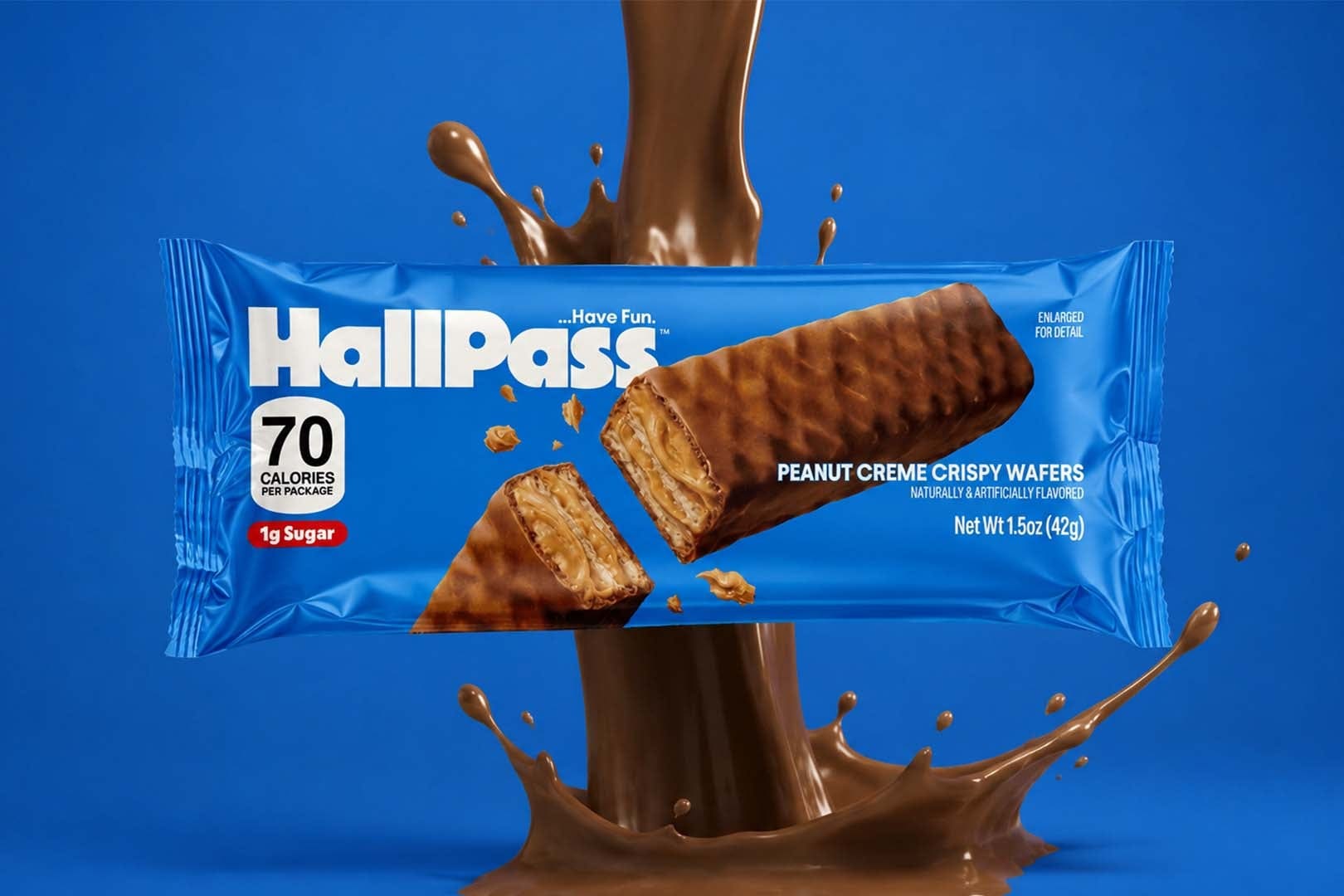
And that’s exactly what Rahal has spent the last several months doing. Medici Brands has already launched an ice cream with 30 grams of protein, 210-260 calories, and 1-2 grams of sugar per pint. The company’s candy brand, HallPass, is now available in every Walmart store and has just 70 calories and 1 gram of sugar per serving. And that’s without even mentioning David’s protein milkshakes and a new chip brand called Rowdy, which is reportedly set to launch later this year.
One thing Rahal probably doesn’t get enough credit for is launching all of these brands under separate names. It would have been easy just to label David as a protein company and apply EPG to various products. Some might even argue that customers would have associated the value prop with each new category much quicker. However, the people who buy protein bars aren’t always buying ice cream or candy, and vice versa. So by creating separate brands, Medici can pursue fitness shoppers, candy buyers, and snack consumers — all featuring EPG.
To be fair, Medici has also faced backlash. Anyone who works in this industry knows that the company has been sued for falsely advertising its calorie count and for cutting off relationships between Epogee and other companies after the acquisition. But both of those lawsuits have been dismissed because 1) the people measuring the calorie count used the wrong protocol and therefore got an incorrect number, and 2) Epogee has started working with smaller, non-competing brands again. The latter is actually something to watch because if EPG becomes more popular, selling the ingredient to other brands that don’t compete with Medici products could open an entirely new revenue stream for the company.
Of course, there are risks: Patents expire, meaning EPG will eventually enter the public domain and anyone can make, use, or sell it without permission. New offerings across frozen foods, beverages, and candy require different operational capabilities and bring different economics. And while David has shown early signs of success, investors are betting that Rahal can turn his portfolio of brands into a high-margin, repeatable purchase, free cash flow-generating machine.
Personally, I think the odds are pretty good. Not only has Rahal already proven that he can scale a food brand to acquisition, but Medici Brands has a much larger total addressable market than RXBAR ever did. If the company’s portfolio of brands can collectively generate $2.5 billion in annual revenue, which doesn’t seem crazy given the breadth of product, ingredient innovation, and early success of David, a 20% EBITDA margin likely results in a $10 billion valuation.
That would make Medici Brands one of the top 50 largest food companies in the world by market capitalization. But while many of those companies have existed for generations (think: Mondelez, JBS, Hershey, Aramark, General Mills, and Tyson), Rahal officially launched Medici Brands just two years ago this month.
If you enjoyed today’s newsletter, share it with a friend.