

So 6 euros per person for taking the elevator up and down 130 meters to then look at Jena sounds steep. But on the other hand: It is clearly cheaper than building the Main Tower in Frankfurt, for example.
Cheaper and more productive. Because of course, anyone who is interested in German high-rise building history has to go to Frankfurt am Main at some point. But first it’s Jena’s turn: Friedrich Pützer built Germany’s first solitary high-rise building here in 1915 for the administration of the Zeiss factory, and after the war, Bauhaus founder Walter Gropius suggested building a real skyscraper next door on Eichplatz. It was exactly there that the Jentower was built 50 years later: its architectural and historical significance still towers over every high-rise building in Frankfurt.
It was planned as a high-rise research building for VEB Carl Zeiss Jena, to which university facilities would be submissively affiliated. In the GDR, VEB stood for state-owned company, and Zeiss remained a systemically important company in every respect, with an international reputation. It was the only computer manufacturer in the GDR, supplied accessories for Soviet space travel and had developed sophisticated armament accessories.
The move never took place and Zeiss never used the tower, which was a bit embarrassing. When it opened in 1972, the building was only called the University High-rise. But it was clearly the tallest building in all of Germany, East and West, and that must be considered a great propaganda success, even if it only lasted until 1973. In any case, from here the view wanders over a panorama of history and stories, finally without the tower: the only way to get rid of it in Jena is, pling!, to conquer it in a two-minute whiz in one of the six elevators.
The peculiarity
The Jentower is a particularly nasty piece of ideological urban planning that has emancipated itself from its original intention in a strange way. From 1972 to 1974 it was the tallest skyscraper in Germany and symbolized the technological ambition of the GDR.
The target group
Anyone who would like to get an overview and is willing to see what they cannot see.
Obstacles on the way
Gatekeepers make sure that the elevator price, currently 6 euros (10 according to city marketing, but that’s wrong), is paid by everyone who doesn’t want to dine upstairs in the restaurant or even drink a coffee for 3.50 euros.
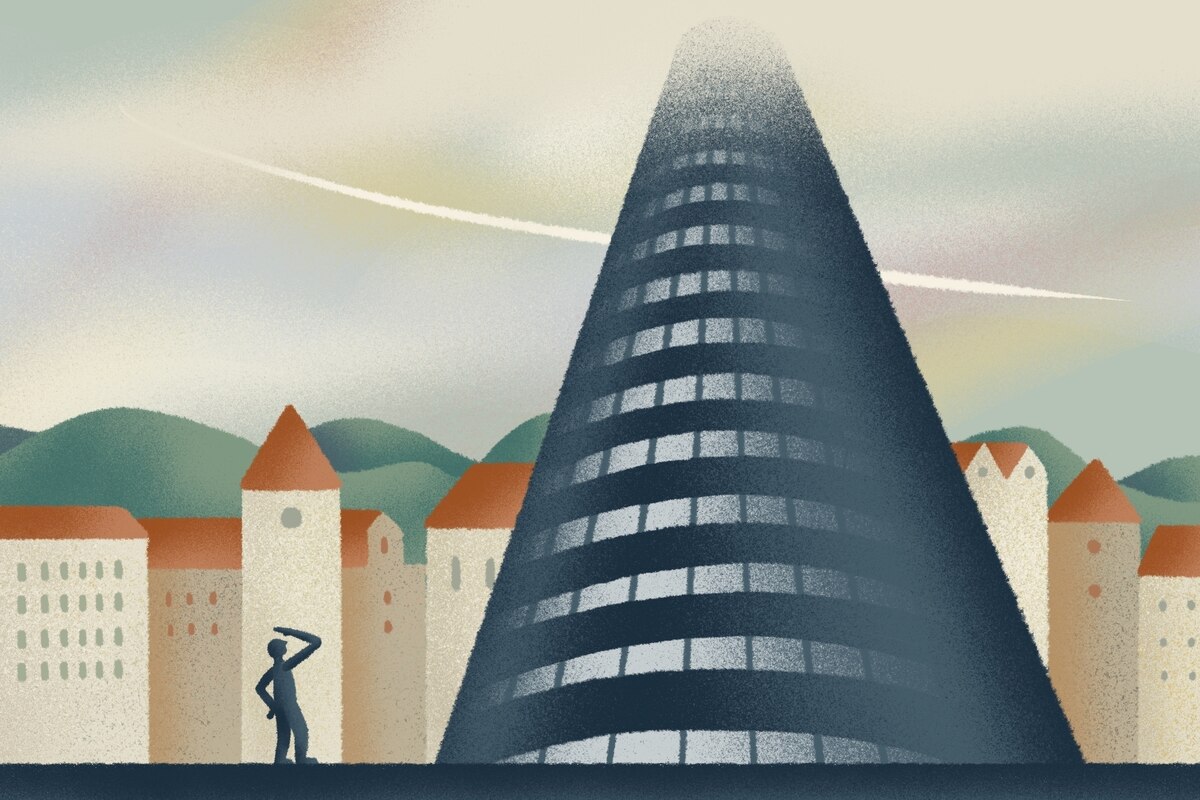
Down in the city he is present everywhere. He inserts himself into every picture like an intrusive mayoral candidate. It is impossible to see only the historic university buildings, only the botanical garden or only the planetarium. The tower is always there.
The superiority of socialism
That was purely intentional: True to the National Development Program in the first five-year plan, the building was intended to express the greatness and superiority of socialism, as Michael Diers talks about in the volume “The Tower of Jena”. “For the first time in the GDR,” “a building for research and production was intended to be the dominant feature of the city” in its historic center.

This text comes from the weekday. Our weekly newspaper from the left! Every week, wochentaz is about the world as it is – and as it could be. A left-wing weekly newspaper with a voice, attitude and the special taz view of the world. New every Saturday at the kiosk and of course by subscription.
This urban planning idea was not particularly GDR-specific at the end of the 1960st. “Old cities had a heart,” complained the urbanist psychoanalyst Alexander Mitscherlich in Frankfurt am Main at the time, criticizing “the heartlessness, the inhospitability of the new construction method” with which the centers were occupied and overwritten. However, the desire to make the old thing seem small and stupid clearly determines the tower project in Jena: “The Zeiss and university town of Jena must be turned into a socialist city of science and technology,” the Politburo had decreed.
Walter Ulbricht himself, at the height of his power, traveled to Thuringia to announce that the architectural design of the center would require “removal of some old teeth.” And not through careful extraction, but through a courageous punch in the face, under the professional guidance of state architect Hermann Henselmann. Around 100 residential and commercial buildings were blown away and an area of one hectare was bulldozed.
But neither Ulbricht nor the GDR were successful in everything. Ulbricht was already cold when the tower opened. And while it was intended to express “the citizens’ pride in their socialist order” and make the “capitalist city of the past” disappear, today it houses a luxury hotel with a fine restaurant and, in the base, an Aldi, a bookstore and the real Deutsche Bank. Yes, this renegade of a tower had already spontaneously allied itself with the picturesque streets and half-timbered buildings around it in the 1970s: its interaction with the old building structure has always created photogenic contrasts. Its dialectical potential is increased even further thanks to the new climate-optimized mirror glass façade: the round high-rise has long since become a landmark.
Probably also thanks to the shape, which was incredibly modern at the time, an stubborn architectural decision that made no sense in view of the tower’s original purpose. The Zeiss management had intensively opposed the inappropriate and costly floor plan, even with Ulbricht himself. But he brusquely rejected all rectangular lobbying.
He is said to have said that he doesn’t care what is being built in Jena – and at the same time elevated the form to the actual function of the building: “The main thing is that it is round.” And that’s how it happened.