

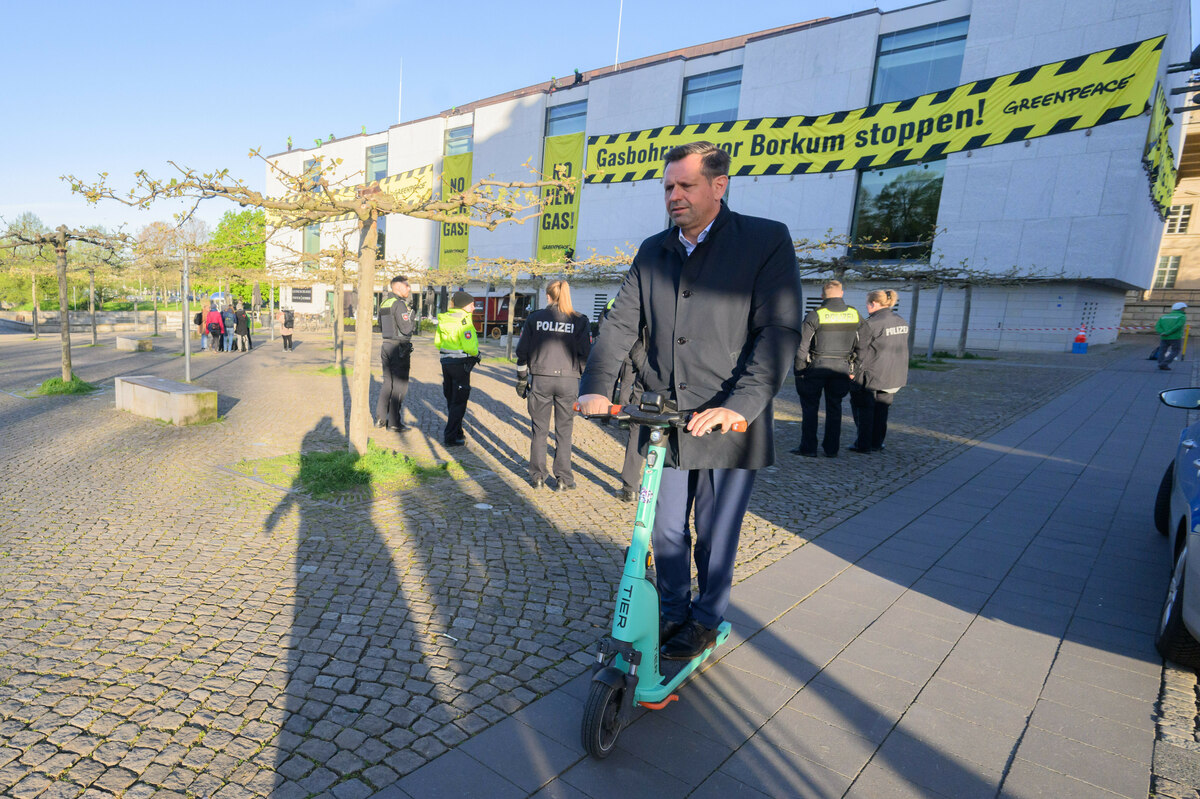
These are serious allegations the German Environmental Aid (DUH) collects: There is talk of a “close relationship” between Lower Saxony’s Prime Minister Olaf Lies (SPD) and the Dutch gas company One-Dyas. From numerous meetings and letters. It’s once again about the controversial gas drilling off the coast of Borkum.
It was already leaked in December that Lies had intervened with his party comrade, Federal Environment Minister Carsten Schneider (SPD), to prevent marine protection legislation from being tightened. Lies described his draft law as “hasty” because it sends the wrong signal and does not sufficiently take into account the concerns of the economy and security of supply.
In this letter there is a sentence that Lies is now particularly criticized by the DUH: “One-Dyas BV relied on the existing German legal situation when making the investment decision of around EUR 500 million.”
Constantin Zerger, head of the energy and climate protection department at the DUH, is of the opinion that Lies is deliberately stirring up fear of allegedly horrendous compensation sums in order to slow down the law in the spirit of One-Dyas. However, a report from its own officials shows that the cost risk for Lower Saxony is significantly lower. The paper published by the DUH calculates it at 2 to 17 million euros.
Lies has made a 180-degree turnaround on this issue
For many environmental associations – in addition to the DUH, BUND, Greenpeace and Fridays for Future have been tirelessly drumming up against the project for four years – this fits into the picture. In fact, Olaf Lies’ position has turned 180 degrees in recent years.
When the Dutch company One-Dyas planned to tap the natural gas field in the German part of the Wadden Sea via cross drilling from a platform on Dutch territory in 2020, Olaf Lies was still Minister of the Environment. At the time, he quickly described the project as “counterintuitive” because it contradicted climate protection goals and endangered the valuable Wadden Sea National Park.
However, that was before Russia’s attack on Ukraine and the resulting gas shortage. Given these events, Lies was not the only one to change his assessment. The Lower Saxony state parliament also revised its decision to no longer allow oil and gas drilling in the Wadden Sea.
In 2022, Lies moved back to the Ministry of Economics and increasingly retreated to the argument that he had little political discretion. According to federal mining law, such a project must be approved provided there are no laws to the contrary. The environmental risks should be controllable through requirements and close monitoring.
There is almost only resistance where the Greens are in government
But this about-face neither the environmental associations nor many of the affected island residents are convinced. They still fear irreparable ecological damage and the loss of the Wadden Sea’s UNESCO World Heritage status.
And that with a comparatively low yield: Even the mining company’s optimistic forecasts assume that only around three percent of Germany’s gas needs can be covered.
“It’s not worth it,” believes Susanne Gerstner, state chairwoman of BUND in Lower Saxony. She hopes that in the end the Federal Council will prevent the worst. This is because he will probably have to ratify the unitarization agreement in March, which will contractually regulate the distribution of revenues and the supervision of the gas field between the Netherlands and Germany.
The opponents are running out of time. Although various lawsuits are still ongoing, the state mining authority has ordered so-called immediate execution of the planning approval decision.
A first discussion in December The federal states in which the Greens co-govern, as well as the red-red Mecklenburg-Western Pomerania, had prevented this. In Lower Saxony, too, Environment Minister Christian Meyer (Greens) has repeatedly spoken out very clearly against the drilling project.
He believes it is unnecessary because gas demand can currently easily be covered from other sources – and will decline in the long term anyway as the phase-out of fossil fuels and the switch to renewable energies progresses.
Time is running out, drilling could start soon
Proponents of the project argue that domestic gas production is significantly more environmentally friendly and climate-friendly than, for example, LNG imported from the USA, which is often fracking gas. As a “bridge technology”, it is necessary, especially for the phase-out of coal, until at least 2045.
The opponents are running out of time. Although various lawsuits are still ongoing, the state mining authority has ordered so-called immediate execution of the planning approval decision. This means One-Dyas can begin its drilling; the lawsuits no longer have a suspensive effect. The Lüneburg Higher Administrative Court confirmed this order again at the end of January.
The environmentalists’ hopes now rest essentially on the Federal Council – whose composition will also change in the course of the coming state elections.