

Can this still be read as “camp”, or have we already arrived in the realm of trash? In the case of “The Housemaid”, almost everything is decided by this demarcation, especially on which side you ultimately believe you are as a viewer.
It determines whether you can watch the new film Paul Feig (“Track Alarm”) can be viewed with a certain benevolence: whether one accepts its narrative breaks, logical inaccuracies and embarrassing moments as part of an over-the-top game and ultimately finds joy in it – or whether one can no longer break them ironically and ultimately rejects “The Housemaid” as a failed whole.
This ambivalence lies not only in the risk but also in the real appeal of “The Housemaid”. Because Paul Feig and screenwriter Rebecca Sonnenshine “dare” to do a lot of things here: for an audience without knowledge of the book of the same name by Freida McFadden – a through “BookTok” fueled bestseller – the film inevitably presents itself as a farce for long stretches.
„The Housemaid“. Regie: Paul Feig. Mit Sydney Sweeney, Amanda Seyfried u.a. USA 2025, 131 Min.
Even the opening sequence is so clearly choreographed that it looks less like a realistic figure drawing than an expected experimental arrangement. Millie (Sydney Sweeney) shows up for a job interview in a residence on Long Island whose sheer perfection immediately signals that she doesn’t belong here: a sprawling property, secured by a wrought iron gate and designed down to the last corner.
Terror behind beautiful appearances
Opposite her sits Nina Winchester (Amanda Seyfried), friendly to the point of penetrance, motherly in tone and so flawless in demeanor that she herself was part of the interior design. All of this was made possible by Andrew, the handsome and successful husband (Brandon Sklenar).
Millie finally gets the job as a “housemaid” – and all the clichés are immediately ticked off: Oh, appearances are deceptive and there is something sinister behind the smooth luxury facade? Oh, the perfect husband will soon develop more than just a benevolent interest in the new housemaid? Oh, and the landlady, who was initially so warm-hearted, is actually not only cold and manipulative, but downright “crazy”?
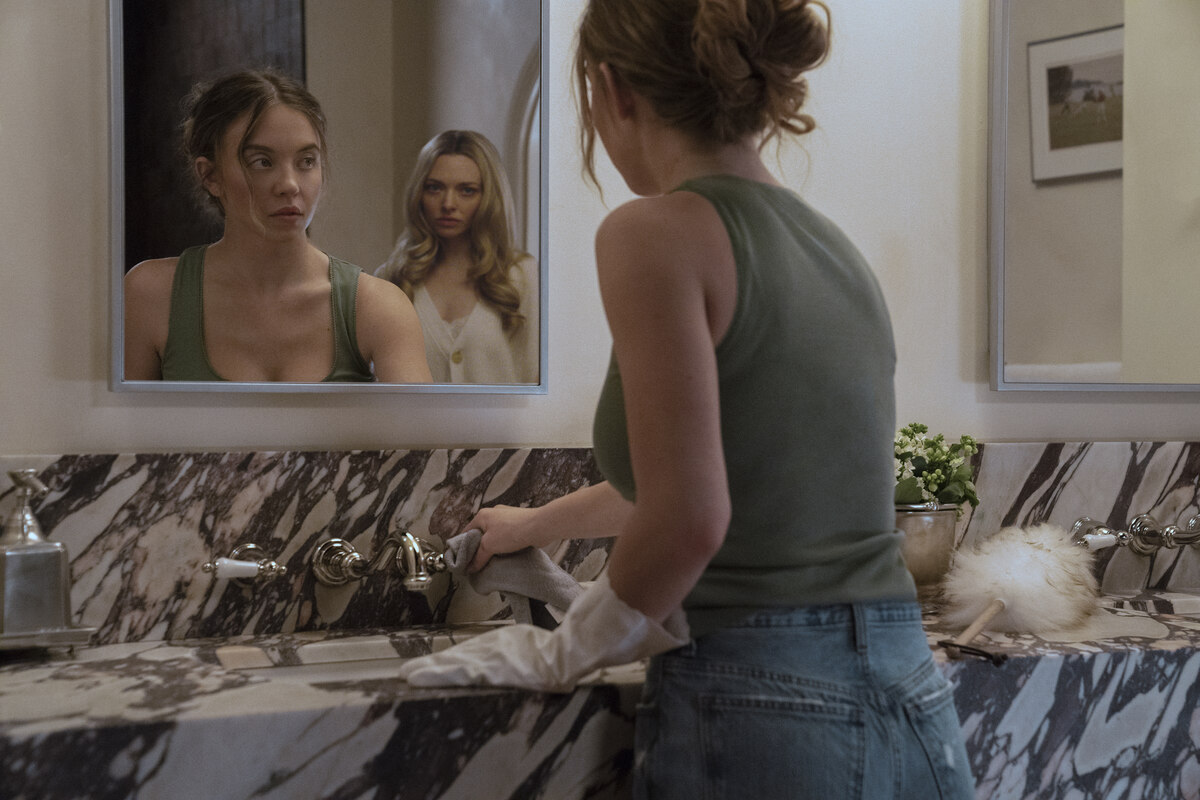
“The Housemaid” spends so long on clumsy scenes that one is inclined to recognize the actual thrust of the film: Amanda Seyfried appears again and again as the mistress of the house wearing a pearl necklace and a white suit with manically wide-open eyes – in the mirror, in door frames, lurking behind Sydney Sweeney as the increasingly skimpily dressed housemaid. Millie, on the other hand, sits on the family couch at night and watches television, her grotesquely displayed cleavage in the foreground, flanked by the man of the house who keeps apologizing for his “difficult” wife.
The comeback of old pictures?
Misogynistic stereotypes are depicted with such alacrity that at some point the question arises as to whether we have finally arrived at the phase of cinema in which the impending social regression becomes apparent; in which “Tradwife”-Fantasien and the “canon of values” of a “grab them by the pussy” president are now also reflected in filmic storytelling.
We would like to show you external content here. You decide whether you also want to see this element:

In any case, “The Housemaid” initially seems to fit into this logic by first pointing the finger at the “house dragon”, exposing the wife as “hysterical” – and at the same time providing the narrative absolution as to why the “poor” husband almost inevitably ends up in bed with the friendly and docile, and on top of that much younger, housemaid.
But then the second twist follows – and even those who expected it will be surprised by its severity and violence. It is a twist that not only puts the narrative that had been followed up to that point in a different light, but also turns the ideological orientation of the film into its opposite: towards a reading that is now moving in the wake of a radical #MeToo perspective – at least for an entertainment cinema suitable for the masses.
The cliche strikes back
The view thus shifts away from the mere indignation about itwas is shown, to the uncomfortable question, Why. What matters is less whether “The Housemaid” works with problematic images – it undoubtedly does – but rather how specifically it uses these images to lure its audience into a certain position and later undermine it.
But Paul Feig shouldn’t be credited with too much progressive idealism. A lot of it is probably calculated provocation to attract attention at the box office. And yet, despite all its crudeness, this risky game works: less as a classic thriller than as a black comedy that doesn’t deny its cheap charms, but counters them with a surprisingly clear declaration of war. In other words: the audience may be lured with Sydney Sweeney’s cleavage – but released with a message of female anger that teaches fear.
Regardless of whether you celebrate this as camp or condemn it as trash: If “The Housemaid” reaches viewers who would otherwise stay away from all films with feminist overtones, then entertainment cinema has ultimately dared more – and possibly even achieved more – than any self-referential arthouse gesture.