

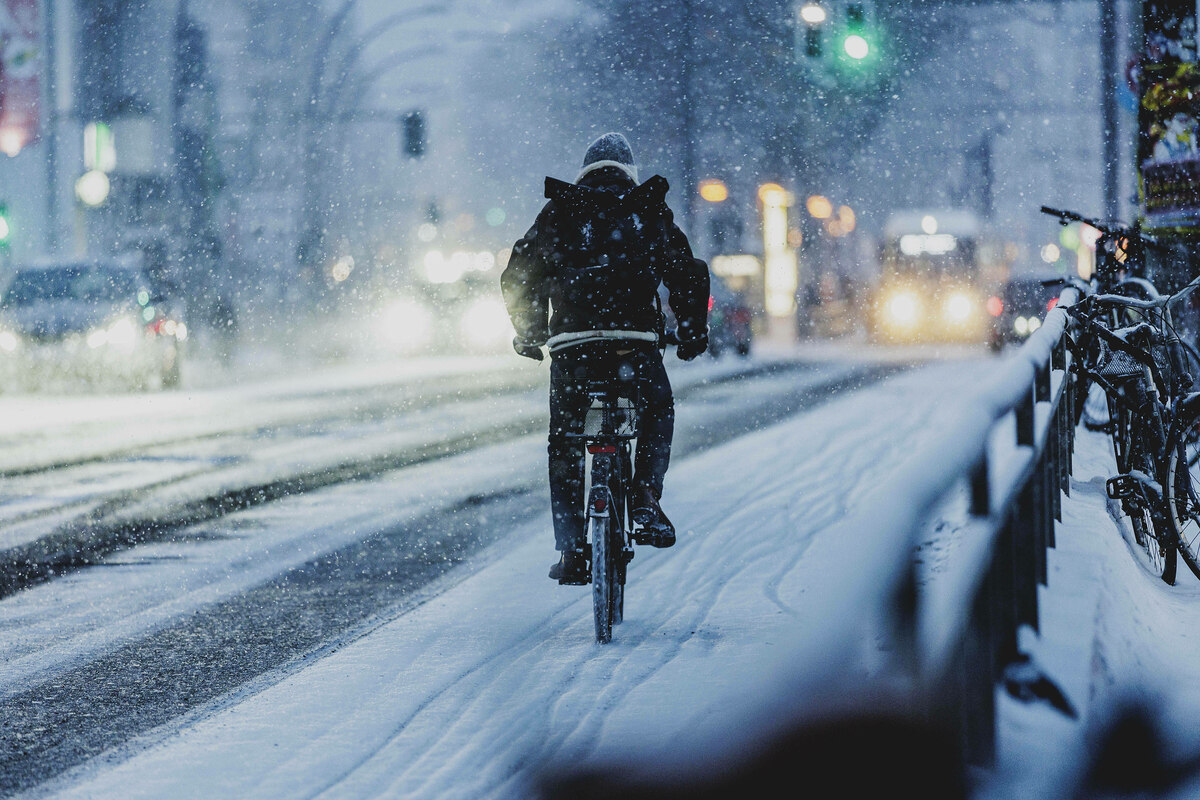
E s rattles inside the police car, parked on the side of the road, two tires on the snowy bike path. I tighten my grip on the handles of my bike handlebars, bracing myself for trouble and choosing my words.
Why am I riding my bike on the federal highway next to the drivers of expensive SUVs in Berlin-Zehlendorf? So, I would rather ride on the separated bike path. Not only is it covered in pretty snow, but it is also covered by a thick layer of ice. And seemed more dangerous to me than the cars that drive 50 plus here and tend to overtake too closely.
When there is snow and ice, the balance of power in road traffic becomes particularly visible. Cars rule – in Berlin as well as in many German cities. The lanes are cleared or sprinkled with gravel or both.

Combustion engine exhausts help not only heat the earthbut also the asphalt and melt remaining snow. The road in Berlin-Zehlendorf is wonderfully passable this evening in sub-zero temperatures. This makes the uncleared bicycle paths and sidewalks all the more slippery.
More than 70 uncleared roads in Berlin
On an interactive map The ADFC cycling club has documented more than 70 cycle paths throughout the capital area that were not cleared of snow – or that snow had piled up there and had been swept away from other areas. In Göttingen, many cycle paths were free of ice, but pedestrians had to slide on sidewalks. In Dresden, cycle paths are to be cleared “on an equal footing” with the streets since 2025 – so far this has only worked in places. In 2021, Hamburg expanded the cycle path network that clears the city when it snows. However, around three quarters of the cycle paths in the city are still not included.
In principle, municipalities are responsible for clearing cycle paths; they must clear important cycle paths for cars just as they do streets. However, they have leeway when it comes to assessing which routes are “transport-important”.
“In case of doubt, an obligation to clear (all) cycle paths should be assumed so that safe cycling is possible,” writes the Association of Municipal Companies. “In most communities this will certainly be politically desired.” The street is cleared, but the bike path next to it isn’t? Well, smooth driving was more important in traditionally car-loving Germany – and politically more desired.
Different rules apply to clearing and sprinkling on sidewalks depending on the municipality. Municipalities can transfer the winter service obligation to the owners of adjacent buildings by statute. Some landlords pass this on to the tenants via a rental agreement.
Failure to carry out gritting and clearing duties
In Berlin, for example, owners usually have to ensure that sidewalks are free of snow and ice. Many homeowners obviously don’t care; the transport transition association Changing Cities criticizedthat the public order office rarely punishes failure to clear and scatter.
Slippery paths have fatal consequences: emergency rooms in Schleswig-Holstein treated people for snow and ice at the beginning of January 50 percent more patients than usualmany with typical slip and fall diagnoses – broken forearms or injured shoulders.
Of course, sliding cars are also dangerous, buses and ambulances must have free movement. Winter service costs requires staff and machines that have been used less frequently in recent years due to warmer winters on average.
But if people simply don’t have the choice between cycling or walking safely, it’s not just unfair. It also leads the traffic transition, building block in the fight against the climate crisisliterally on the ice.
Expensive accident costs
How can it be done differently? In Copenhagen, some cycle paths are heated with waste heat. In Reykjavík, Iceland, “Service 1a” applies to cycle paths – top clearance priority, early in the morning, so that people can cycle to work safely. Sweden has calculated that treating victims of ice accidents is much more expensive for society than comprehensive winter service.
By the way, there is no trouble with the police officers in Berlin-Zehlendorf. Shortly afterwards, however, the driver of an expensive SUV honks loudly and long, overtakes closely and gestures angrily. I would really rather ride on the bike path.