

Marco Schneid* uses a floor saw to break the stones out of the pedestrian path. “Shit, they’re stiff,” he mutters. Then he sticks a spade into the ground and digs out the moist earth. He is wearing black work clothes, a black hoodie and gloves. Sirens wail from Sonnenallee, the tarpaulin on the scaffolding opposite rustles in the wind. It says in red letters: “SchwuZ”.
The queer club is the reason for the action by Schneid and his friends on Sunday evening. The Berliners are behind the “Steinzeit Alter” collective, which has erected a gravestone for Schwuz on Rollbergstrasse. After 48 years, the club filed for bankruptcy at the end of last year, and the farewell party took place on November 1st. The club commission is now looking for a new, smaller location for Schwuz.
“Schwuz 1977–2025” is carved into the gray gravestone. Two figures – one standing, one kneeling – hold a basket of reflective disco balls together. A figure’s back reads: “Glitter is not camouflage, it is armor that shines in the light full of wounds.” The saying is intended to represent the fight of the queer community. “Glitter is visibility and not an escape from discrimination,” explains Schneid. However, in view of the ongoing fight for equal rights and physical and mental safety, it acts as armor. The wounds remained visible.
It is the fourth gravestone that the collective has erected to draw attention to the death of clubs in the city. In January 2025 they erected the first stone for Watergatefollowed by one for the Griessmühle and a grave lantern for Rosi’s. “Every stone should be a reminder of the thriving, cultural, diverse life in this city,” says the collective. With their performance art they want to make people think – about the loss of club culture, but also about the negative urban development as a whole. “Studios and small cafés are being pushed out; instead, co-working spaces and new development areas are being built – everything but affordable apartments,” criticizes one member.
Without culture there is a risk of regressing into the Stone Age

If culture disappears from the big city or is pushed to the outskirts, the city becomes a “dead spot,” says Schneid. “Then we go back to the Stone Age.” This idea also underlies the name of the collective. New clubs are now almost only opening outside the S-Bahn ring, as was the case in November in Spandau and Westend. reason for this too high rents and noise complaints in the city center.

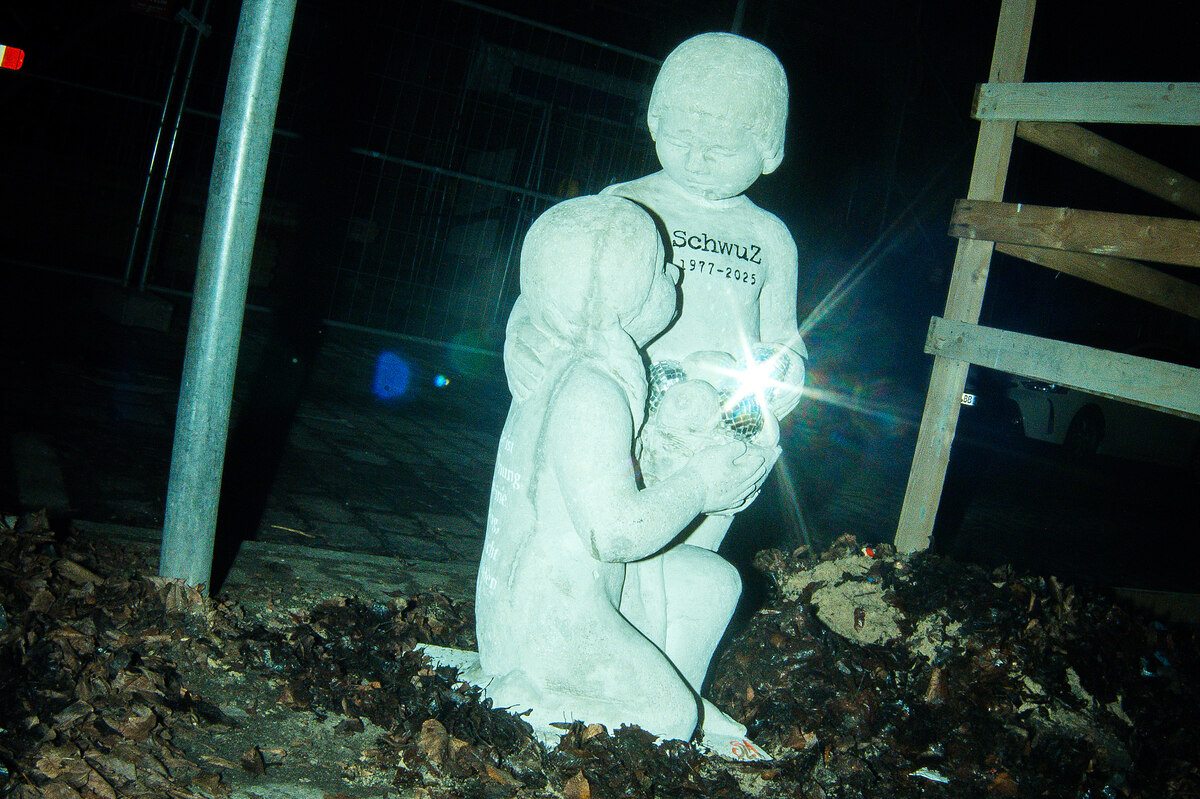
Schneid stands on the back of the car and lifts the gravestone onto a red hand truck. “It will be difficult to get him out of here,” he says. The other men stand ready with lit cigarettes in their mouths to receive the stone. “Jackpot!” shouts Schneid as the 150 kilogram, one meter tall figure lands unharmed on the street.
Schneid works as a stonemason and makes gravestones in a workshop in his free time. They come from graves that had already expired and were intended for scrapping. The work is complex: he invested 40 to 50 hours on this stone. The other collective members come from the creative scene: photographers, musicians, producers, organizers, DJs. They therefore produce their own track for each gravestone.
The men mix the concrete in the truck bed, then quickly run down the street with the tub full of concrete before it hardens. The stone is then lifted into the concrete using the hand truck. Two men shine, Schneid spreads the wet concrete. “Attention! Car is coming,” warns one. There is a police section on the corner, emergency vehicles keep moving out and returning. The collective faces penalties for their actions. Putting up the stones can be seen as an interference with public road regulations and can result in a high fine.
Interactive Street Art
After about an hour the work is completed. Shortly afterwards, the first passers-by stopped, pulled out their cell phones and took photos. The reactions to her performance art have been consistently positive, says Schneid. “People put flowers, confetti and glitter on the gravestones.” Groups of city guides also walked past the Watergate Stone. The club’s manager had tears in his eyes when he saw the stone, he says.
However, most stones only last a short time in public spaces. The men report that the gravestone for Rosi’s was gone after just eight hours. The one from Watergate was removed by the parks department after two weeks. “They expect the stone to come away,” says one member. “And yet it’s still very sad every time.” The collective is considering equipping the next gravestones with GPS trackers.
The idea is to make street art interactive. At the gravestone in front of Rosi’s, for example, those interested could open the grave lantern, wind up the music box, light up disco balls and play music. A logo that could be scanned led to the collective’s website. The stone for the semolina mill is also interactive. The artists distributed mini gravestones around the city with the code to the key box containing the lighting technology. “Then people can change the batteries and change the colors,” explains Schneid – and thus keep the stone and thus a piece of club culture alive.
*Name changed by the editors