

They are still coming sporadically, but we can already hear the calls for German nuclear weapons. Most recently, Brigadier General demanded Frank Pieper in Stern tactical nuclear weapons for the Bundeswehr. Conventional armament is no longer sufficient as a deterrent. Pieper is, after all, director of strategy at the Bundeswehr Command Academy. He emphasized that he was speaking as a private person.
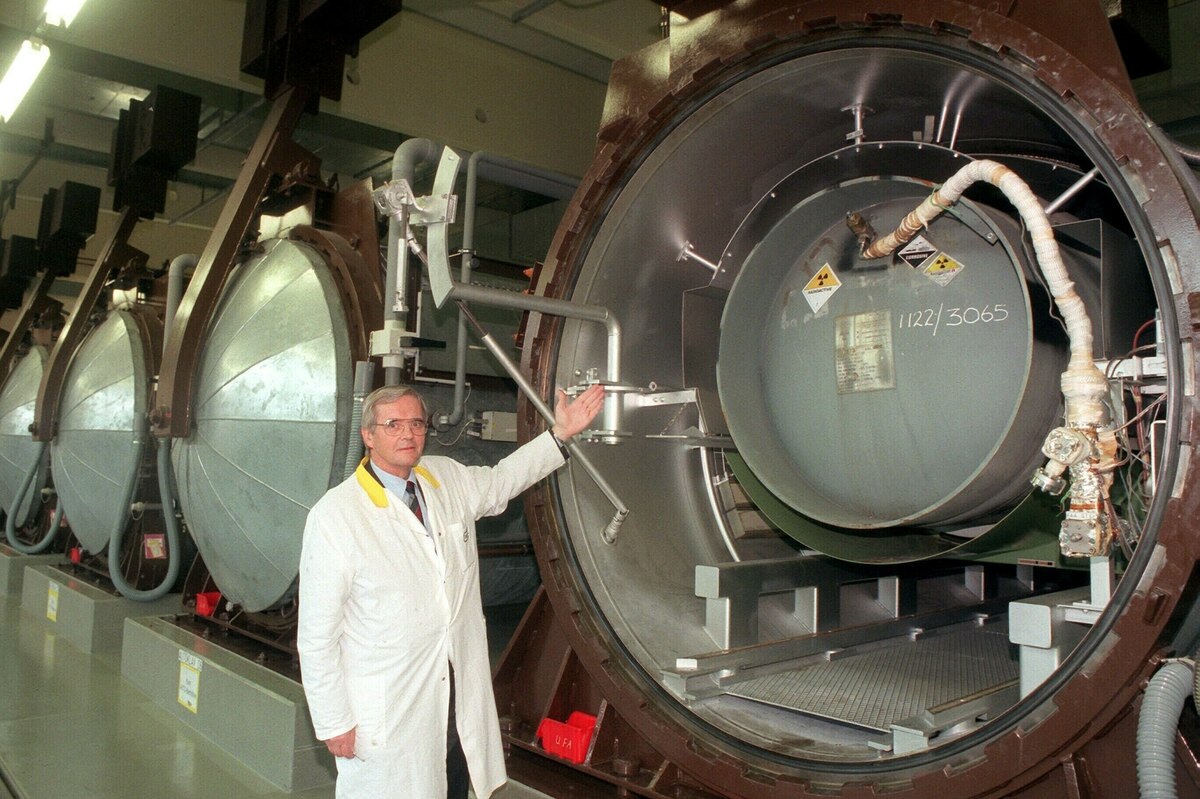
The historian Harald Biermann, President of the House of History Foundation in Bonn, also sees a need for action: “The nuclear question is the core of a state’s national sovereignty. Germany must also face this question,” he said, also in the Stern. Chemist, reactor safety expert and whistleblower Rainer Moormann also pointed out the technical feasibility. In principle it could Uranium enrichment plant (UAA) in Gronau, Westphalia be used to build atomic bombs. Moormann published a critical reassessment of the safety of pebble bed reactors in 2008 and ensured that his criticism was spread through the media and through lectures.
The Gronau UAA went into operation in 1985 and is the only factory of its kind in the country. The operator is the company Urenco (Uranium Enrichment Company), one of the world’s leading providers in the field of uranium enrichment. Urenco is owned equally by the British state, the Dutch state and the two German energy companies E.ON and RWE. In addition to Gronau, the group operates three other uranium enrichment plants in Almelo (Netherlands), Capenhurst (Great Britain) and Eunice (USA).
Thousands of centrifuges
Urenco’s plants, including those in Gronau, use the gas centrifuge process to increase the proportion of the fissile uranium isotope U-235. In natural uranium, U-238 is by far the most common isotope with a proportion of 99.3 percent; in contrast to U-235, it is difficult to split using thermal neutrons. U-235, on the other hand, only occurs in around 0.7 percent. For operation in nuclear power plants, the proportion of U-235 must be increased to three and a half to five percent.
The first step in the process is the conversion of solid uranium into gaseous uranium hexafluoride (UF₆). This does not happen in the UAA, but in special conversion facilities in France and North America. In the UAA, the gas is forced through rapidly rotating centrifuges, pushing the heavier uranium-238 isotopes to the outer wall while the lighter uranium-235 collects in the center.
Since a single centrifuge only enriches the uranium slightly, thousands of them are connected in series in so-called cascades. With the same, technology also used by Iran and many other centrifuges, uranium can be highly enriched, to 80 or 90 percent U-235. This would make it suitable for nuclear weapons.
The remaining depleted, weakly radioactive uranium, which is produced in large quantities in Gronau, is currently stored next to the UAA in large containers. In the past it was also exported to Russia, where, according to research by Federal Association of Citizens’ Initiatives for Environmental Protection (BBU) and Russian environmentalists are largely kept in the open air. Russia, for its part, supplies enriched uranium for the fuel element factory in Lingen, Lower Saxony.
The Gronau facility has an unlimited operating license. The BBU and other initiatives have long been calling for its permanent closure: for almost 40 years, activists have demonstrated every month – with a Sunday walk at the UAA gate.