

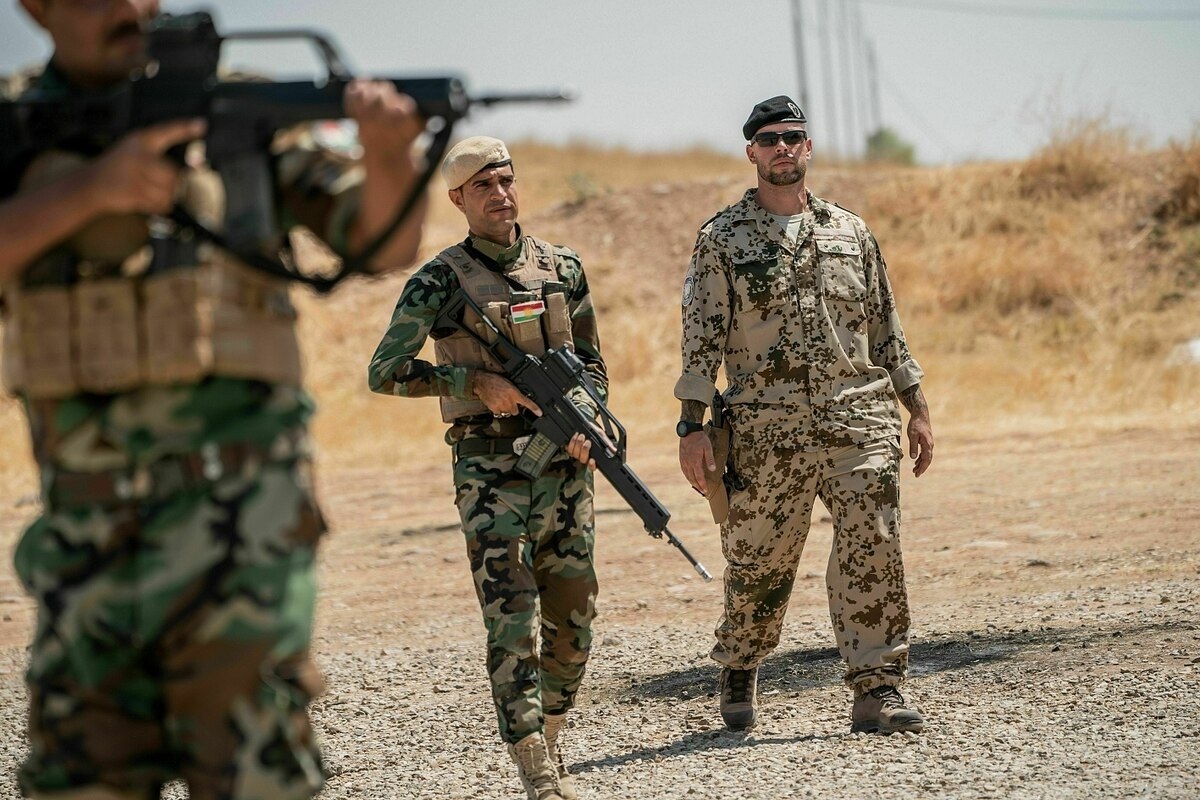
The Bundeswehr’s currently almost largest foreign mandate takes place beyond public perception: up to 500 German soldiers have been supporting the fight against IS and strengthening the country’s armed forces in Iraq since the end of 2015. On Thursday evening, the Bundestag voted to extend this mandate until the end of January 2027. It is the Bundeswehr’s second-largest mission, only slightly smaller than its participation in the NATO mission “Sea Guardian” in the Mediterranean.
It is becoming apparent that the Bundeswehr wants to continue its operations in Iraq, especially in the Kurdish areas in the north of the country – even if the USA continues to scale down its operations in the region. According to the application, “the federal government intends to continue its military commitment even after OIR is terminated.” OIR stands for the international Operation Inherent Resolve, which the USA and Iraq more or less agreed to carry out in September 2024.
The basis for the Bundeswehr’s new mandate is the desire of the government in Baghdad and the leadership in the Autonomous Region of Kurdistan in Erbil, northern Iraq, to maintain the NATO presence there. According to the federal government, the USA ended its air strikes on IS positions on Iraqi territory in September 2025. The international armed forces are now to be relocated from the center of the country to the north in order to fight against a possible return of the terrorist threat of IS from Syria.
Due to its continuous presence in northern Iraq for more than ten years, Germany enjoys a special position among the Kurds there, who have their own armed forces, the Peshmerga. The Bundeswehr occupies the international operations command in Erbil that advises the Kurdish fighters. In the past, Germany also supplied the Peshmerga with weapons and supported the training of the fighters. It should continue to be part of the mandate for the Bundeswehr to advise the Kurdish Ministry on Peshmerga affairs.
390 MPs approved the extension of the operation in a roll-call vote; in addition to the Union and SPD, the Greens had also signaled their approval. This is all the more important because the Kurds have lost massive amounts of power in Iraq’s two neighboring states: the Kurdish militias are in Syria faced an unprecedented offensive by Turkish-backed forces. In Turkey, too, the repression against the political aspirations of the Kurds continues unabated.
It’s not just the Bundeswehr that is active in Iraq: According to government figures, the Development Ministry provided more than 53 million euros for the country in 2025. In addition, there will be almost 420 million euros from the Foreign Office for the country’s security policy for 2024. According to the government, this is intended to prevent a resurgence of IS in the long term. The deployment of the Bundeswehr is intended to underpin the investment militarily.
Leftists criticize the operation
The Left Party voted against extending the deployment. The left-wing faction’s defense policy spokesman, Ulrich Thoden, criticized the fact that the federal government, on the one hand, is courting the government of the Islamist Ahmad al-Sharaa in Syria, who is taking action against the Kurds in the country. On the other hand, Germany stands behind the Peshmerga. Thoden instead called for increasing political pressure on the Syrian interim government to stop its advance in Rojava.
The left-wing politician also fears that the Bundeswehr’s reconnaissance work in the region could reach Turkey via NATO interfaces, which could then use the situation report for its fight against the Kurds. To what extent this corresponds to operational practice is at least unclear. It cannot be assumed that Turkey will share intelligence data from its fight against the Kurds with its Western NATO partners.
Kurdish-born Green Party member of the Bundestag Kassem Taher Saleh welcomes the continuation of the German mandate. “The attacks by the Islamist Syrian interim government on the Kurds increase the risk that IS will regain strength,” he said, referring to developments in Syria. This not only affects the people in the region, but also security in Europe and Germany.