


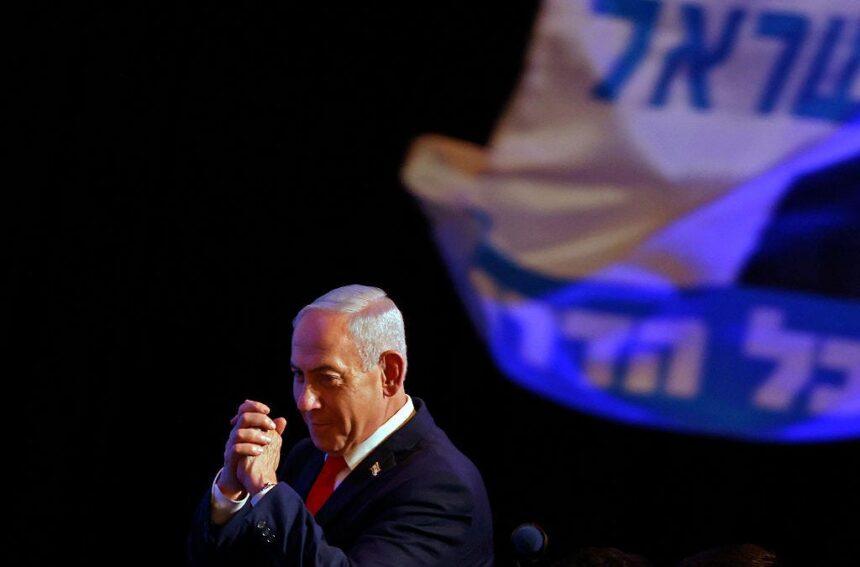
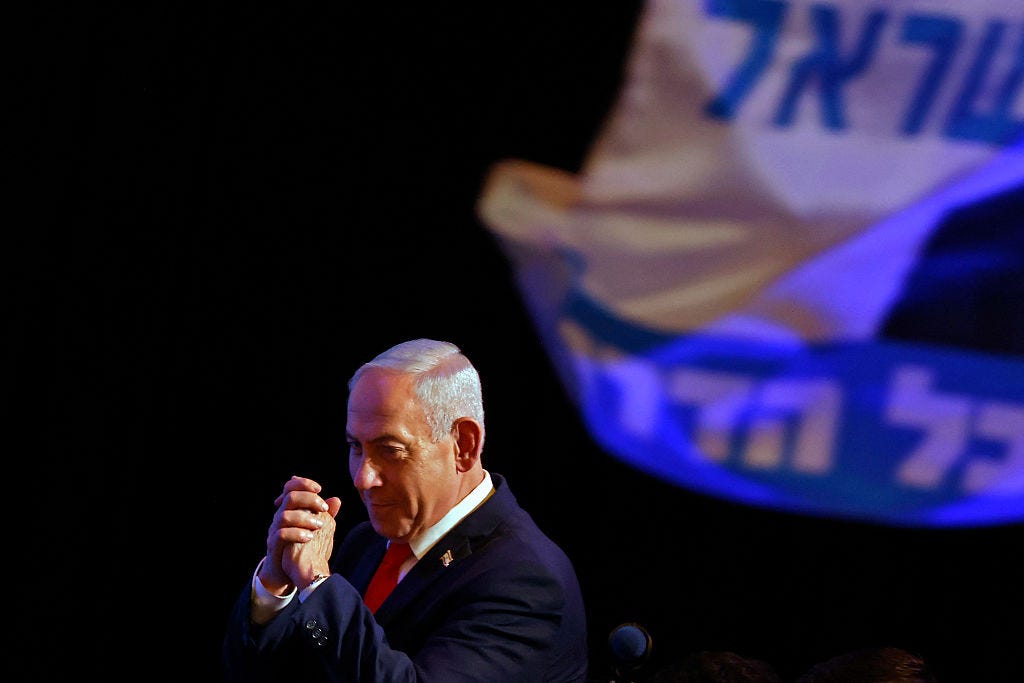
Benjamin Netanyahu towers over Israeli politics like a colossus. Two factors, more than any others, determine how Israelis vote: their attitude toward religion and their attitude toward the prime minister. At the polls, Israelis choose among a bewildering array of parties, but nearly every one of them falls clearly into one of two blocs: pro-Netanyahu or anti-Netanyahu.
The Hamas attacks on October 7, 2023, gave the anti-Netanyahu bloc its best chance yet to topple the king, because they exposed grave flaws in Israeli security and defense policy—long considered Netanyahu’s strongest suit. Last week’s election was the first since that fateful day, and therefore the first real opportunity for voters to hold the leadership accountable. The anti-Netanyahu forces took their best shot—and missed, with Netanyahu’s coalition winning a plurality of seats in Israel’s 120-seat parliament, the Knesset.
They failed for two reasons. First, the leader of the anti-Netanyahu bloc is lackluster. To call Gadi Eisenkot a creation of consultants and public-relations gurus would be an exaggeration, but his very real accomplishments mattered less than the ways they could be weaponized against Netanyahu. Eisenkot spent 41 years in the Israel Defense Forces, rising to chief of staff before retiring in 2019. He also has a wrenching personal story: He lost a son and two nephews in the war in Gaza. He presented himself to the electorate as a security professional untainted by October 7 who had nonetheless paid an unbearable personal price for the leadership’s failures. Even the name of his new party, Yashar—“straight” or “upright”—drew a pointed contrast with a prime minister he and his supporters portray as crooked.
Eisenkot’s biography checked the boxes the moment seemed to require, but it never answered the more important question: Why this particular security professional, and why now? Eisenkot entered politics in 2022, after the mandatory cooling-off period for retired generals, and has left almost no mark since. In his first election, he ran third on the list in Benny Gantz’s National Unity Party, which won 12 seats in the Knesset. It sat in the opposition coalition, then joined the emergency government formed after October 7, only to walk out a few months later.
Thus, Eisenkot’s only stint in civilian office lasted about eight months. He has never run a ministry, never led a party into government, and never shown he can assemble a coalition and hold it together. His record as a soldier is solid. The political case the consultants built on it is mushy.
Read more