
Hello! First, thank you Ted for featuring accessibility on your Substack!! Today’s takeover is by Annalisa Shoemaker and Cassidy Dimon. Annalisa (she/her) is the founder and CEO of Suncatcher Productions, a boutique film distribution company that amplifies intentional, representative stories to awaken audiences, particularly about women, people with disabilities, and the environment. Cassidy (she/they) is the executive director of FWD-Doc, a global, intersectional community of disabled creators and allies, rooted in documentary film, that champions and elevates stories by, for, and about disabled people across all types of media.
5 BEST PRACTICES to make films and in-person screenings accessible for both filmmakers and audiences:
1. ACCESS PRODUCER
An access producer hired during production is tasked with identifying and resolving access barriers for the film’s cast and crew. Once the film is finished, an access producer can also be of service to address access barriers for a film’s audience (e.g., captions, audio descriptions). By the way, we refer to this individual as a producer, instead of a coordinator or manager, to empower them to challenge a film’s hierarchy and to place accessibility across the lifespan of a film from pre-production through distribution.
2. CAPTIONING
Captions are text on screen of either the character’s dialogue or descriptions of pertinent sounds. Captions can be either open (always on screen) or closed (able to turn on/off) using a personal device often provided by the theater. We recommend open captioned screenings whenever possible as personal captioning devices require maintenance and technology that can be unreliable which can lead to an inaccessible experience.
3. AUDIO DESCRIPTION
Audio description is a voiceover describing the visual information on screen when a character is not speaking. Audio description can also be either open (always on) or closed (able to turn on/off using a personal device). For filmmakers, audio description is another creative tool in the storytelling toolbox to artistically present your film to a larger audience. It is recommended that directors take an active role in scripting audio description (and captioning) and not hand this off to third parties or AI.
4. AUDIENCE ADVISORY
Some surprises are good, but not all. An audience advisory is helpful to inform audiences about scenes or content that may be triggering like strobe lighting or mental health content. Ideally, the advisory is before audience members purchase a ticket and again at the beginning of the feature with the goal of educating the audience so they can best decide how and when to participate and not be surprised by triggering content.
5. VENUE ACCESSIBILITY
Venue accessibility refers to theaters being physically accessible. For example, having ADA seating, companion seating, captioning devices, Audio Description devices, ADA compliant bathrooms, and more. It’s one thing to make films accessible but the venues themselves must be accessible for audiences as well. The journey should be accessible from the front door, through concessions, to seating, restrooms, and egress.
In addition to the above, one of the most important accessibility tips is to always communicate! Make sure accessibility information is easily available on your event page. List what accessibility options you have and what may be some access barriers (ex. The theater is accessible, however the bathrooms are not ADA compliant). Providing information BEFORE tickets are purchased is essential for disabled and other patrons to make an informed choice on whether to attend or not. Don’t be afraid to list what is not available, it’s just more information to make the right decision for an individual. In addition to accessibility information, provide an email or phone number for accessibility questions.
This is a cursory review of film exhibition accessibility. To dive in a little deeper, read more, find support and more, please visit the resources listed below.
CASE STUDY: Brailled It
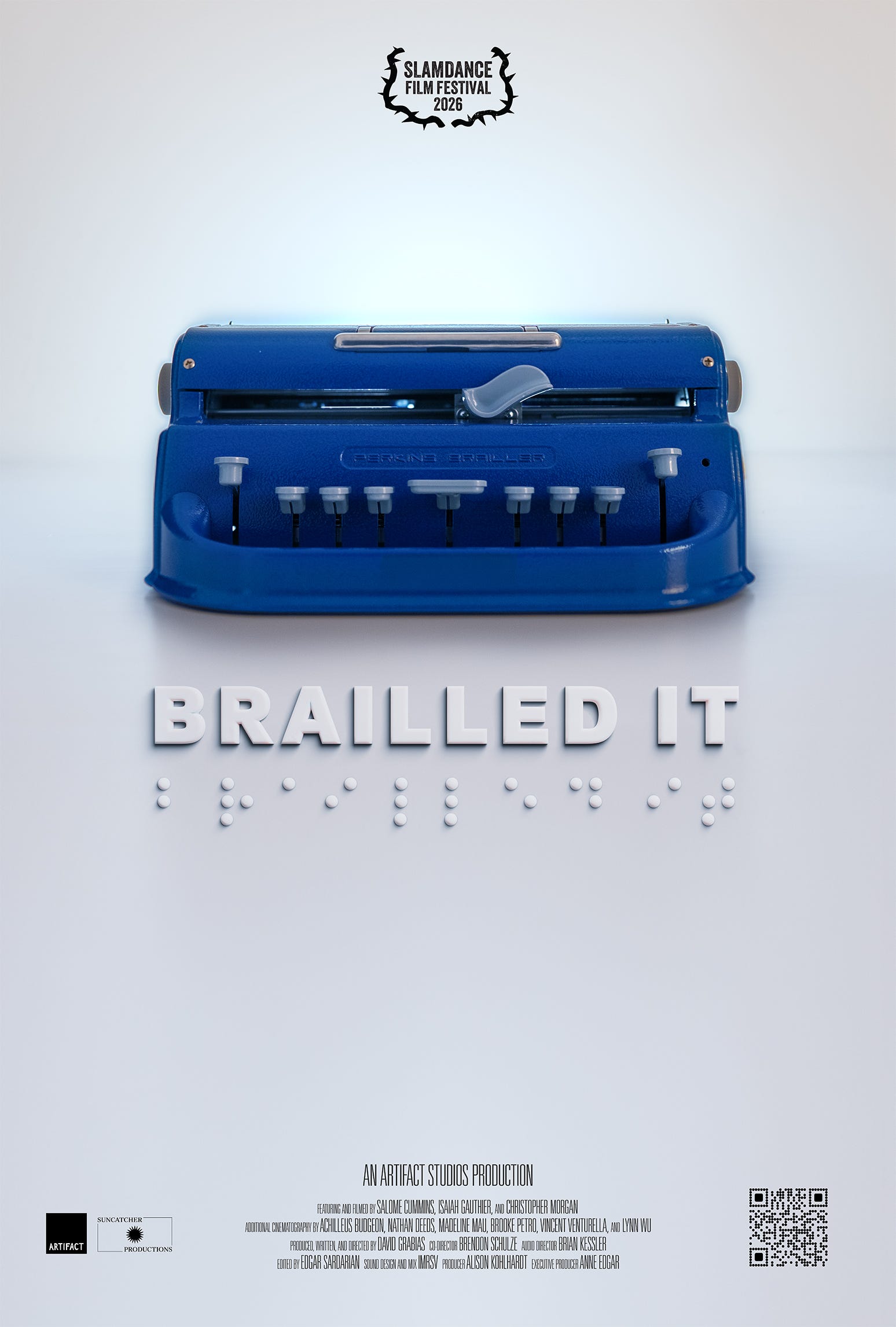
Image Description: Poster for Brailled It, featuring a vivid blue Perkins-style brailler centered against a pale blue-white background, with festival award laurels above and the title shown below in large white block letters with braille dots underneath.
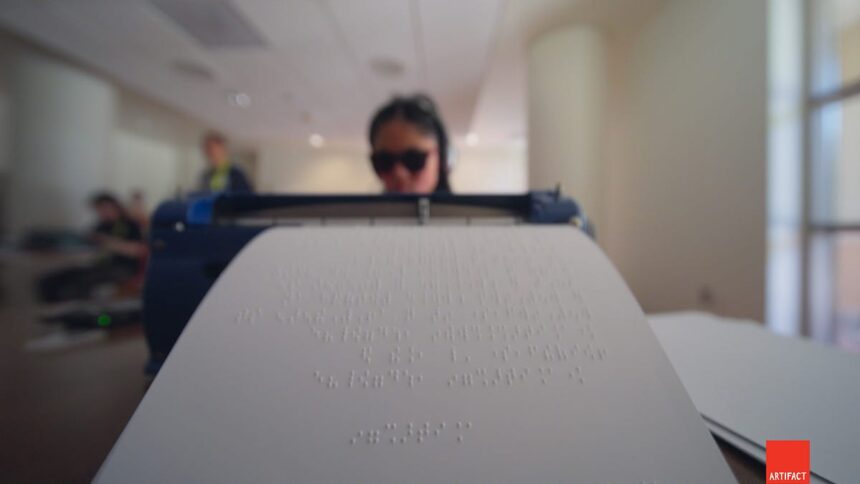
About: For the first time, blind and low-vision kids take control of the cameras and capture their own experiences at the annual Braille Challenge – a weekend of high-pressure competition and raw coming-of-age moments. Brailled It premiered at the 2026 Slamdance Film Festival and is touring on the festival circuit.
Accessibility: This first of its kind documentary is playing in theaters across the country this Fall with open captions and open audio descriptions. Therefore, audience members will not need to worry about the theater having enough devices to experience Brailled It. Select screenings also feature live brailler demonstrations in the theater lobby.
Experience It Now: Brailled It opened Friday, Sept 4th at the Quad Cinema in New York, NY. Then the film expanded to the Tara in Atlanta, GA and the Nightlike Cinema in Akron, OH. This weekend, the film opens in Los Angeles, CA at the Laemmle Glendale with special Q&As scheduled.
Brailled It is also confirmed to play:
● Prospector Theater (Ridgefield, CT) on Saturday, Sept 19th at 1:00pm
● Sidewalk Cinema (Birmingham, AL) on Saturday, Sept 19th at 6:30pm
● The Roxie (San Francisco, CA) on Sunday, Sept 20th at 12:30pm
● Alamo Drafthouse (Littleton, CO) on Tuesday, Sept 22nd at 7:15pm and Sunday, Sept 27th
● SIFF Film Center (Seattle, WA) on Sunday, Sept 20th at 4:00pm
● Music Box Theatre (Chicago, IL) on Sunday, Sept 27th at 2:00pm – Cassidy moderating Q&A afterwards
● Broadway Centre Cinemas (Salt Lake City, UT) on Thursday, Oct 8th at 7:00pm
● FilmNorth (Minneapolis, MN) on Sunday, Oct 25th
Buy your tickets here!
@BrailledItMovie
Trailer linked here
Exhibition Accessibility Resources
From Film Event Accessibility Working Group
From FWD-Doc
● Toolkit for Disability Inclusion & Accessibility
● Accessibility Scorecard Impact Report
● Film Event Accessibility Scorecard
About the Authors:
Annalisa Shoemaker (she/her) is the founder and CEO of Suncatcher Productions, a woman and disabled-led boutique film distribution company. Suncatcher amplifies intentional, representative stories to awaken audiences, particularly about women, people with disabilities, and the environment. Since Suncatcher’s inception in 2023, Annalisa has led the theatrical releases of fourteen feature films including disability themed rom-com Good Bad Things. Prior to Suncatcher, Annalisa spent over a decade working on theatrical distribution campaigns at Amazon Studios and Focus Features. Annalisa is also an adjunct professor at AFI teaching movie marketing and distribution.
To learn more distribution tips and be in the know about upcoming Suncatcher releases, join our newsletter here. @SuncatcherProds
Cassidy Dimon (she/they) is the Executive Director of FWD-Doc a global, intersectional community of over 1400 disabled creators and allies working in media to build a more inclusive, accessible, and equitable entertainment industry. They are a filmmaker, former film festival worker and accessibility advocate. She founded the Film Event Accessibility Working Group (FEAW) in 2021, a collective that harnesses the collaborative power of event professionals to help film exhibitors across the country develop and execute accessible film events. In addition, they are one of the creators of the groundbreaking accessibility tool, the Film Event Accessibility Scorecard, and co-author of the subsequent Accessibility Scorecard Impact Report. Cassidy was selected as one of ten Leaders for a New Chicago in 2024 by the Field and MacArthur Foundations and loves gardening, listening to vinyl records and bird watching.