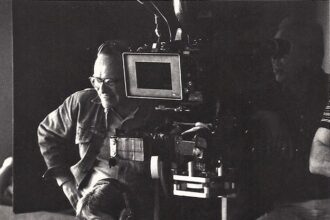


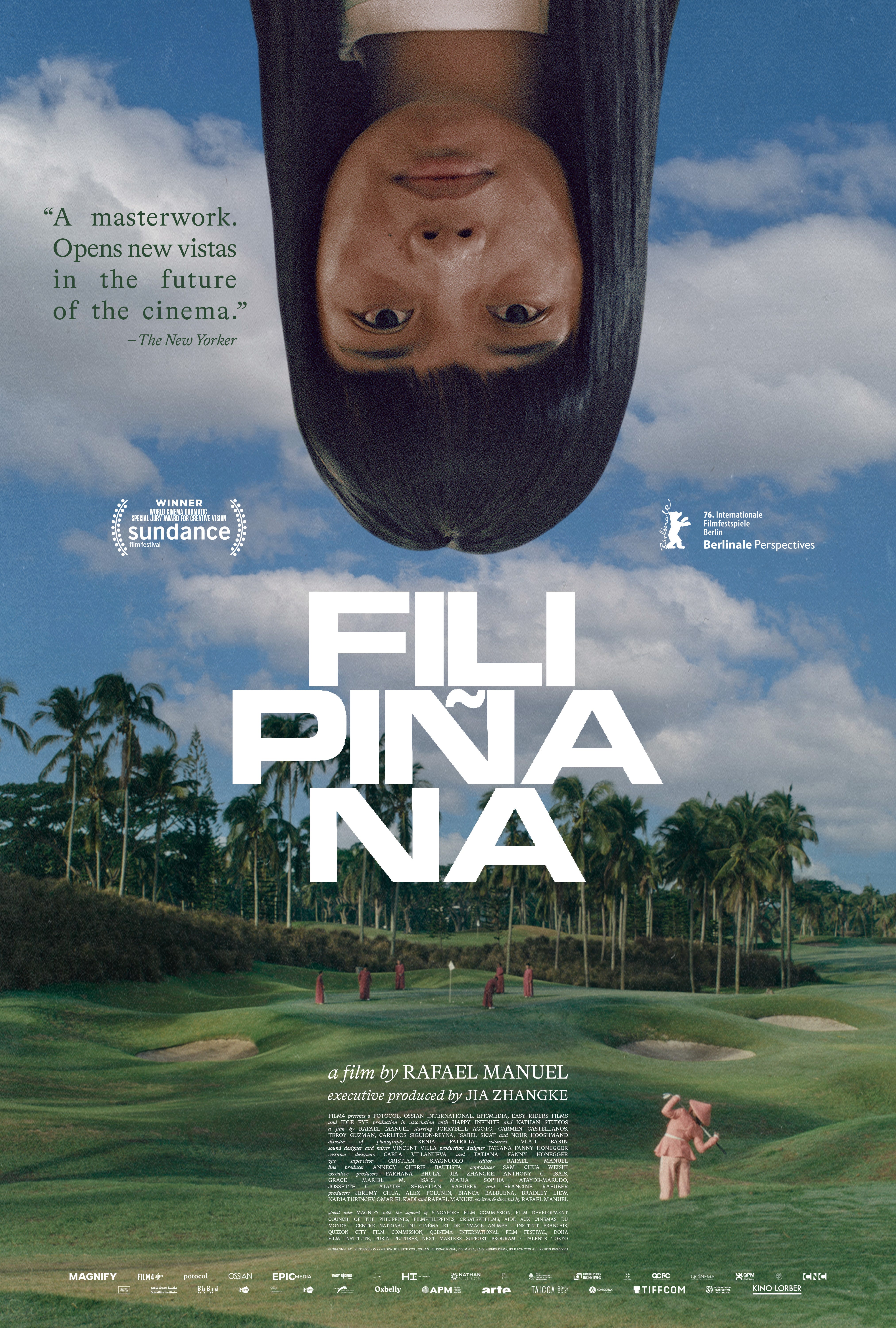
In this vHopeful Conversation, I speak with writer-director-editor Rafael Manuel about Filipiñana, his haunting and visually exquisite debut feature, winner of Sundance’s Special Jury Award for Creative Vision. Set at an exclusive golf club outside Manila, the film follows Isabel, a 17-year-old tee girl whose movement through its manicured grounds reveals a world structured by class, gender, colonial history, and carefully concealed violence. Rafael and I discuss golf courses as emblems of privatized land and globalization; the relationship between beauty and structural violence; the film’s dreamlike, temporally unsettled visual language; and why he thinks of its narrative architecture less as conventional plot than as a song, built from choruses and interludes. We explore memory, resistance, playfulness, and the possibility of creating space for audiences to see and feel the systems that often remain hidden.
Transcript lightly edited. Podcast available on Apple, Spotify or wherever you listen on this Substack or Ted’s Hope for Film
Vanessa Hope: I’m very excited to be joined by filmmaker Rafael Manuel, writer, director, and editor of the extraordinary new feature Filipiñana, which won the Special Jury Award for Creative Vision at the 2026 Sundance Film Festival and the New Directors Award at San Francisco Film. This film opens in theaters in LA on September 4, brought to us by Kino Lorber, who’s fantastic.
And it’s very exciting to me that Rafael was the final film protégé in the Rolex Arts Initiative, mentored by the great Chinese filmmaker Jia Zhangke, whose every film I’ve seen, so we’ll talk about this. Filipiñana is Rafael’s debut feature film, and it follows Isabel, a 17-year-old tee girl at an exclusive golf club outside Manila. As she moves through its immaculate fairways and hidden spaces, she discovers disturbing truths about the club, her country, and her own past. It is a visually ravishing, poetic, and profoundly unsettling film about power, class, patriarchy, memory, and the violence concealed beneath a perfectly manicured surface. Rafael, congratulations, and thank you so much for being here.
Rafael Manuel: Thank you so much for taking the time, and yeah, such a privilege to be here.
Vanessa: It’s a very profound and deep film about a subject that happens to be particularly hot in American television right now, which is golf. Whether starring Owen Wilson or Will Ferrell and Molly Shannon—they’re everywhere. (And my brother is a TV writer and wrote one of them, so he had us watch.) And, this is such a different take. Please, people, go to the movie theater and watch this movie, Filipiñana, because you will have a whole other understanding of golf.
But let’s start with your title, because I think it’s meaningful, and I would love to hear how you came up with it and what it means.
Rafael Manuel: Yeah, it’s a great first question because I guess the title, Filipiñana, references so much the themes of colonialism and imperialism, of gentrification, which the film tries to deal with or tries to explore. It’s actually a play on Americana.
And the added ñ, which we use in the Philippines, is an allusion to our Spanish colonial roots. So both our colonial roots with the Americans and with the Spanish are, for me, perfectly encapsulated by this word. And also, I guess, in the Philippines, how we use Filipiñana, it’s kind of like this catch-all word to describe anything—particularly fashion or literature—that relates to Filipino culture.
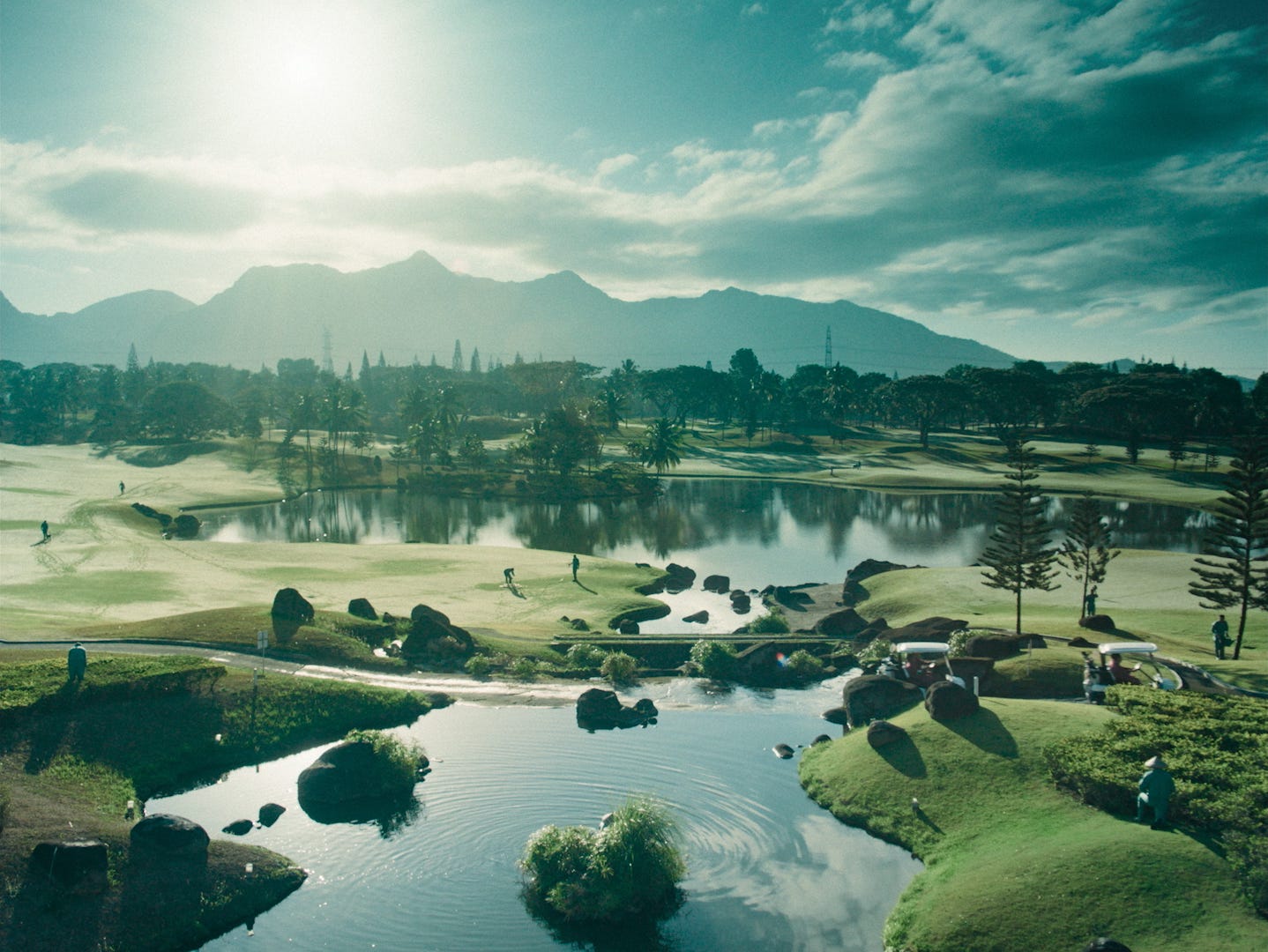
And for me, it’s just kind of interesting to reframe Filipino culture in the context of this golf course because a golf course isn’t exactly the first image that comes to mind when one thinks of the Philippines, which is actually ironic considering, like, in Manila alone, there are over 60 golf courses.
Vanessa: Wow.
Rafael: So, yeah, that’s how I came up with the title, Filipiñana.
Vanessa: And let’s talk about the golf courses for a second, because they’re a very specific setting, and they’re like a whole social system. A whole world lives within them that we’re not normally seeing or thinking about, and you reveal to us. How did that choice come about?
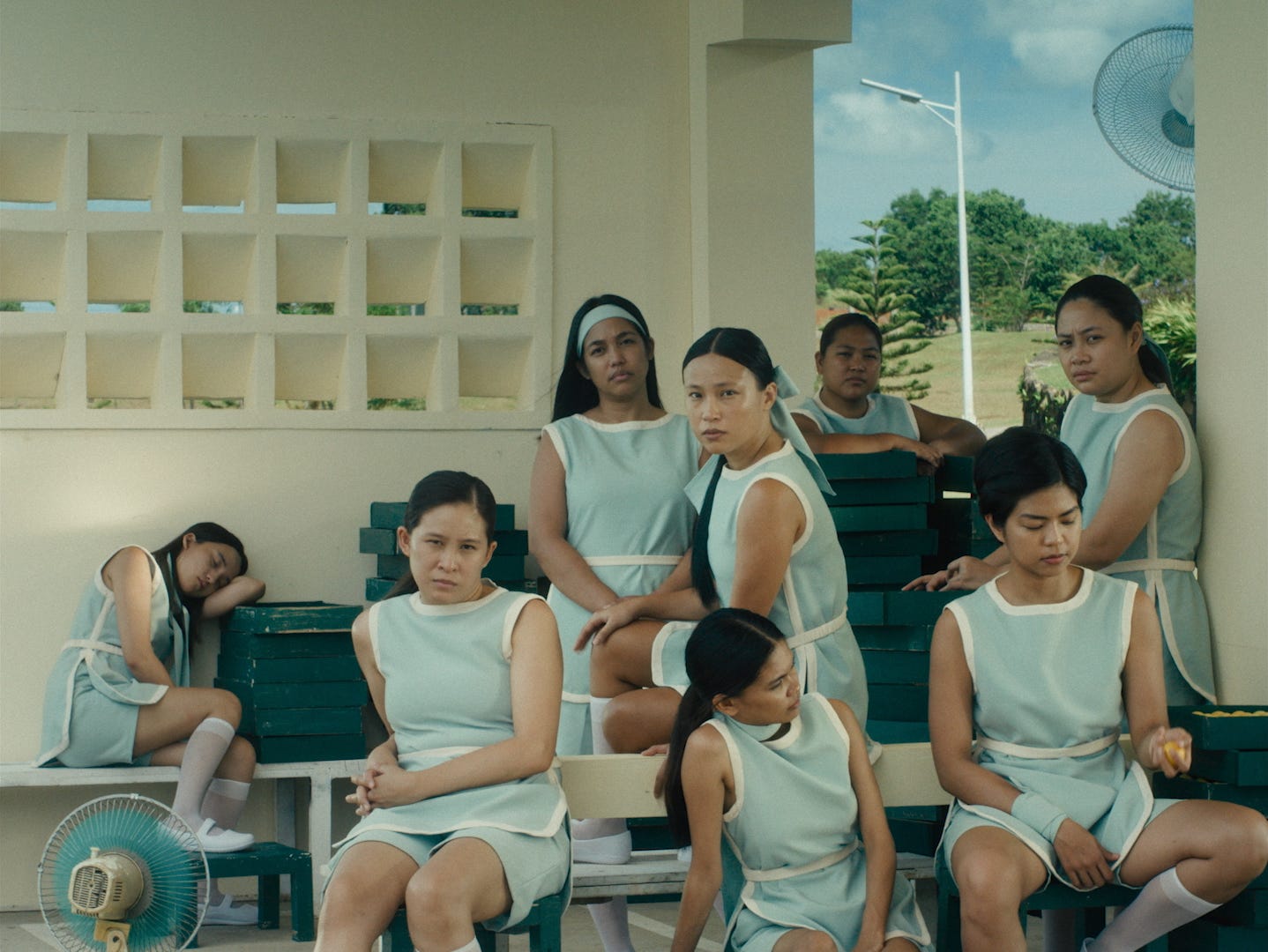
Rafael: Again, going back to these themes of colonialism, the first golf courses in the Philippines were actually on American military bases. So golf was introduced to us by the Americans. And when they left, these spaces of power then kind of became inhabited by the local ruling elite.
Yeah, so there’s just really a rich history of colonialism tied to the space, this land of golf.
In the Philippines, like for those of you that don’t know or have never been, there’s very little public land in the Philippines. Absolutely everything is privatized. I think in Manila, which is a city of 20 million, we have one public park but 50 golf courses, which are all membership golf courses. You have to be a member to be in these golf courses.
Land is another thing that is another theme that really plays into the film’s politics and the film’s framework: this land, who owns it, and who gets to use it.
Vanessa: Yeah. Right. So there was colonial violence on the land, and then it’s sort of smoothed over with a pristine, beautiful green golf course, which also contains a certain level of violence, which is hidden, right? Not explicit, but hidden.
And then your main character, who’s wonderful, this 17-year-old Isabel from Ilocos, which I think is also significant, starts to understand as she moves through the course of a day. I feel like you’re very efficient, that there’s so much happening in every small moment. How did you conceive of Isabel and her story and what she uncovers at the golf course?
Rafael: Yeah, I think, very good question. I think the starting point was really landscape photography. I know it’s kind of like—so let me go wide and then to the macro, and then maybe I can try to veer into the micro.
So I’m a really big fan of landscape photography in terms of, like, I like to study the art form. It’s actually landscape in general, whether it’s painting or photography, and the power dynamics of landscapes. Going through archives, like early Philippine archives, when the Americans were starting to colonize the Philippines, you’ll see a very common motif, which are landscapes of Filipino rice fields or Filipino tobacco fields or, like, Filipino land, basically. And in these vast landscape photographs, you’ll see small, nondescript, faceless Filipino workers working.
It really makes me think about this one thing that I read, written by Simon Schama, when he talks about how a landscape, before it is land, it’s actually culture. So a landscape is culture before it is land, in that, in a landscape, human beings’ imagination is projected onto grass, onto land, onto water, into rock.
And then this kind of led me to this question: whose imagination is being projected onto the land? Because it’s definitely not the workers that are in the landscape. The workers that are in the landscape have a very different relationship to a landscape portrait than the person behind the camera taking it.
Vanessa: Yeah. Yes.
Rafael: So, yeah, when exploring this milieu of a golf course, which is just vast expanses of greenery, for me, my very first starting point was to explore it through the eyes of a worker on this golf course. And for me, Isabel as the tee girl was a very uniquely Filipino kind of perspective to explore this space because I think it’s only in Southeast Asia—I mean, mainly in the Philippines—where this job exists, where you have girls.
Vanessa: I was wondering that, because I don’t play golf and I thought, is a tee girl normal? Someone who…—you explain…
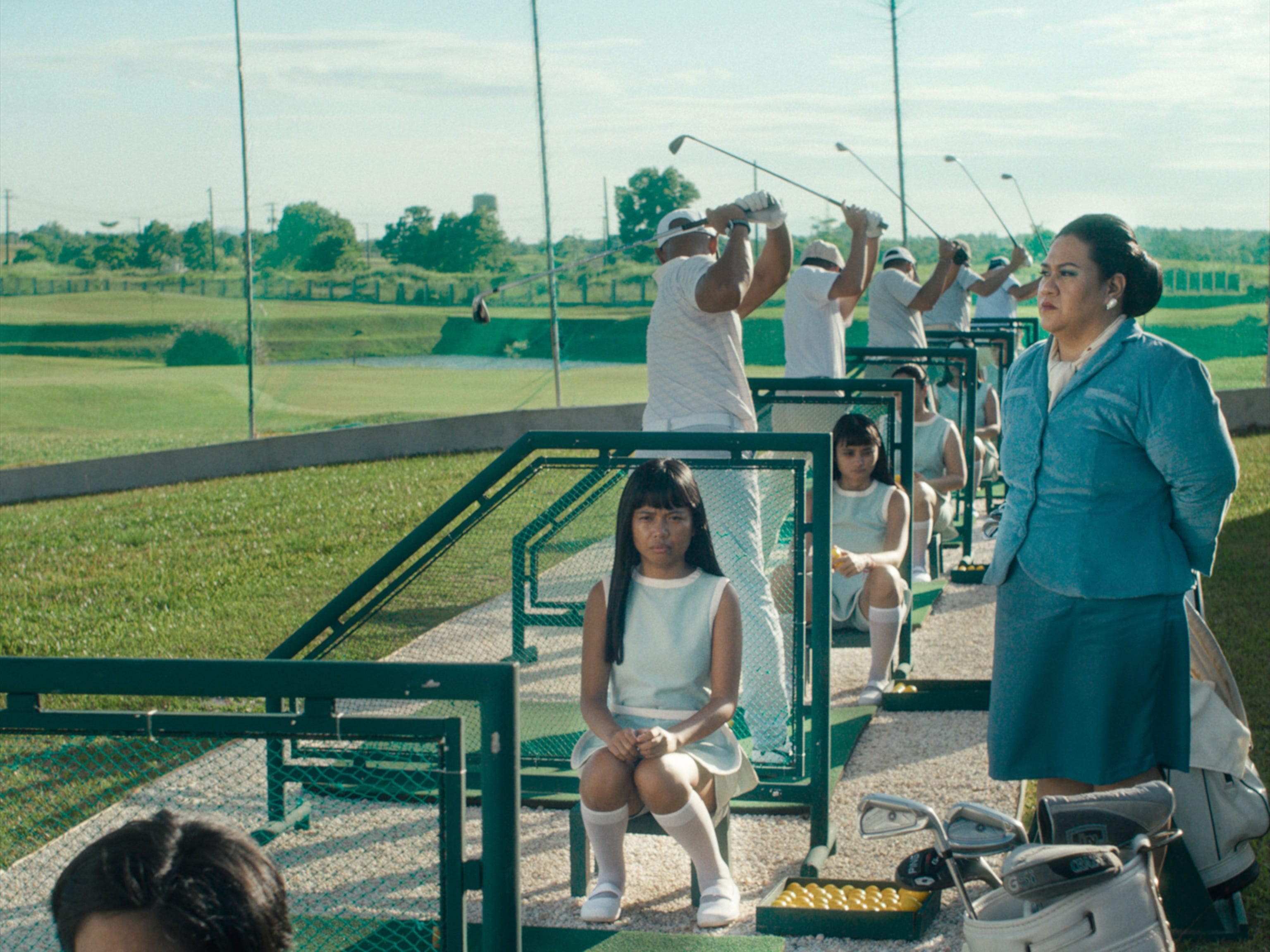
Rafael: Yeah. I mean, literally, their job is to spend the whole day sitting on a stool, serving golf balls for golfers to hit as they swing steel clubs just inches away from their face the whole day. They just sit, and they’re doing that very repetitive, monotonous work. So, yeah.
Vanessa: The way you film that scene from Isabel’s perspective, looking up, and then you hear that smack of the golf club against the ball, and she’s right there, as you said, right in her face—it feels violent.
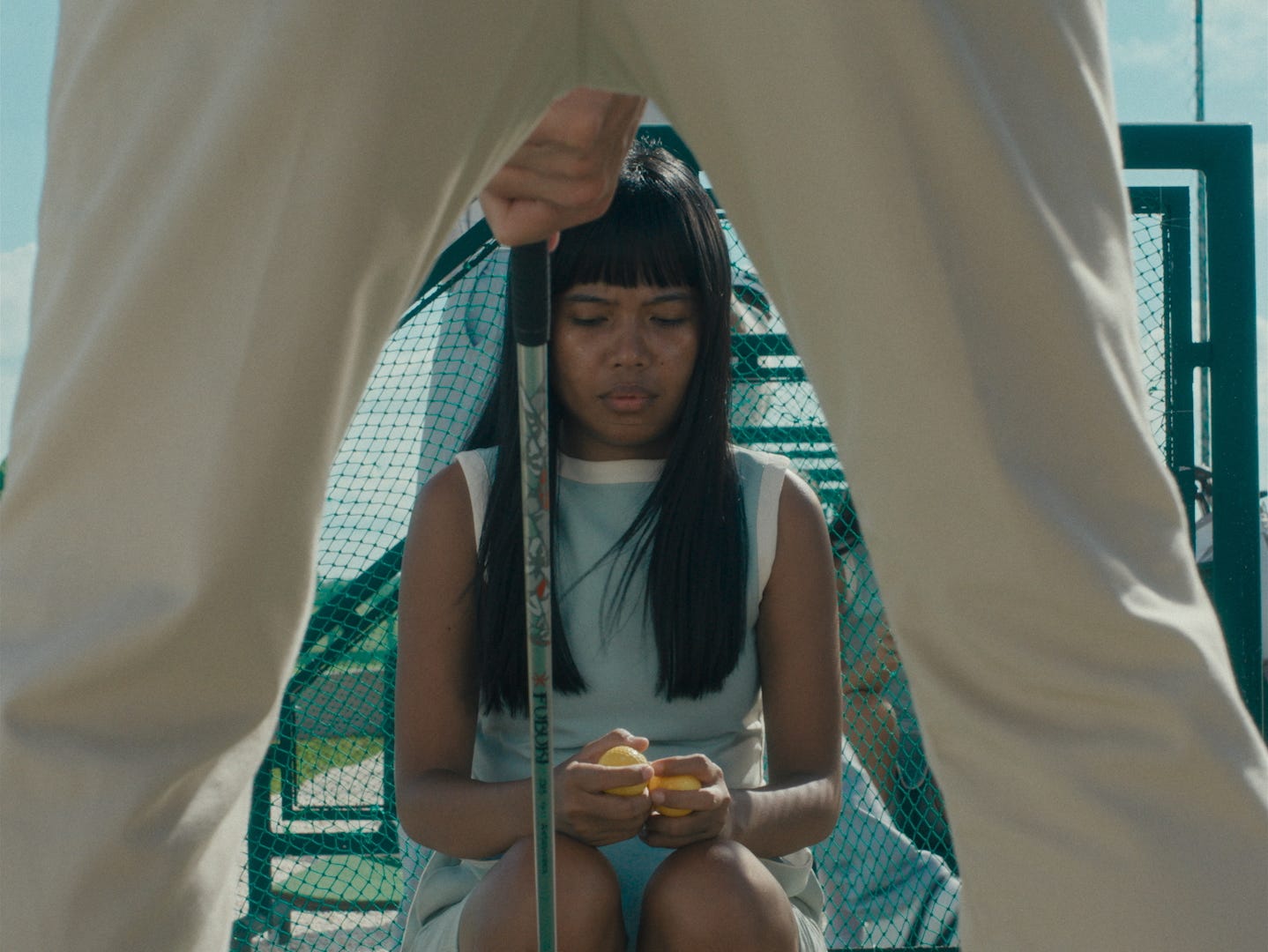
Rafael: Yes. I mean, I find it very violent. Like, the genesis of this entire film is kind of this image of—like, the first image that came to my head was this image of her framed in between the golfer’s legs, you know, because obviously there’s a sexual connotation there, but beyond that, it’s the implication of the power distance, the power relations between the two characters.
Vanessa: Yeah. And that character who Isabel happens to interact with early on is Dr. Palanca, who’s the owner of the golf course. And she almost seems to develop a crush on him and then has this journey of needing to return a golf club to him, but so much happens on the way.
Rafael: Yeah, I guess, to put it in simplistic terms, Filipiñana starts off as a coming-of-age story. And, yeah, this infatuation is a common motif in these—or, like, this love-story kind of angle is a common motif in these coming-of-age stories or genre.
But then, for me, it’s so much more a journey into memory and a journey into identity for this faceless worker.
Vanessa: Yeah. And it does feel like such a romantic setting, bizarrely. It’s hot, and you have this kind of languorous way, you linger on every frame and the beauty of the nature that’s around, in addition to the manicured green. It feels ripe for things to happen in the bushes, and you have a little of that.
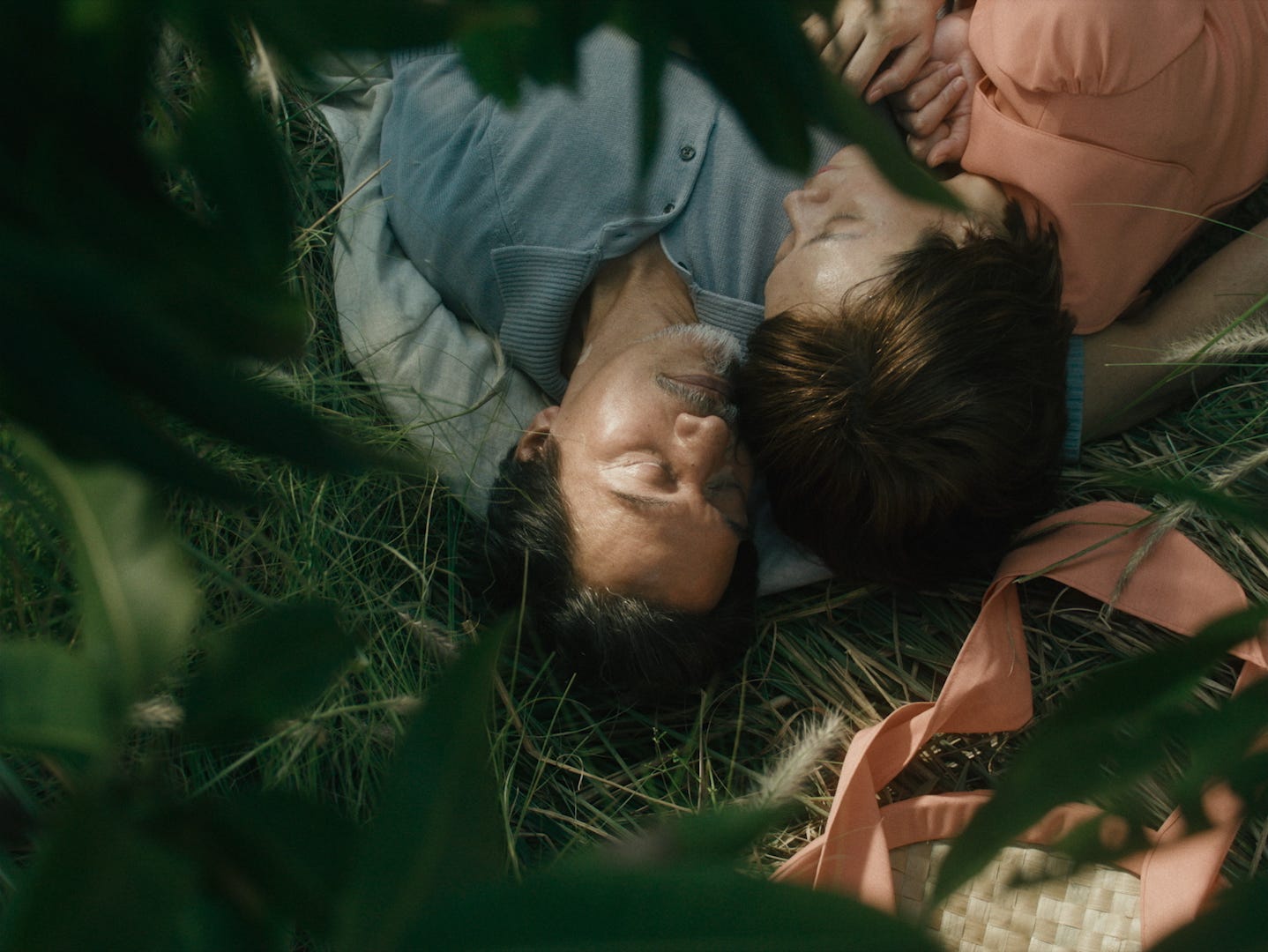
Rafael: Yes, yeah, no, totally. And I’d like to relate that back to the violence that you’re talking about because the kind of violence I feel like this film tries to tackle, or to explore, is a very different kind of violence from a lot of the violent acts that come out of the Global South, or the cinema that comes out of the Global South, which has a lot of, obviously violent acts such as murder or rape.
I feel like with Filipiñana, we were very much more interested in exploring a more invisible kind of violence that actually, for me, is a bit more dangerous because while these other kinds of violence are easier to spot and resist, this kind of violence is, like you said, romantic. It has the danger of seducing you into inaction and complicity. And for me, it’s just such an important part of why I wanted to make this film: to make the violence of the Global South relatable to Western audiences as well.
Because I feel like it’s so easy to watch a film that’s so centered on poverty porn, that has murder and rape, and for white audiences to be like, “How sad,” but then, you know, “That’s not my reality.” Whereas I think, with gentrification being such a big thing these days—and what is a golf course about if not the gentrification of land?—I feel like, no matter where you are, this is a kind of violence that should be relatable to you.
Vanessa: Yes, and you make it more relatable with another character in your film, Clara, who is an expat who feels like a New Yorker. I think she’s living in New York, but her uncle has brought her back to the Philippines and plays a round of golf with her and is in the process of trying to convince her to move back to Manila.
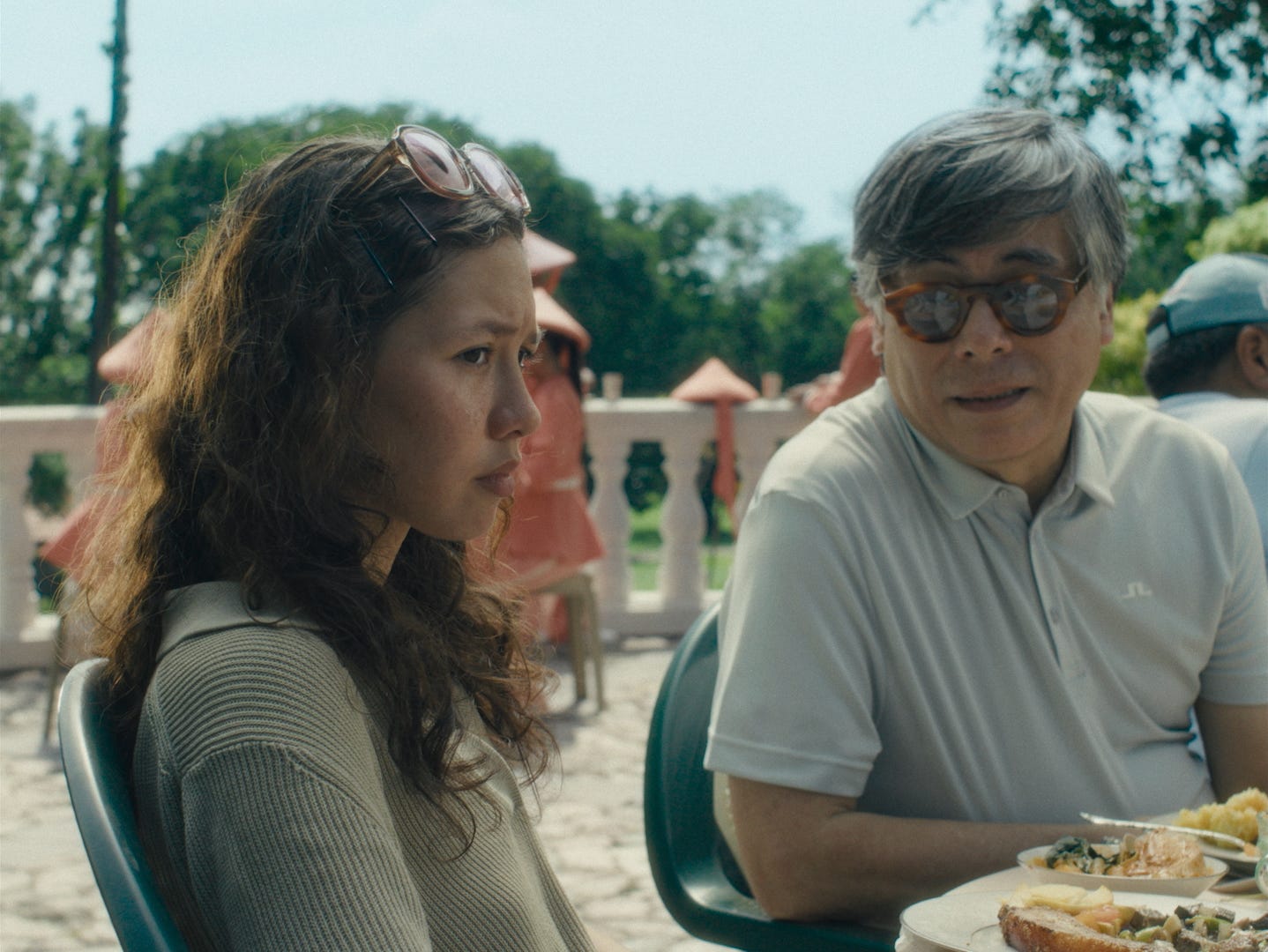
And how did you come up with her character? Because actually, when you were speaking of the hidden violence, there is some violence that takes place there that we don’t want to reveal, but that is definitely something that is hidden.
Rafael: You know, for sure. She’s actually—because I did a short film, also entitled Filipiñana, like five, six years ago, and this character, Clara, wasn’t in that short film. And I realized that if I wanted the feature film to not just be an expansion of the short but an evolution of the short, and to really justify its place beside the short, there was an opportunity to kind of explore this environment, this milieu of the golf course, through multiple perspectives.
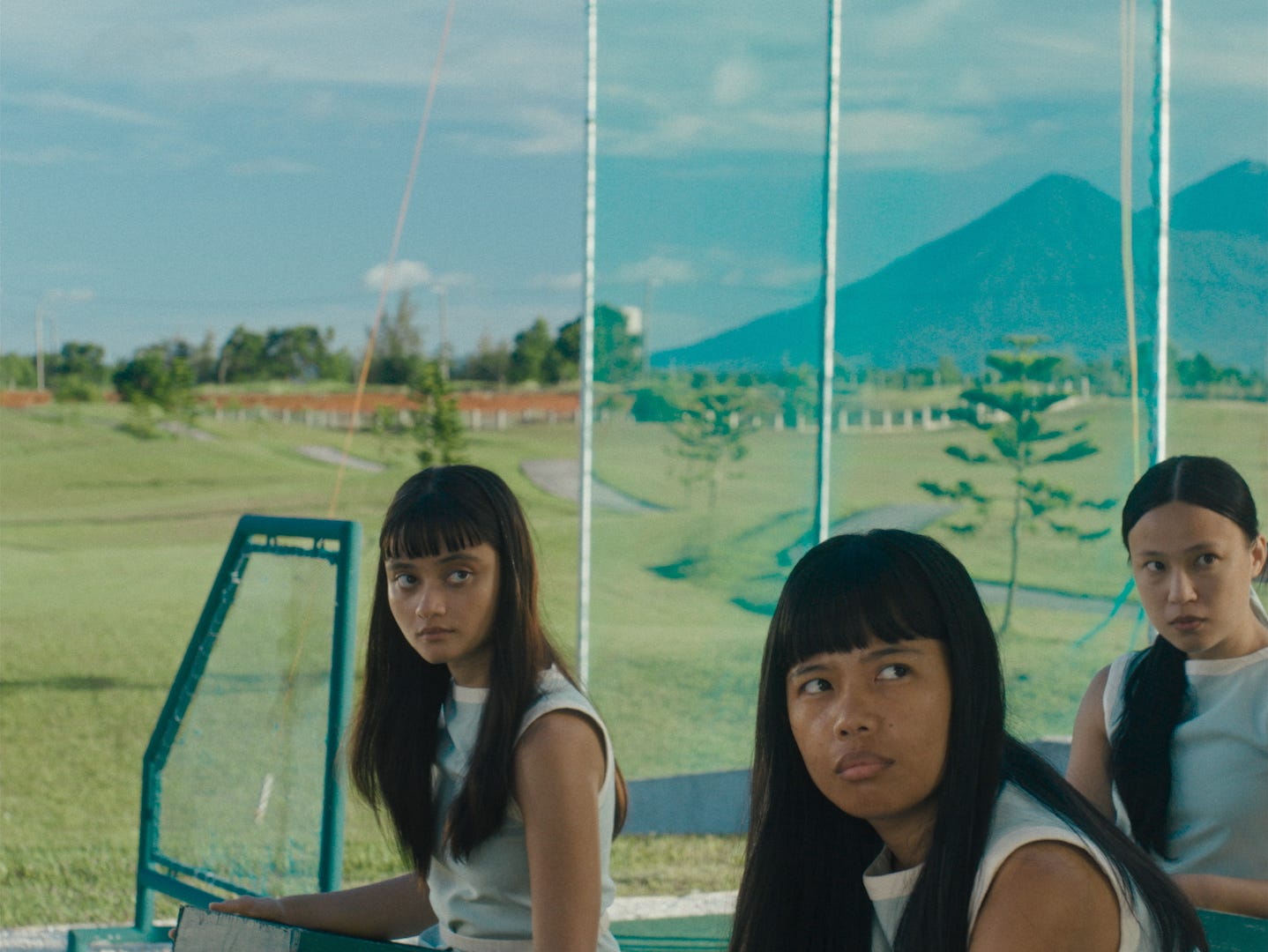
And I think Clara works, for me at least, as a very, very, very good mirror for Isabel, in that they’re both outsiders to the golf course and they both have kind of like this alien gaze onto the golf course, but because of their different standing in the social strata, have different kinds of access, of mobility. Their mobility is very different.
I feel like while Isabel’s, you can look at it as a journey into an awakening, for me, Clara’s is a journey into slumber. And so while Isabel’s is a journey into action, Clara’s is a journey into inaction. Yeah.
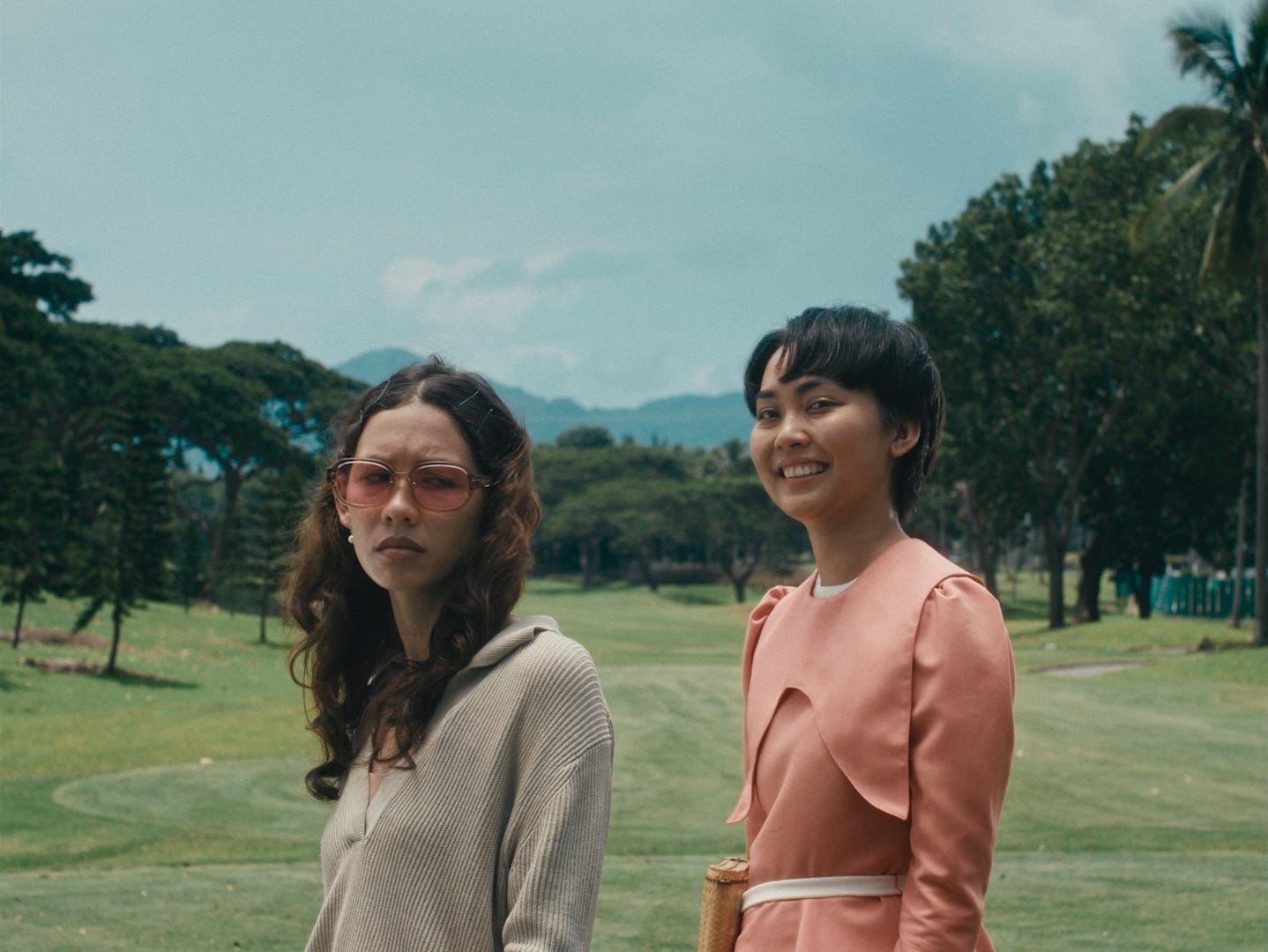
Vanessa: Yeah. That’s beautifully put. It is exquisitely filmed. Every frame is like a still life, to quote a Jia Zhangke film I’m sure we both like and know. And I’m so impressed. I mean, it’s true art in every frame. I just—the colors, the framing, the costumes, I mean the dress, everything. And I wonder how you went about that. It felt very significant to your storytelling.
Rafael: Yeah, thank you so much. I mean, for me personally, Still Life is my favorite Jia Zhangke film. What I love so much about it is that—I think it was Kiarostami that said that when he likes shooting in cars, it’s because in cars you see a person’s present, you see their past through the rearview mirror, and you see their future through the windshield.
And I feel like Still Life, because this story is happening with an entire city being dismantled in the background, you have this kind of—you know, the power of cinema to show the present, the past, and the future. And I think that I really took inspiration from that for Filipiñana.
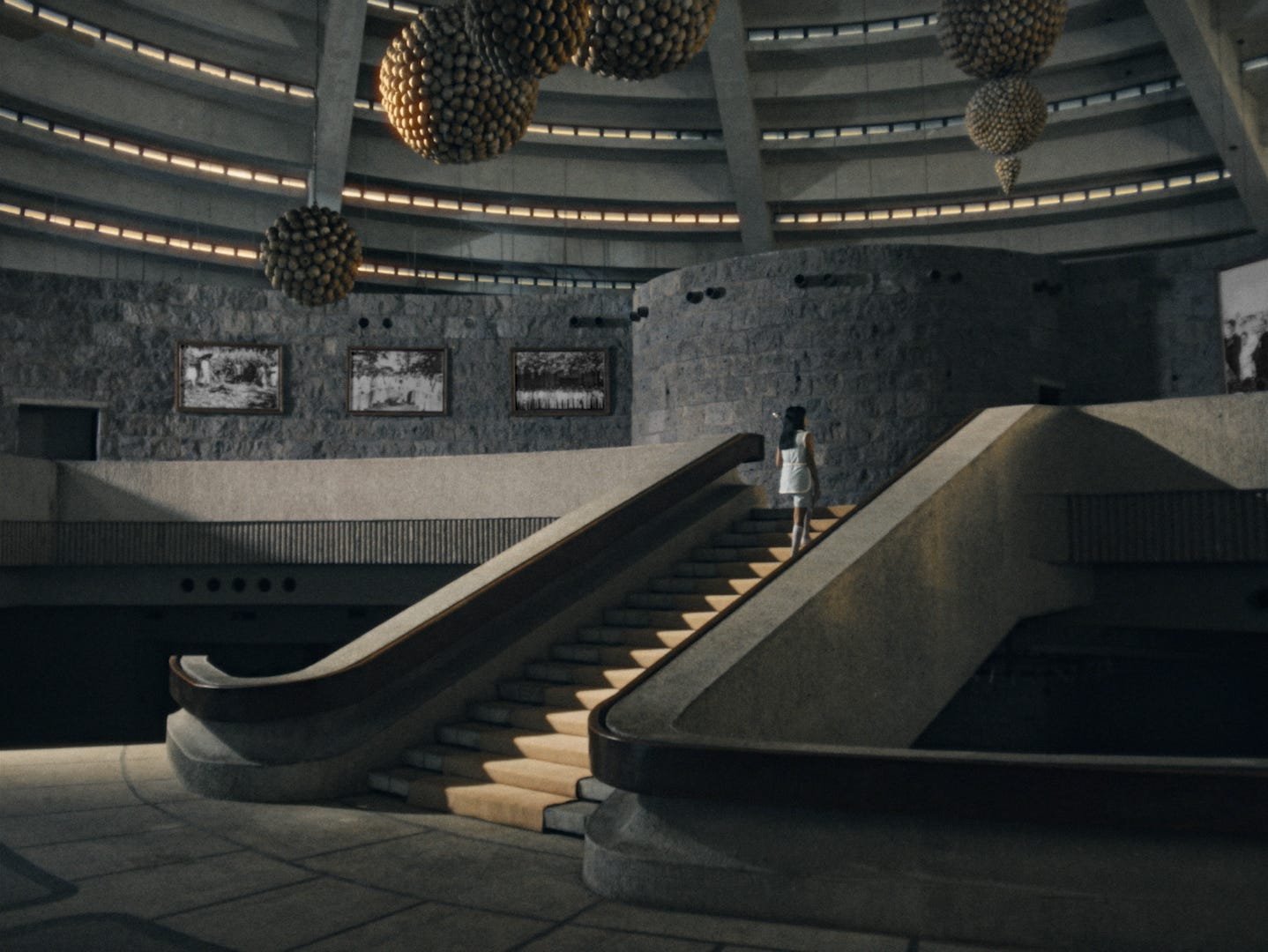
Like you mentioned, the production design, the costume design, the framing. And for me, it was so important to play a little bit with the time setting, and that it could be happening now, it could be happening 50 years ago, or it could be happening 50 years in the future. We took a lot of inspiration from the design language of the ’50s and the ’60s, with kind of like this nostalgic futurism angle.
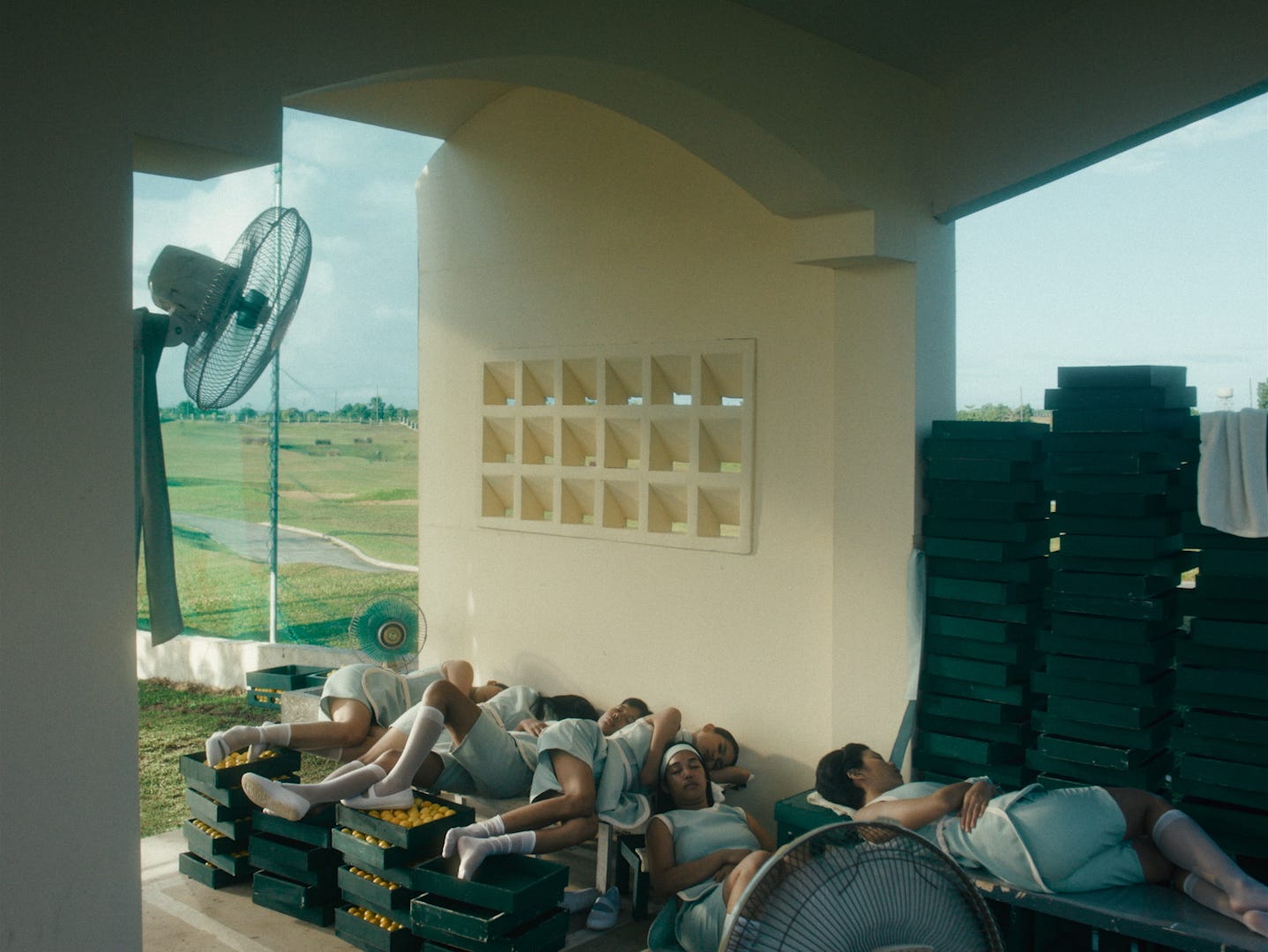
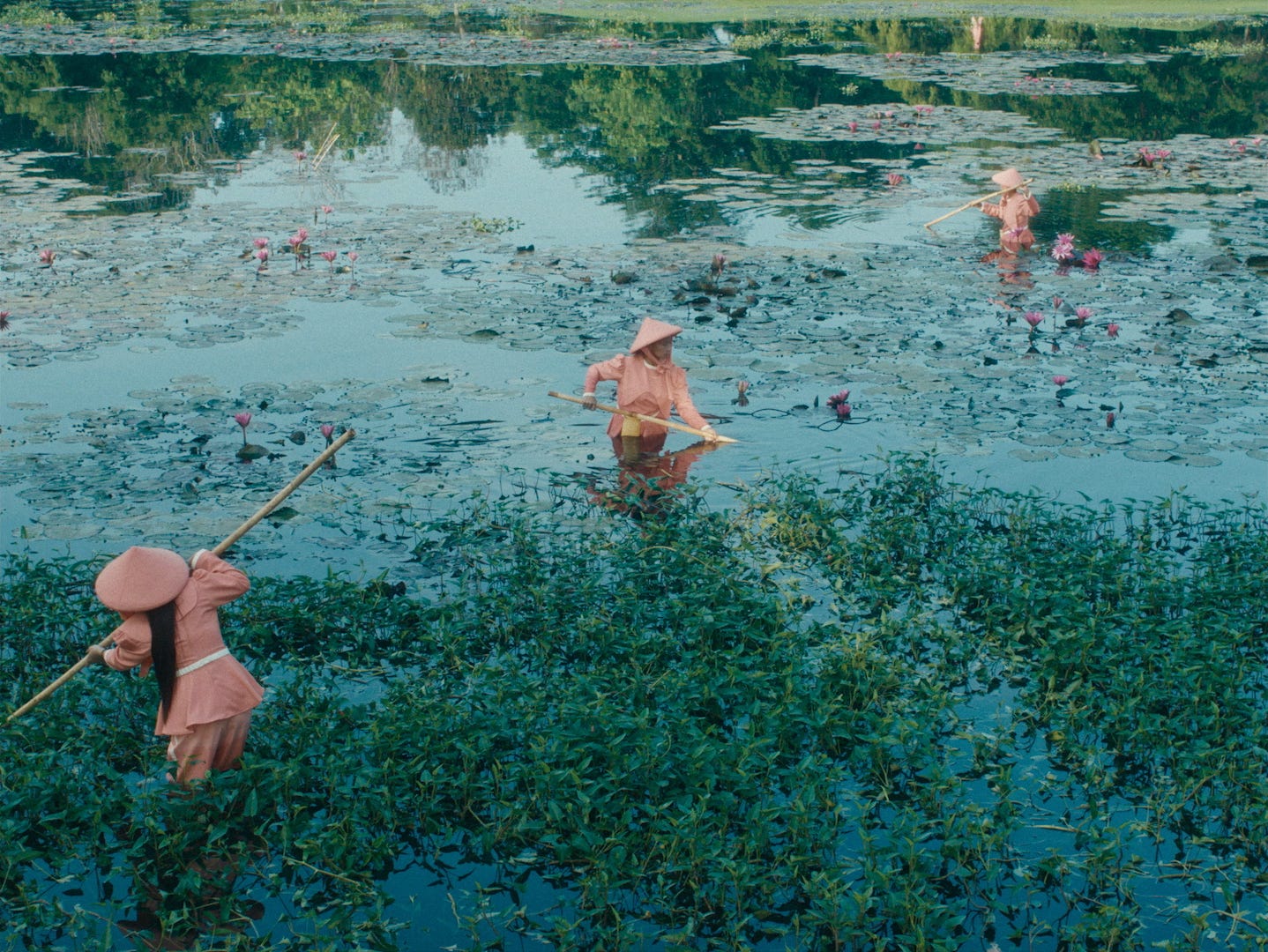
Yeah, I feel like because colonial issues—I really don’t like the word post-colonial. Colonial issues are today. They’re current. They were rooted in the past, and unless we do something about it now, it’s going to be a reality in the future also. And so, yeah, that’s what really informed the visual language of the film, as well as—I already talked about landscape photography—but for me, what is really important is kind of developing a visual-auditory language where the more beautiful a shot is, the more it serves to—the more violent it is, in a way, because it hides the violence, the historic violence that’s behind the shot.
Vanessa: Yeah. I think, without giving too much away of the film, I think we could probably talk a little bit about Ilocos, where Isabel is from and where I understand Ferdinand Marcos, dictator of the Philippines, is from. And I don’t know how many have read Maria Ressa’s book How to Stand Up to a Dictator, but it’s fantastic, and I highly recommend it. But Marcos—the family—is back, a little bit like here in the U.S., we are in the reign of Trump 2. And so I think this visual language and auditory language you’ve developed so exquisitely speaks to some of this too in the storytelling.
Rafael: Yeah, no, completely. Yeah, I mean, also, Jorrybell Agoto, who plays Isabel, is from Ilocos. So for me, beyond—I mean, obviously the sociopolitical aspect of that in the film, and Ilocos being such a historic and politically charged region of the Philippines, obviously it’s there to read for people that see it. But for me, the main thing is that Jorrybell is from Ilocos, and so I really wrote around that.
And it’s kind of like, because the Philippines is so fragmented—it’s an archipelago, we have like about 7,000 islands in the Philippines—that regionalism really is such a thing. Like, the reason why Duterte, who was our past president, who—he’s, yeah, like, if you don’t know about Duterte, read up about Duterte, and I think actually he might still be, like, just a couple of—you know, a few hundred miles away from me right now at the International Criminal Court (in Amsterdam) for all the drug-related extrajudicial killings he did during his reign as president.
But the reason why he won the elections was—what was this, like maybe eight to 10 years ago? I’m sorry, my timeline’s all jumbled up if I’m wrong—but it was because it was this whole regional thing of everyone that was just not from Manila voted for him because they were just tired of people from Manila having a say over who rules the country.
So, yeah, while this film is kind of pointed at Ilocos and, you know, with the Marcos family being from Ilocos, so obviously the connotations of that, for me, what’s more important is that if it’s not them, it will be someone else. So really, it’s more about that.
Vanessa: Yeah. And I really appreciate the way it builds the film’s storytelling and sense of dread that, in fact, a golf course is a little bit of a microcosm of a dictatorship. It’s very controlled, tightly controlled. I mean, you see that also in the landscape, as you said.
And yet you have these lighter moments of dance and song. Can you tell us about that?
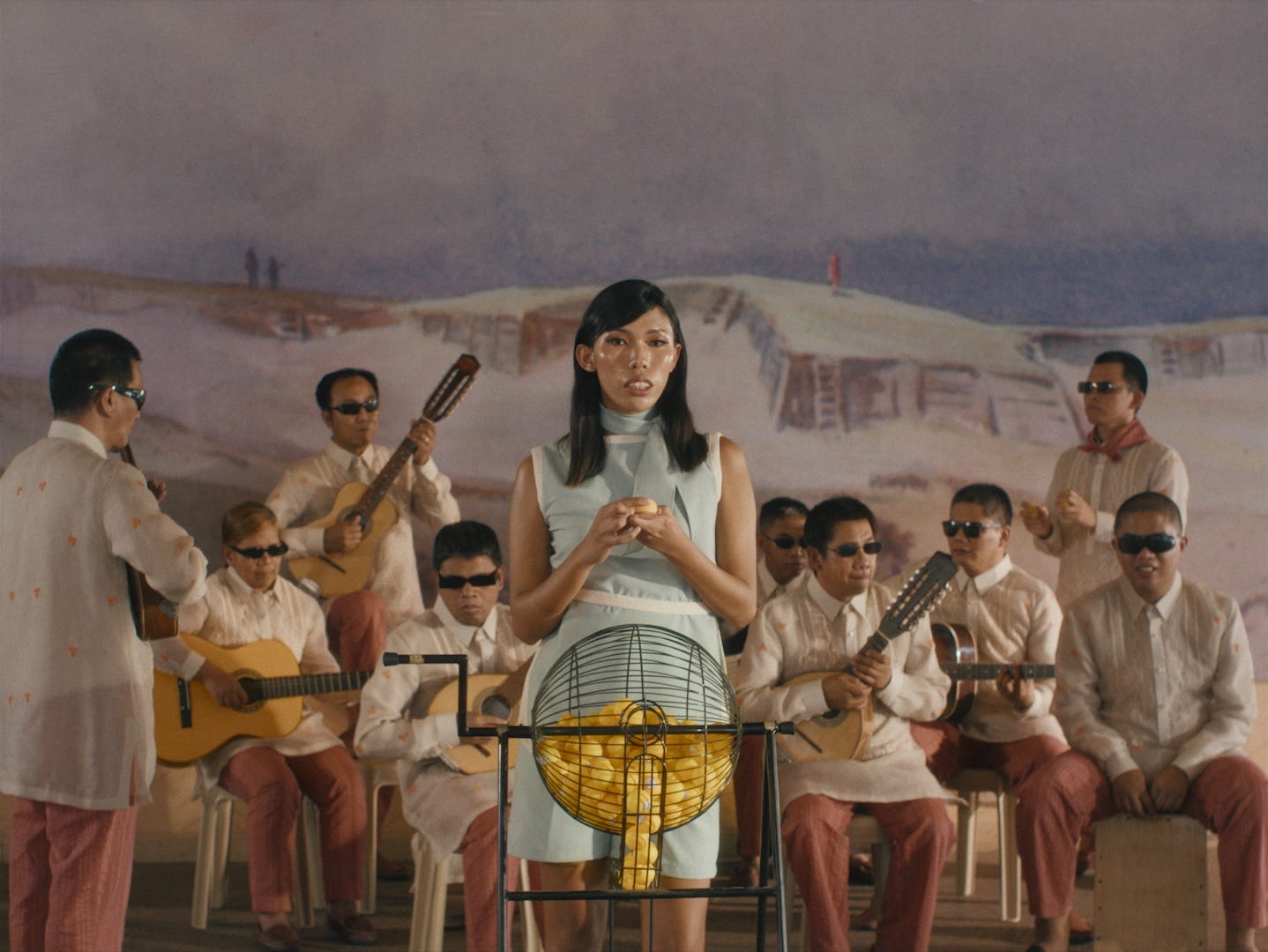
Rafael: Yeah, it’s—well, first of all, I really try to be as playful as I can be with my filmmaking because I feel like playfulness is one of the most important things, if not the most important thing, to me at least. Because through playfulness, I guess one can remain an optimist, one can remain optimistic.
And yeah, so I guess these little moments, these musical moments of song and dance, really, for me, try to capture the playfulness of the Filipino people who, throughout their history, have been subjugated, have been oppressed, but still manage to find time to sing and dance and to still enjoy life. And for me, this is super, super important because although I’m a short-term pessimist, I like to think of myself as a long-term optimist.
Vanessa: I love it. And maybe that speaks to a question Ted and I were discussing in advance because so many of the people who listen to the podcast are filmmakers and interested in making films of their own. And I think you’ve launched in this unique way where you’re automatically in this art-house level of kind of superlative filmmaking, but did you ever feel a need to think commercially, or how have you approached your filmmaking journey from school into choice of mentors and all of that?
Rafael: That’s a really big question. Yeah, I guess because with short film, it’s easy, right? Because short film has no commercial pressures because they still haven’t figured out how to monetize the short film. And I think that’s for the better because the short film is still a space for filmmakers to explore and to test out their ideas.
And then you have the feature film, which is, like, so intimidating. It’s like, you’re a serious filmmaker when you make feature films. But for me, I kind of don’t want to be that kind of filmmaker that treats short as a stepping stone to feature. I think both can exist and both enrich one another.
And I guess if you’re asking if there are any commercial, or whatever, considerations that I was thinking about when making this, and when developing this film, I think—let me put it this way. In film school, one piece of advice I got, which seemed very smart at the time, was that the goal of the film that you’re working on now is to make sure that it gets you the financing you need for your next film, right? Which is very standard and very pragmatic, very commonsensical advice.
But the more I think about it, the more I realized that actually it didn’t excite me to think about film that way. And for me, what really excites me more is to think about the film that you’re doing now as if it’s the last film that you get to make.
Vanessa: Yeah, I think that way.
Rafael: Yeah, that’s it. And so, I mean, you’ll see it a lot with the form of this film because it’s really a film about resistance, right? I really try to resist conventional narrative structure, but still obviously wanting people to enjoy the film. And so it plays a lot with genre, it plays a lot with building tension and then dispersing it with climax and anti-climax. So there’s structure there for sure, because people follow structure.
But for me, there are two things. The first thing is that I feel like in filmmaking, or in storytelling in general, there are two kinds of clarity. There’s narrative clarity and there’s emotional clarity. And I think narrative clarity leads to very formulaic filmmaking because when one part of the plot, once an audience member doesn’t get it, everything falls apart and it’s flimsy.
Whereas if you focus on emotional clarity, then it doesn’t really matter how much of the plot the audience understands because what matters is how it makes them feel, or if they can understand how the characters are feeling at the time. And so, for me, I like to focus more on that.
And because I focus more on that, the way I structured the film was less like thinking in terms of scenes and acts, but more thinking in terms of song. So I structured it with my very good script consultant, Franz Rodenkirchen. And we thought about how—and we’re both musicians, our backgrounds are both in music—and it really excited us to think about structuring the film in terms of choruses versus interludes. You know, which, tying back to the kind of anti-colonial ideas of this film, is actually a pre-colonial type of storytelling because pre-colonial storytelling in the Philippines, and many parts of the world, is oral. It was extended through oration or even through song. And so, yeah, that’s one way, I think.
Vanessa: Yeah. That’s incredible to think that you were thinking of the film as a song, and that makes sense of the poetry and it makes sense how powerful it is emotionally without needing tons of things to be happening in a plot all the time. That’s beautiful.
Rafael: Thank you.
Vanessa: I just can’t emphasize enough how important it is to see it in a movie theater because it’s film as art, and it’s also—the way it works is so—this is what I think is also the mark of a really strong film, and excellent television, but it needs to have layers like yours. Layers so that you’re thinking, you’re drawn in emotionally and visually and aurally, but you’re also thinking on new levels and in new ways.
And it’s inspiring this sense of resistance, as you said, and playfulness, and a new understanding. The audience journey is hopefully one of awakening and not one of inaction and sleep, you know, like the different characters.
But I should also just say there are so many characters in this film. It’s like this macro-micro thinking. We’ve zoomed in on—I love the two characters we’ve discussed, but you have many. You paint a very big picture.
Rafael: Yeah, I like that you mentioned the plethora of characters that are in Filipiñana. I’m very much influenced by Fellini, and I love how his characters, even though sometimes they can appear as caricatures, you can still feel his love for each and every one of the characters.
And I feel like that’s how I feel about a lot of my characters in Filipiñana, regardless of—I feel like there are no true villains or true heroes in Filipiñana, that everyone is a bit of both.
And also, when you’re talking about the layers, I really like that as well, because I feel like we talked so much about the privatization of land and gentrification and all these things. And so what this film tries to do is carve out a space of autonomy for the audience because everything around us is already owned. Everywhere else we’re being sold something. And so what this film really tries to do is carve out a space, visually and sonically, for the audience to project themselves onto the film and to see themselves in the characters and to have a space of autonomy for themselves.
Vanessa: Yeah. You are such an important new voice from the Philippines.
Whether you’re already obsessed with golf or you’ve never played, or you’re interested in the Philippines or you’ve never been, this story is so much bigger. It’s about globalization. Golf courses are an American export; they’re all over the world. But this is a very specific, very beautiful, meaningful story that we should be rushing into the movie theaters to see. Thank you so much.
Rafael: Thank you so much. It was such a pleasure to talk to you, really.
Vanessa: Thank you. Yes, it really was. I hope we can continue this conversation, and I hope to see your next film.
Rafael: I hope so too.
Vanessa: Great.
RAFAEL MANUEL (Writer/Director/Editor)
Based in between Amsterdam, London, and Manila, Rafael Manuel’s short films have won a Silver Bear at the Berlinale, have screened at Locarno, IFFR, and FIDMarseiiles, and are exhibited by ARTE and the Criterion Collection. He is the last film protege at the Rolex Arts Initiative where he was mentored by Jia Zhang-ke. Filipiñana is his debut feature-length film.