

Let’s say you want to buy an NBA team. You own a multi-billion-dollar company but don’t have $4 billion in cash, so you take out a loan. You call JPMorgan and tell them you need a few billion in cash and are willing to pledge your company’s stock as collateral. JPMorgan is happy to help. They take your personal stock as collateral and give you a few billion. You have to repay the loan within 10 years, but you don’t have to sell any stock or trigger capital gains to fund the purchase, and the interest rate is so low that you can pay it back with incoming dividends.
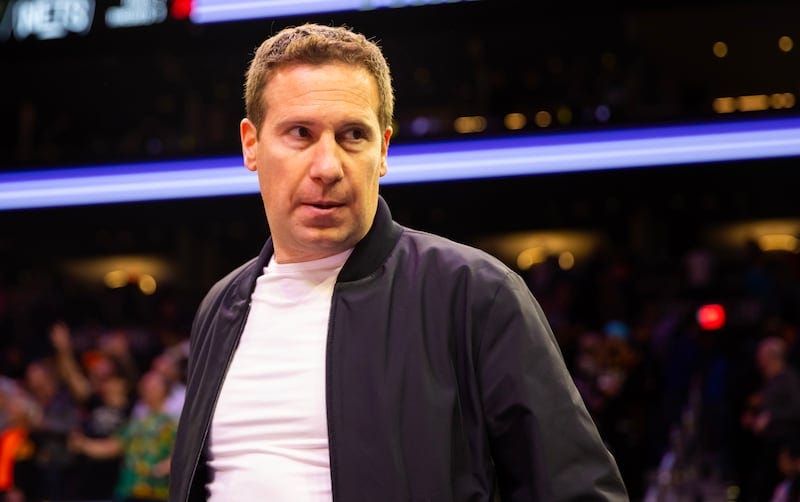
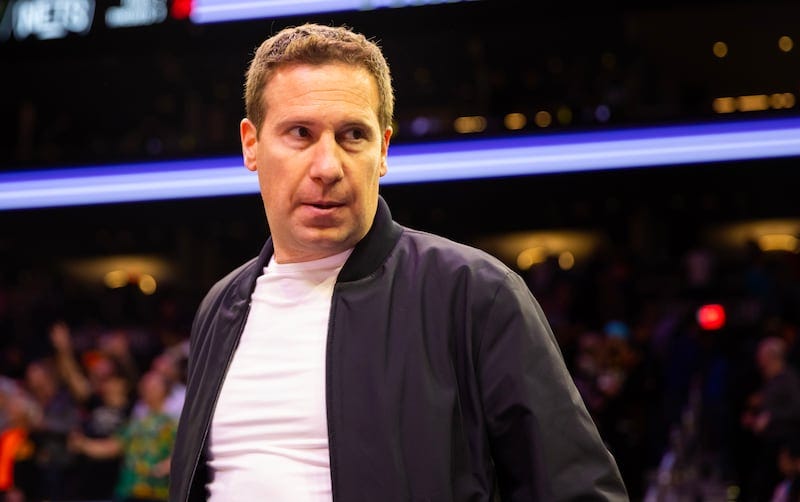
That is essentially what Mat Ishbia did when he bought the Phoenix Suns for a then-record $4 billion in 2023. It’s a pretty good strategy. Since Ishbia didn’t have to sell a ton of stock in his mortgage company (UWM) to fund the purchase, he maintained majority control via voting rights (~90%) and the board of directors.
The only problem with this strategy is what happens when things go south. Say the stock you pledged starts to drop. 10% in a month. 40% in a year. 75% in five years. Every time that happens, the bank calls you and asks you to put up more collateral. This is a margin call. The bank needs to keep the loan-to-value (LTV) ratio at a certain level, so when the price of your collateral drops, it triggers a margin call, and the borrower must post additional collateral to prevent default.
It’s a nasty cycle that can get really bad really quick. Margin calls can lead to forced liquidations, with forced sellers driving the stock price even lower. The only way to get out of it is for the value of the collateral to increase (think: the stock price going up) or for the borrower to put up additional equity and/or cash.
Understanding how these agreements work matters because this is the exact dilemma Mat Ishbia is now facing. Just days before he purchased the Phoenix Suns in 2023, Ishbia secured two loans from JPMorgan. Those loans gave Ishbia the liquidity he needed to complete the $4 billion purchase, but in exchange, Ishbia’s personal holding company had to pledge 805 million shares of UWM stock as collateral. That pledge represented more than half of all UWM’s outstanding stock, and the company’s stock price has since fallen more than 70%.
In simple terms, that means Ishbia put up roughly $4.6 billion of UWM stock as collateral with JPMorgan, but those shares are now worth just $1.15 billion.
So what happens next? When will JPMorgan reach its limit? And if JPMorgan does reach a limit, does that mean Mat Ishbia will have to sell the Phoenix Suns?
Well, that’s usually how it works. The resulting scenario is pretty straightforward: Ishbia secures loans collateralized by UWM stock → UWM stock drops 50% → JPMorgan makes Ishbia put up more stock/cash to avoid default → UWM stock keeps dropping → JPMorgan calls Ishbia for more stock/cash → If Ishbia can’t put up enough collateral to bring the loan-to-value ratio within an acceptable threshold, JPMorgan can seize or sell portions of his UWM stock in the open market to cover the debt → forced selling then drives UWM’s stock even lower.
And without burying the lede, this situation got worse earlier this month when UWM reported a $600 million loss from a failed takeover and a mistimed bet on interest rates. Ishbia says the loss was tied to a hedge it put on its books based on a portfolio of securities it was set to acquire from another company, but that acquisition failed to close, forcing UWM to write off $600 million. It’s worth mentioning that others believe Ishbia was just betting that interest rates would go down because 1) UWM doesn’t traditionally hedge the product that Ishbia said they were hedging and 2) the company they were set to acquire already had a hedge in place for the securities. But I’m not sure the reason actually matters.
The $600 million loss forced UWM to secure a $1.5 billion capital infusion from Oaktree. Ishbia’s holding company then added $150 million, and the company is planning a $400 million rights offering to existing shareholders. That’s $2.05 billion all-in. UWM also suspended its quarterly dividend, causing the stock to fall another 35% in a single day.
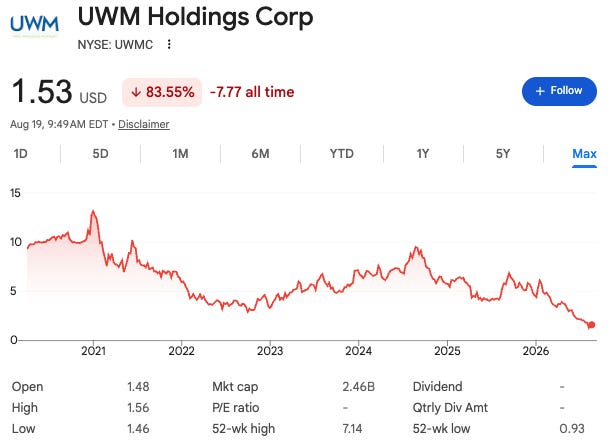
This is why people are talking about a margin call. UWM’s stock has fallen about 70% since Ishbia initially pledged his shares as collateral, and people are justified in asking whether this has implications for Ishbia’s broader sports portfolio, including the Phoenix Suns and Mercury and a piece of the Chicago White Sox.
The logic is that UWM’s stock has dropped so low that Ishbia has no choice but to repay the JPMorgan loans with cash. And to access that much liquidity in such a short period of time, Ishbia might have to sell equity stakes in his sports teams.
But I don’t think that is true. The reality is that Mat Ishbia’s situation is very different from Mark Walter’s. Mark Walter has a liquidity problem. He needs to sell his ownership stakes to raise cash to pay back loans, whereas Ishbia just has a bad business problem. Ishbia doesn’t need the cash because UWM has paid a quarterly 10-cent dividend since it went public, and with Ishbia and his family owning nearly all outstanding shares, he has received more than $6 billion in distributions over the last five years, almost exclusively from dividend payments.
That’s point number one. Second, Ishbia is personally contributing $150 million alongside Oaktree, which means short-term liquidity isn’t a problem (because he has received more than $6 billion in distributions). And third, while many people just assumed Ishbia only collateralized his loan with UWM stock, we 1) don’t know exactly how much money he borrowed (maybe he overcollateralized it to avoid margin calls?) and 2) recent filings suggest that Ishbia also added future distributions from the Suns and part of his private equity portfolio as collateral.
When you add all of those assets up, Ishbia may not be in danger of default. In fact, UWM even released a statement saying that anyone trying to use the Oaktree deal as a way to suggest that Mat’s financial situation with UWM or the Phoenix Suns is threatened is “clearly ignoring the facts,” and that the outstanding balance on Ishbia’s loans “is so low that it could be paid off anytime.”
To be clear, that doesn’t mean Ishbia isn’t facing trouble. The Oaktree deal, for instance, is certainly not ideal. In exchange for a $1.5 billion rescue, Oaktree will earn 10% annually in cash. If UWM can’t pay in cash, it goes up to 13%. Oaktree also received 330 million warrants that give it the right to buy shares later on at $2 or $6. If the business turns around and UWM wants to buy Oaktree out, the wholesale mortgage lender must pay a premium, starting at 10% and increasing by 10 percentage points each year after that, reaching 60% at the beginning of the sixth year. And that’s without even mentioning the fact that Oaktree can block changes to UWM’s senior management and the bylaws, put two people on the board, and force UWM to buy it out after seven years. In that scenario, Oaktree would be guaranteed to walk away from the deal with at least $600 million.
But again, there is a difference between a UWM problem and a Mat Ishbia problem. The former is Ishbia’s problem too, but it’s also a different kind of problem than the latter. Ishbia doesn’t need cash to cover his loans. He needs to turn UWM around. The Oaktree deal hurts, especially for someone who has been so protective of the company’s voting rights and its board of directors. But just because UWM’s stock price is dropping doesn’t mean Ishbia will have to sell the Suns. He has taken enough cash out of the business over the years that he could buy the entire team outright if he wanted to. And that might be just what he does, as Bloomberg reported this week that Ishbia is finalizing a deal to buy out the remaining Suns and Mercury shareholders, bringing his ownership stake to 99%.
If you enjoyed today’s newsletter, share it with a friend.