

Two police officers armed with machine guns block the narrow path. An elderly man is stopped. The uniformed men suspiciously inspect a button on his jacket that says “Nemtsov Bridge.” After a short verbal exchange, they let him through.
The opposition politician Boris Nemtsov was shot eleven years ago on a bridge opposite the Kremlin. Since then, volunteers have been holding the fort there practically around the clock. However, on this January 19th, two other political murder victims will be remembered not far from Moscow’s Cathedral of Christ the Savior. Recent Russian history knows countless of them.
On January 19, 2009, human rights lawyer Stanislaw Markelow, who is involved in a number of politically explosive criminal cases, walks towards the metro after a press conference. Anastasia Baburova accompanies him. She writes as a freelance journalist for the opposition Novaya Gazeta, for them too Anna Politkovskaya, who was murdered in 2006 worked.
A man approaches from behind with an old Browning pistol, aims at the back of Markelow’s head and pulls the trigger. The shooter wants to run away immediately. Baburova turns around and tries to stop him and is then hit with a fatal shot herself.
In broad daylight
The fact that this cold-blooded murder could have happened in broad daylight in the middle of the city shocked many at the time. Eventually it turned out that the neo-Nazi Nikita Tikhonov and his partner Yevgenia Khazis had committed the crime.
Both were part of the fighting organization of Russian nationalists, or BORN for short, whose members continued to murder and even shot a judge. Only then did the state finally begin to take rigorous criminal action against the Russian extreme right.
Hundreds of racist murders are their responsibility. BORN killed several members of the anti-fascist scene. During his lifetime, Markelow did everything he could to ensure that right-wing violence was punished by law and not trivialized as “hooliganism”.
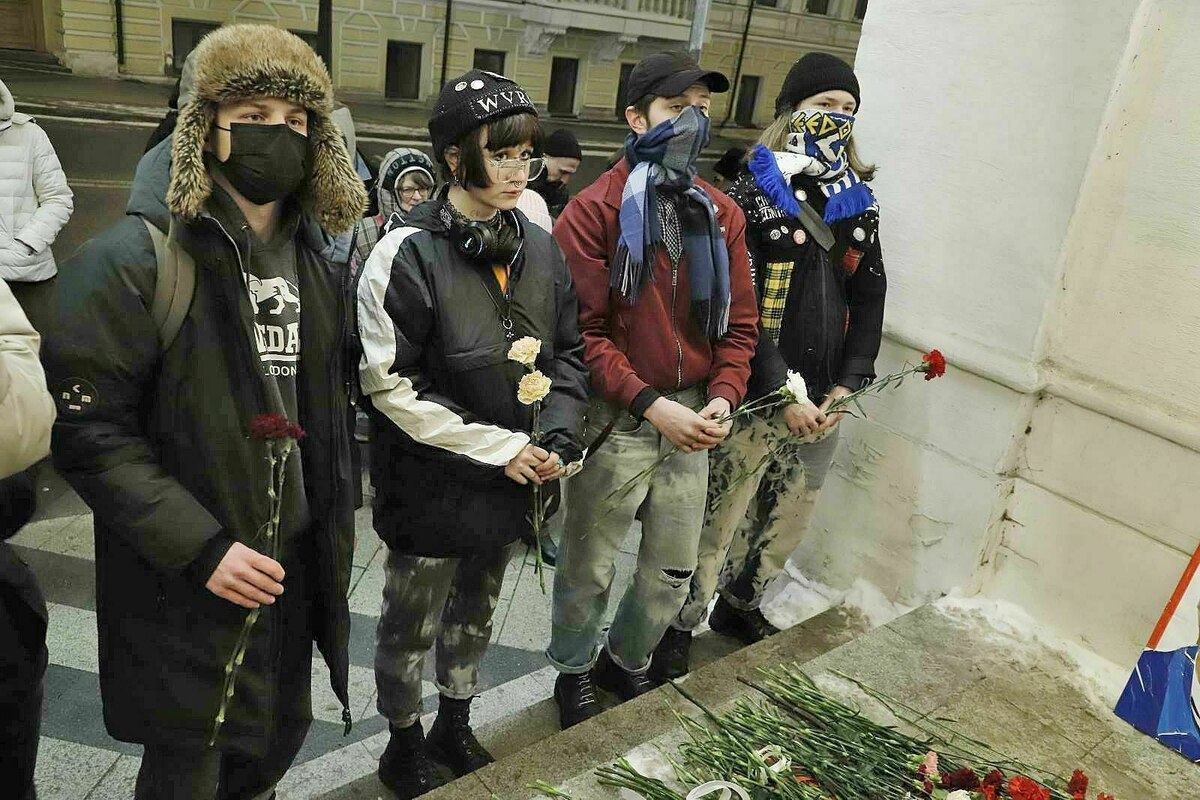
In the stair area of the historic building at Pretschistenkastraße 1 there are portraits of Markelow, Baburowa – she had also researched the neo-Nazi scene – and other murdered anti-fascists. Red carnations and a few white roses are draped on the steps. From 7 p.m. onwards, more and more people come to the place and leave flowers. Some identify themselves as leftists, others as anti-fascists. Many are in their mid-twenties at most – like Baburova when she died.
Merciless reckoning
Three young women are standing a little apart. What motivated you to come to this memorial event? “I discovered an anti-fascist brochure with texts by Markelow in a bookstore,” says one of them. That got her thinking. She was there for the first time a year ago on January 19th, this time she brought her friends with her.
In the “Red Book Antifa” there is a text with the telling title “Patriotism as Diagnosis” – a merciless reckoning with any form of patriotism that ultimately brings nothing but death. How prescient. Markelow positioned himself as a left-wing, political lawyer – one who did not hide his views behind a professional mask. This was unique in Russia at the time.

Memorial ceremony for Stanislav Markelov and Anastasia Baburova on Tverskaya Street in Moscow on January 19, 2021
Photo:
Valery Sharifulin/imago
People come and go. Their number can only be estimated, perhaps there are 200, perhaps more. The police ensure that those gathered stay on the sidewalk, but otherwise do not interfere. Demonstrating is forbidden, as is gathering. On January 19th, however, people were tolerated at the former crime scene.
Men in civilian clothes, presumably from the Center for Combating Extremism, are constantly photographing faces, especially those of the young Antifa members. As they say, unlike last year, they didn’t notice any neo-Nazis. Then Dmitri Muratov, editor-in-chief of, appears Novaya Gazetawhich still has an editorial office in Moscow. Muratov quietly crosses himself; he looks depressed.
Became a tradition
Beness Aijo, nicknamed “Black Lenin,” seems a little out of place. Born and raised in Latvia, the former Donbas fighter sees himself as a Russian patriot. “Markelow stood against racism,” says Aijo, whose father is from Uganda, explaining his presence. He doesn’t seem to know much more about the lawyer, but listens with interest as someone tells him more details.
Although he did not know Markelov personally, Sascha Myslenkow has been taking part in the memorial event, which has long since become a tradition, for over ten years. From Vladivostok to Rostov, but also in Berlin and London, the murdered Russian anti-fascists were remembered on Monday. Until the Covid pandemic, an anti-fascist demonstration took place in Moscow on January 19th.
Liberals like Myslenkow met left-wing and queer activists there. He immediately liked this concept. “Despite individual contradictions, we have a lot in common,” Myslenkow is certain. Unfortunately, for now it would be a matter of waiting. Until political life finally picks up speed again.